
in this case
- Aer Lingus failed to load business class passengers’ priority-tagged luggage onto four consecutive flights despite AirTag tracking showing exact locations.
- Couple had photographic evidence and shared screenshots with baggage services daily, but airline kept making false promises about delivery.
- After airline promised $265 reimbursement in writing, they ghosted the couple for six months before declaring the case closed without payment.
For their 50th anniversary trip to Europe, Jack and Leslie Hamann splurged on business class tickets on Aer Lingus. They got business class treatment. Their luggage? Not so much, and their Aer Lingus lost luggage compensation fight was just beginning.
Their Aer Lingus itinerary from Redmond, Ore., to Brussels via San Francisco and Dublin was supposed to be the beginning of a three-week European getaway. Instead, it became a six-month odyssey through customer service purgatory.
The Hamanns’ story is about more than just lost luggage. It’s about an airline that made promise after promise, then systematically broke every one. It’s about a company that admitted liability, agreed to pay compensation, then vanished when payment came due.
This case raises several important questions:
- What happens when an airline repeatedly fails to load your tracked baggage onto flights?
- Can airlines ignore their own written promises to compensate passengers?
- How long should customers wait before seeking outside help with unresolved claims?
But first, let me tell you how this nightmare began, and why it took a consumer advocate to finally wake up a sleeping airline.
Inside the Aer Lingus lost luggage disaster
When the Hamanns checked their bags in Redmond, they had every reason to expect smooth sailing. After all, they’d paid extra for business class, so their luggage got priority tags. They’d purchased comprehensive travel insurance. They’d even tucked AirTags into their luggage, a decision that would prove more prescient than they knew.
But their bags never made it onto their flight.
Their bags contained cold-weather clothing for the European winter and daily prescription medications. (Note: You should never pack prescription medication in checked luggage.)
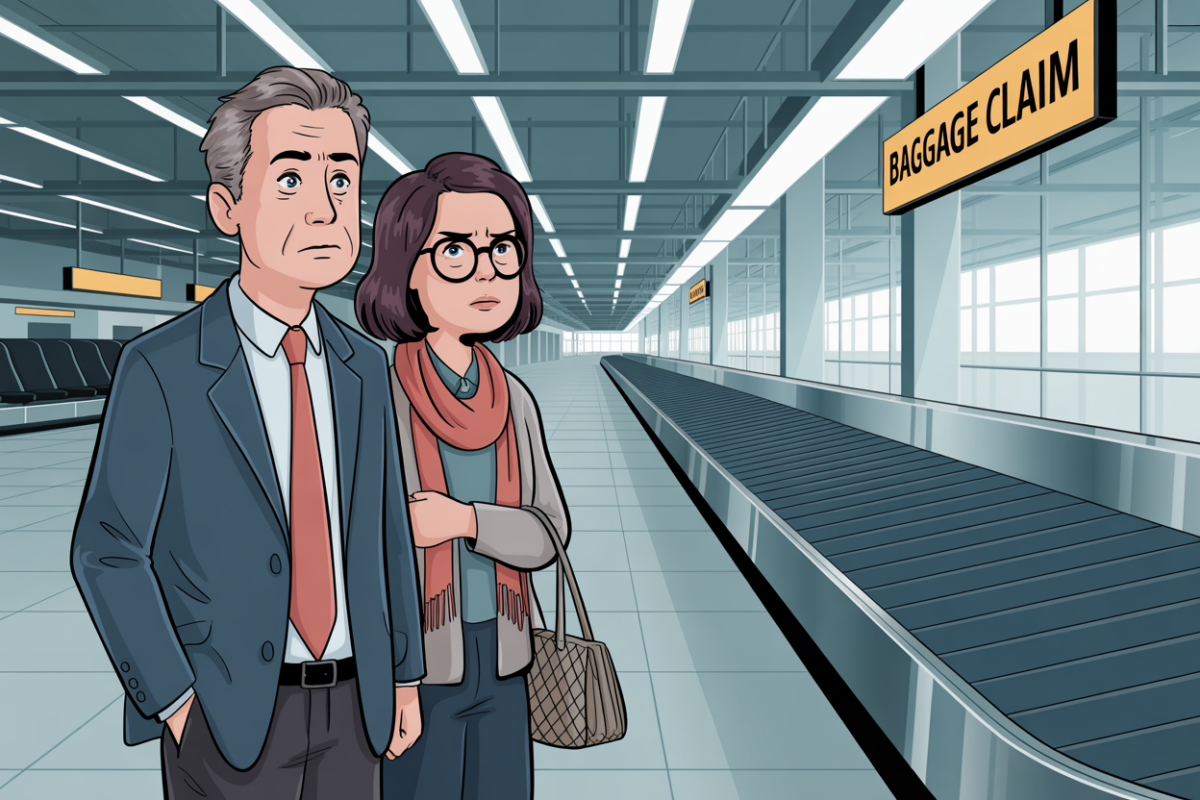
This wasn’t a case of truly lost luggage. For four consecutive days, Aer Lingus simply failed to load the Hamanns’ luggage onto the next available flight: three times in San Francisco, once in Brussels. The bags were sitting right there in the baggage area, clearly visible to anyone who bothered to look.
The Hamanns had photographic evidence, too. They’d shared screenshots of their AirTag locations with Aer Lingus baggage services. The couple reminded them that the bags had priority tags on them. Yet day after day, the luggage remained at the airport. (Related: Aer Lingus owes me $1,285 but claims my bank doesn’t exist.)
“Every day, Aer Lingus called, emailed or texted to say that the luggage had been located and was on its way,” Hamann explained. “That was mostly untrue.”
The delay was more than an inconvenience.
“Relying on the airline’s false assurances was extremely stressful,” he says. “We were forced to make daily changes and calculations about our schedule and whether to make replacement purchases.”
The Hamanns finally received their luggage five full days into what was supposed to be the vacation of a lifetime. But their ordeal was just beginning.
Having to itemize your contents so in the future you can make a claim is now becoming important. I only carry one checked bag and spread the contents on my bed before packing and take a photo. As you advised, never pack any medicine. Flying to the Dominican Republic in a window seat, I saw the luggage train load the suitcases and left my bag in the far back and then drive off. I immediately told the flight attendant my bag was not put on. She told me impossible, all bags look the same. She asked what color. At that time most bags did look the same, black, but mine had pink tape on it. Sure enough when I landed my bag did not appear on the carousel. Two days later my bag arrived at the resort. This was the catalyst for me to have mostly what I’ll need for a couple of days in my small carry-on backpack in case this happens again.
Read more insightful reader feedback. See all comments.
What airlines must do when your baggage is delayed
When an airline mishandles your luggage, a delayed baggage claim triggers obligations under international treaties and the carrier’s own policies to reimburse reasonable expenses. (Here’s my complete guide to dealing with lost luggage.)
The Montreal Convention, which governs international flights, makes carriers liable for damage caused by baggage delays.
But here’s what most passengers don’t understand: Airlines have significant discretionary power in determining what constitutes “reasonable” expenses. They can refuse to cover charges they consider excessive. They can question the necessity of purchases. And they can drag out the reimbursement process through bureaucratic inertia.
The Hamanns did everything right. They filed their claim immediately. They submitted receipts for replacement clothing, medications, and toiletries. They provided detailed bank transfer information when Aer Lingus requested it. They followed every protocol in the airline’s compensation playbook.
Aer Lingus responded with what seemed like good news shortly after the Hamanns filed their claim.
“After thoroughly reviewing your case and the documentation you provided, I am pleased to inform you that a payment of $265 will be processed to cover the expenses you have submitted,” an Aer Lingus representative wrote. “Please allow 30 days for this to be processed.”
The email contained multiple errors: incorrect flight dates, wrong flight numbers, wrong departure airports. But the message seemed clear: Aer Lingus acknowledged liability and promised payment within 30 days.
Four months later, the Hamanns still hadn’t received their money.
They’d been ghosted.
Baggage compensation cases can be infuriating. Some passengers report receiving generous goodwill gestures that exceed their actual expenses at the time of their loss. Others, like the Hamanns, have to fight for reimbursement that the airline has already agreed to pay.
The key is documentation and persistence. Keep every receipt. Screenshot every promise. Save every email. Airlines count on passenger fatigue: the hope that you’ll eventually give up rather than continue pursuing a relatively small claim.
But $265 isn’t a small amount when it represents the principle that companies should honor their written commitments. The Hamanns understood this, and they were not about to let go.
Can airlines ignore a written reimbursement promise?
Legally, no. A written airline reimbursement promise creates a contractual obligation, even if the carrier later tries to walk it back. Aer Lingus’s email wasn’t just customer service politeness. It was a binding commitment.
But practically speaking, airlines ignore their promises all the time. They bet that most customers will eventually give up, write off the loss, and move on with their lives. It’s a calculated gamble based on customer service fatigue.
The Hamanns refused to play that game.
After Aer Lingus missed its self-imposed deadline, the couple continued to blaze a paper trail. They sent follow-up emails. They reached out to executives. (Here are the Aer Lingus executive contacts.) They documented every non-response and logged every broken promise.
Finally, Aer Lingus sent the couple a terse email informing them that it had “closed” their case.
Ah, the old “case closed” gambit. That’s a customer service technique designed to shut down further communication. The airline simply declares the matter resolved and stops reading emails. It’s corporate gaslighting at its finest.
But the Hamanns had kept their own detailed records. When they finally contacted my advocacy team, they provided a complete email chain spanning 64 messages. They had documentation of every promise, every missed deadline, and every non-response.
This is why I tell every consumer filing a delayed baggage claim to keep their own paper trail. Don’t rely on the company’s records or their assurance that your case is being “escalated” or “reviewed.” Keep your own copies of everything.
Airlines have become masters of customer service theater. It’s lots of activity that creates the appearance of progress without actually resolving anything. They shuffle cases between departments, assign new reference numbers, and schedule follow-up calls that never come.
The only defense is meticulous record-keeping and the willingness to escalate when companies fail to honor their commitments.
How Elliott Advocacy resolved the baggage claim
When the Hamanns contacted Elliott Advocacy, we did what we always do: After carefully reviewing their damning paper trail, we reached out to Aer Lingus. We explained the situation, provided the documentation, and asked for a response.
The effect was immediate.
Aer Lingus discovered it had failed to properly complete the payment transfer paperwork. When the airline finally completed the forms correctly a few weeks later, the money transferred immediately.
“Six months after Aer Lingus temporarily lost, and then badly mismanaged, our two bags, we finally received the bare minimum in reimbursement,” Hamann reported.
The resolution was both satisfying and maddening. It was satisfying because the Hamanns finally got their money. And it was maddening because it shouldn’t have taken six months and our intervention to get an airline to honor its written promise.
But that’s the reality of modern customer service. Companies have discovered that stonewalling works with most customers most of the time. They’ve calculated that the cost of ignoring complaints is lower than the cost of promptly resolving them.
This cynical approach only changes when companies face public scrutiny or media attention. Suddenly, the “impossible” becomes possible. Database errors are corrected overnight. Supervisors who were “unavailable” materialize instantly. Payments that were “processing” for months appear in customer accounts within days.
It’s a frustrating system, but it’s the one we’re stuck with. The best defense is knowing how to work within it, and knowing when to call in reinforcements.
As for the Hamanns, they finally got their reimbursement, but they also got a hard lesson in airline customer service.
“We travel a lot and have never experienced such a consistent string of what appears to be intentionally poor customer service,” they told me.
It’s a sentiment I hear far too often. Airlines have systematically degraded their customer service to cut costs, betting that blind brand loyalty and market consolidation will keep passengers coming back regardless of treatment.
Sometimes that bet pays off. But sometimes, just sometimes, passengers fight back. And when they do, with the right documentation and dogged persistence, they can still win.
The Hamanns proved that airline reimbursement promises still matter. They just shouldn’t have had to fight six months to collect.
Your voice matters
Airlines lose luggage, promise reimbursement, then ghost passengers for months. Some wait years. Others give up entirely. Companies bet you’ll stop fighting before they honor written commitments.
- Should airlines be legally required to complete promised reimbursements within 30 days or face automatic penalties for each additional week of delay?
- Should airlines be prohibited from closing baggage claims without customer confirmation that the issue has been fully resolved to their satisfaction?
- Should airlines face mandatory compensation multipliers when they fail to load priority-tagged business class luggage onto multiple consecutive flights despite tracking confirmation?
frequently asked questions
What should I do if an airline loses or delays my checked luggage?
File a mishandled baggage report with the airline before leaving the airport. Save your bag-claim tags, boarding pass, and baggage receipt. Keep every receipt for replacement clothing, toiletries, and medication you buy while your bag is delayed. The U.S. Department of Transportation requires airlines to reimburse reasonable, verifiable, and actual incidental expenses. For a step-by-step walkthrough, see our ultimate guide to finding your lost luggage.
How much compensation can I get for delayed baggage on an international flight?
On most international flights, the Montreal Convention caps airline baggage liability at 1,519 Special Drawing Rights per passenger, roughly $2,175 USD. On domestic U.S. flights, DOT rules cap liability at $4,700 per passenger. Airlines can pay more than these limits voluntarily, but they are not required to. (DOT source)
What is the Montreal Convention and how does it protect passengers?
The Montreal Convention is an international treaty that governs airline liability for most international flights. It makes airlines responsible for damage caused by delayed, lost, or damaged baggage, up to 1,519 SDR per passenger. The International Civil Aviation Organization reviews this limit for inflation every five years. (ICAO source)
How long does an airline have to reimburse delayed baggage expenses?
There is no single federal deadline for paying delayed-baggage incidental expenses, but the 2024 DOT refund rule requires airlines to automatically refund checked bag fees if a bag is significantly delayed, within 12 hours domestic or 15 to 30 hours international. Refunds must be issued within 7 business days for credit card purchases. Don’t wait too long — see what happened when one passenger missed the filing window.
Can an airline close a baggage claim without paying the promised reimbursement?
An airline cannot legally walk away from a written reimbursement commitment. A written promise to pay creates a contractual obligation. In practice, some carriers mark cases “closed” and stop responding. Keep every email, screenshot every promise, and escalate to executives or a consumer advocate if the airline refuses to pay what it agreed to.
How do I escalate a baggage claim when an airline stops responding?
Forward your full paper trail to an airline executive, file a complaint with the U.S. Department of Transportation, and contact a consumer advocacy organization. Airlines that violate DOT rules can be subject to fines. Persistence and complete documentation are the two factors that recover most claims. Start with our Aer Lingus executive contacts to reach a decision-maker directly.

Have a question about this story? Tell us what happened — we read every comment.
Join the conversation