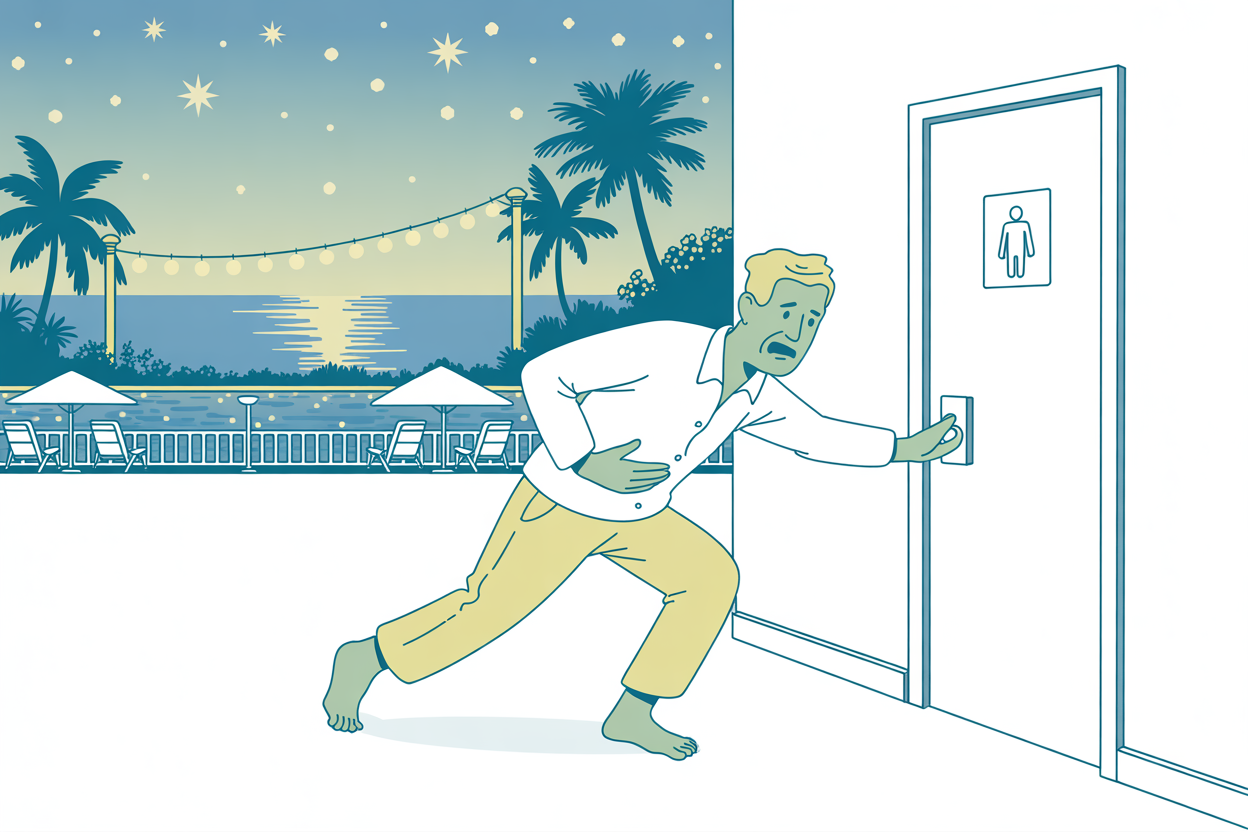
Cartoon of a green-faced traveler clutching his stomach as he rushes toward a restroom door, a palm-lined resort at dusk behind him.

How an airport sandwich could destroy your next vacation

It starts with a plate of chilled shrimp at the resort buffet. It looks pink and fine, sitting on a bed of ice, and you feel fine after you eat it. Then, six hours later, your vacation is over and you are on the bathroom floor. Late summer is peak season for exactly this kind of culinary hazard, and this year the risk is sharpened by record heat colliding with a travel industry already in meltdown, delayed flights, understaffed hotels, tarmac waits with the air conditioning broken. While everyone worries about cancellations and lost bags, something more dangerous is brewing quietly in galley carts and buffet lines. Your food depends on a cold chain, a temperature-controlled path from farm to fork, and when the heat spikes, that chain can snap. The bacteria that move in when it does are the kind you cannot see, cannot smell, and cannot taste, which is what makes them so easy to eat.

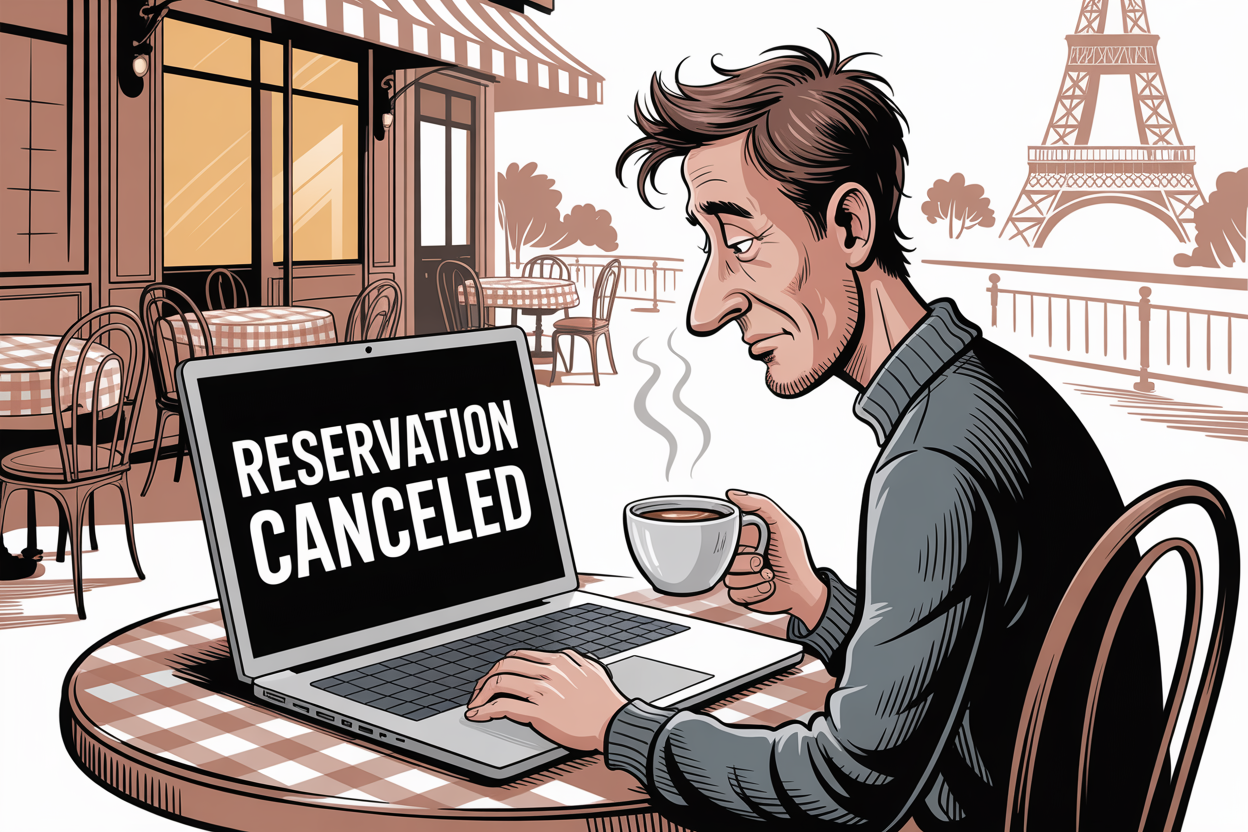
Cartoon of a dismayed man at a Paris cafe table, Eiffel Tower behind him, staring at a laptop screen that reads "RESERVATION CANCELED."

Travel companies say their customers are no-shows—but are they?

On a recent flight from San Francisco to Paris, Dan Skilken was a no-show. It was not his fault. A weather delay scrambled his first leg, the airline rebooked him, and then someone pushed the wrong button, so the system decided he had missed his connection. He only found out when he tried to check his return reservation from France and discovered he had no tickets at all. Because that is how it works: miss one leg of a flight, and the airline quietly cancels the rest. Skilken knew the industry well enough to sort it out, but plenty of travelers do not, and lately there are more of them. Teresa McGee flew from Detroit to Charlotte on American Airlines without a hitch, then tried to fly home and was told she had no ticket. She had a boarding pass proving she had flown the outbound. The airline could not tell her why, only that it had labeled her a no-show and that a new ticket would cost her. Cases like these keep landing in my inbox, and they raise an uncomfortable question. When a company marks a paying customer a no-show and keeps the money, is that a clerical slip, or has the no-show become a quiet little revenue stream?

Illustration of a worried woman in a tank top standing at a cruise ship railing, shading her eyes with one hand as she scans the horizon against a clear blue sky.

SAS lost her luggage—then a motel in Stockholm found it

After Patrice Krecek’s suitcase did not arrive at Stockholm’s airport, she did everything right. She filed a Property Irregularity Report with SAS. She submitted a claim. She called customer service, more than once. Maybe she should have checked the Motel L Alvsjo, a 40-minute drive away, because that is exactly where her luggage turned up five weeks later, how it got there a mystery wrapped in pink duct tape. Inside that bag was most of her clothing for a 14-night cruise, including a new sweater she had bought just for the trip and never got to wear. Her husband had wrapped the case in hot pink tape so it would be easy to spot on the carousel, a detail that would matter more than he could have guessed. The motel could only hold the bag for a month before donating it. SAS had the address, the photos, and clear instructions, and still the suitcase sat 4,000 miles away. What it took to finally get it moving, and whether a claim filed one day late would cost the Kreceks everything, is where this case turns.

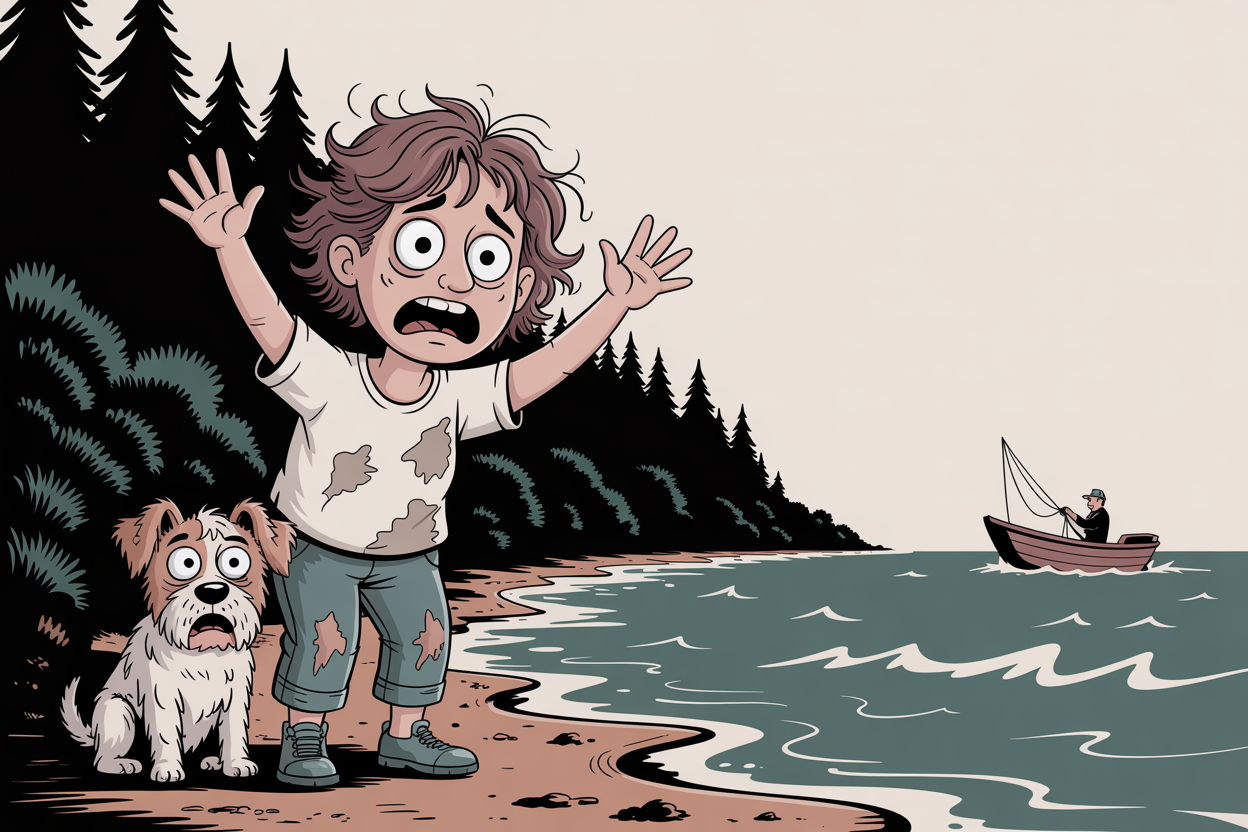
Cartoon of a frazzled, dirt-smudged hiker waving both arms for help on a wooded shoreline beside her startled terrier, as a fisherman in a small boat approaches across the water.

No more digital detoxes? Why you should keep your phone with you when you travel

Michelle Girasole thought she knew Rhode Island’s Beavertail State Park well enough to leave her phone in the car. It was a warm summer morning, and she wanted to catch the sunrise with her terrier, Scooter, and enjoy a few minutes without calls, texts, or notifications. Then she followed Scooter off the path and lost her bearings. She spent the next nine hours stranded, with no water, no sunscreen, and no way to call for help, until a fisherman finally spotted her on the shoreline. “If I had my phone,” she says, “none of that would have happened.” Her ordeal is a warning about the travel industry’s latest wellness obsession, the digital detox, which hotels and tour operators are selling as the only way to truly be present. Nearly every traveler says they want to disconnect. But there is a reason a row of security and medical-evacuation experts say that, for anyone without a private fixer, ditching your phone is not relaxation. It is something closer to recklessness.

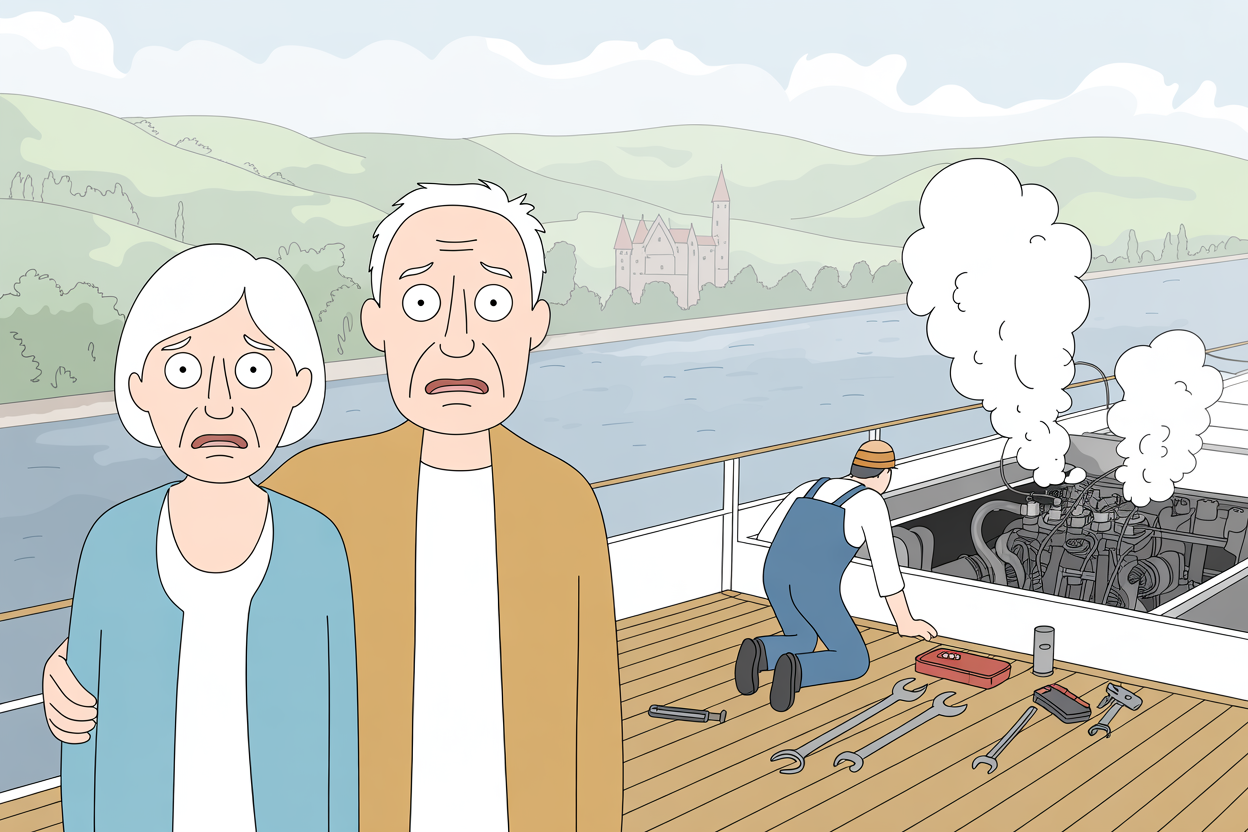
cartoon of a worried older couple standing on a river cruise deck while a mechanic kneels over a smoking engine behind them, with green hills and a castle along the Rhine in the background.

Can this company refuse to cover my costs for a canceled river cruise?

Michael Cawley and his wife had been looking forward to a relaxing six-day Rhine River cruise with CroisiEurope, a gentle start before they carried on to Dublin. What they got instead was a series of mechanical problems and a lot of anxiety. The ship stopped cruising early the first night. The next morning, scuba divers worked under the hull, the departure ran late, and an excursion was scrapped. Then, around midnight, the ship hit something. The hull shook, and at 1:30 a.m. every passenger was roused and herded into the lounge. By the next morning the verdict was in: the cruise was canceled, a bad motor. With nonrefundable travel waiting at the far end and no help yet in sight, the couple booked their own train and hotel to keep their connection, only to be offered an alternative too late to use. CroisiEurope returned the cruise fare. What it decided to do about the rest of their money, and the European law it leaned on to justify it, is where this case turns.

Cartoon of a frustrated traveler with arms crossed standing between two suitcases in an empty airport gate area, beneath a large red departures sign reading "FLIGHT DOES NOT EXIST."

Booking.com said my flight was confirmed, but the airline says it never existed

Lindley Kinerk’s last morning in Dresden seemed routine. She and her companions packed up, checked out, and headed to the airport for their 8:25 a.m. flight home to Boston. They had even gotten a friendly check-in reminder from Booking.com the night before. Then they reached the counter and learned something that would cost them nearly $6,000: their flight did not exist. Not that morning, not any morning. It had been off the airline’s schedule for months. Booking.com, it seems, had quietly rebooked them on an earlier flight and never said a word, and the airline insisted the whole thing was not its problem. With a third ticketing agency tangled into the booking and every company pointing at the others, Kinerk had to buy new tickets on the spot just to get home. What she did next, and what Booking.com eventually said about her money, is where this case turns.

Minimalist black and white cartoon of a lone traveler with a rolling suitcase standing outside a nearly empty airport terminal, looking uncertain, evoking a trip thrown into limbo.

Let’s keep politics out of your summer vacation

Steve Brody is flying out of Newark this week, and he is worried. There are plans afoot to pull the Customs and Border Protection officers out of airports in certain cities, with Newark Liberty International first in line. Brody, a retired government worker, is flying nonstop to Vancouver, but he has to pass back through US Customs on his return. “Gimme strength,” he says. He is not being dramatic. Customs officers are the people who let you back into the country, and pull them out and international flights cannot unload their passengers. That is the part that should bother everyone, left, right, and undecided. A passport does not have a party affiliation. When a flight gets canceled, the system does not check your voter registration before it strands you. You are stuck. Which is the real question worth sitting with before your next trip: whether the airport you are counting on this summer should ever be something an administration is allowed to switch off to win an argument that has nothing to do with you.

Illustration of a worried young traveler sitting inside an airport as smoke, flames, and panicked crowds appear outside the windows.

When your vacation turns dangerous: How do you know it’s time to leave?

Kate McCulley, a journalist based in Prague, knew it was time to leave Madagascar. Flights were getting canceled, protests had moved outside her hotel in Antananarivo, and the country was on the verge of a military coup. The police blanketed the neighborhood in tear gas. After several days of trying, she finally caught a flight to Réunion. Most travelers face a much harder version of her call. After months of planning and thousands of dollars spent, deciding whether to cut a vacation short when conditions shift is rarely simple. Civil unrest, a natural disaster, a sudden spike in crime, or a slow drift in local sentiment can each push a manageable risk toward a real threat. Government advisories often lag behind reality on the ground, tour operators have an interest in downplaying risk, and standard travel insurance generally will not cover a trip cut short on fear alone. There is no algorithm for the stay-or-leave decision, but security professionals point to clear early triggers that separate a manageable situation from a dangerous one, if travelers know what to watch for.

An angry airline passenger stands with a suitcase while holding a $10 voucher after a flight delay.

The delay tax: Why your airline voucher barely covers your expenses anymore 

When a flight is delayed or canceled, airlines cover only what they call duty of care: a meal voucher, sometimes a hotel, or a refund if the flight is canceled. Angela Justice received a $10 voucher after her Boston to Chicago flight was canceled. The real cost, the delay tax, is far larger. It includes nonrefundable hotels travelers cannot reach, lost wages, child care that keeps ticking, and the replacement flights passengers must book themselves when the airline’s rescheduling timeline proves useless. Airlines calculate compensation based on what it costs them to reschedule a flight, not what it costs the traveler to miss the reason they flew in the first place. The official story is that duty of care solves the problem and the Department of Transportation signs off. But the law was written in a different era, when travel was simpler and airlines were more generous, and regulators have not caught up now that delays are chronic and carriers watch every penny.