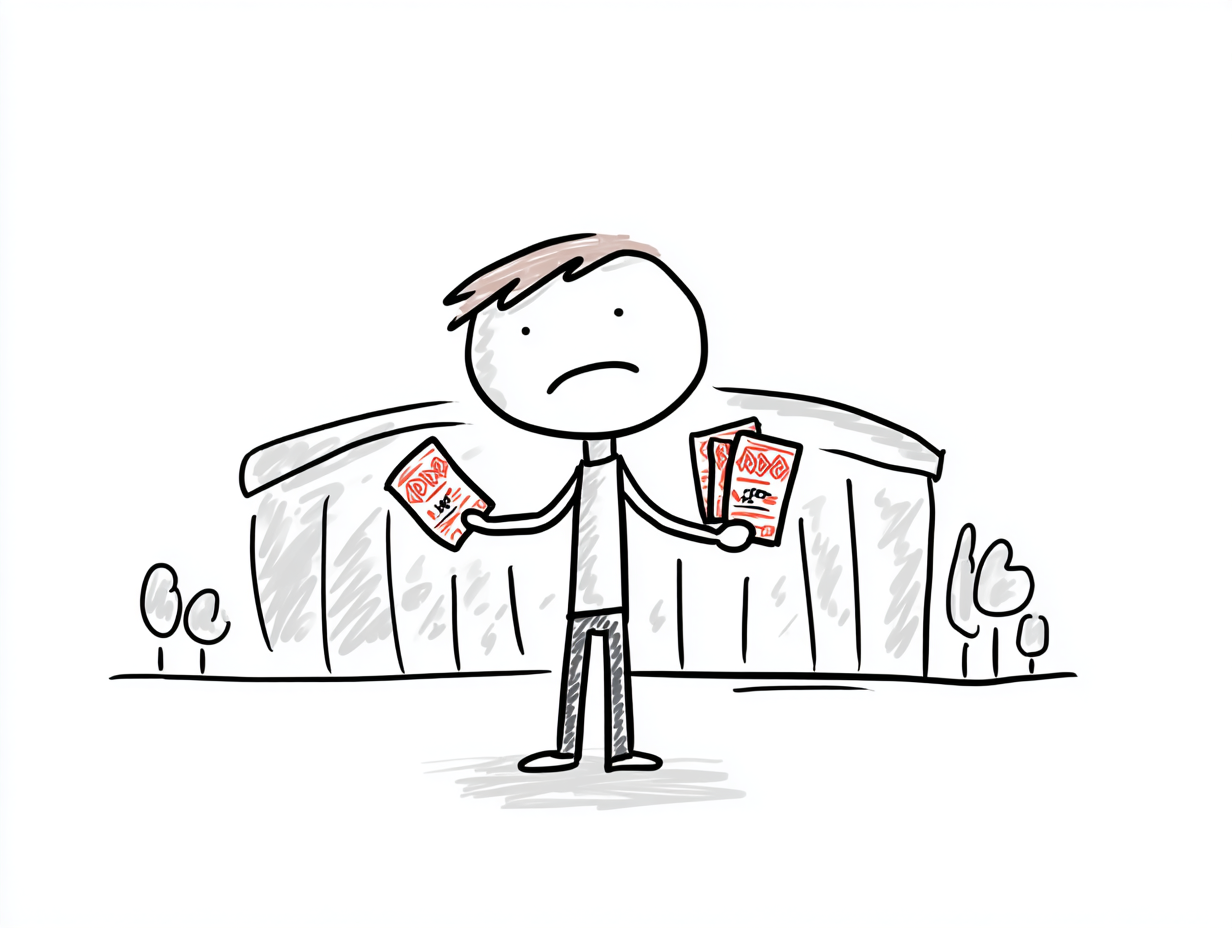
Cartoon of a glum man standing alone outside a packed UFC arena as crowds stream past him to the entrance, illustrating a fan shut out of an event he paid for but could not attend.

StubHub’s FanProtect guarantee fails: The $4,606 ticket he never got

Roland Nazariyan paid $4,606 to see a UFC fight, and he missed the main event. He had ordered three tickets through StubHub on the day of the fight, and when none of them arrived in time, he called the platform. It refunded the first two orders after he sent screenshots showing the tickets were never delivered. The third and most expensive order sat in limbo, marked as in final escalation, and then came back denied: a seller had claimed the ticket was transferred, and StubHub told him he had never even contacted the company about it, despite its own emails in the thread asking him for proof. Here is the standard worth holding any reseller to before you accept a denial like this. StubHub’s FanProtect guarantee promises that you will get your tickets in time for the event, and if not, comparable or better tickets or your money back. A guarantee, in other words, is only as good as a company’s willingness to honor the words it is built on.

Stylized illustration of a distressed traveler clutching his chest in front of a palm-lined hospital as medical staff wheel a patient on a gurney toward the entrance, evoking a vacation cut short by a family emergency.

The hotel refunded his money, but the booking site kept it anyway

When John Moss’s stepfather was rushed to the hospital, he knew his Florida vacation was over before it started. He contacted Traveluro, the site where he had booked a nonrefundable $615 stay at the Hilton Melbourne Beach, and sent hospital records proving the family emergency. The hotel understood and agreed to cancel without penalty, releasing the money back to the booking site. All Traveluro had to do was pass it along. Instead, weeks of silence followed, until Moss filed a dispute with his credit card company and Traveluro suddenly made him an offer: drop the dispute, and we will send your refund. Here is what every cardholder should understand before saying yes. A credit card dispute freezes the transaction while your issuer investigates, which means the merchant cannot touch the money until the matter is resolved. That is real, tangible leverage, and a company asking you to give it up in exchange for a promise is asking you to trade the one protection the law puts on your side.

Soft pastel digital illustration of a young teenage girl with a messy brown bun and large worried eyes standing alone with her arms crossed and a small brown shoulder bag, beside her dark blue rolling suitcase, in the middle of a busy blurred airport terminal with other travelers and luggage in the background, illustrating a 13-year-old unaccompanied minor stranded at LAX after United Airlines denied boarding for a connecting flight the airline itself had authorized

United authorized my teen’s connecting flight, then left her stranded at LAX

Shiri Willcot’s travel agent tried to book her 13-year-old daughter Ryan on a connecting flight from Los Angeles to Costa Rica via Houston, but United Airlines policy prohibits unaccompanied minors ages 5 to 14 on connecting flights. A United supervisor overrode the system, approved the reservation, and charged Willcot’s credit card the $300 unaccompanied minor fee. The travel agent reconfirmed the booking twice before departure, and a United representative on a recorded call two days before the flight confirmed Ryan could board without issue. At LAX, United agents refused to let Ryan board. For a month afterward, United claimed no record of the original flight existed despite confirmation emails, the credit card charge, and the recorded call. The airline gave three contradicting explanations before settling on its final narrative blaming the travel agency.

Editorial cartoon illustration of an exasperated young man with messy brown hair and large round glasses looking upward in defeat while surrounded by towering stacks of white paper documents piled high on both sides and in front of him, illustrating the frustration of repeatedly submitting the same documents to a travel insurance company that refuses to process the claim

Why is my insurance company asking for the same documents over and over and over?

John Christensen developed Deep Vein Thrombosis after his flight from Albuquerque to Auckland. He spent three days hospitalized in New Zealand and racked up $3,867 in medical bills before filing his Allianz Global Assistance travel insurance claim two weeks later. Five months passed while Allianz repeatedly asked for documents he had already submitted multiple times, with the claim status cycling back to “more information needed” without explanation. Most state insurance regulations require insurers to acknowledge claim receipt within 15 days and approve or deny within 30 to 45 days of receiving complete documentation. State insurance commissioners handle consumer complaints when insurers delay payment without specific explanation.

Watercolor editorial illustration of a father in a white shirt and red tie standing with his young son who carries a backpack at an American Airlines departure gate, with an American Airlines plane visible through the window beyond the closed gate door, illustrating how families get separated when airlines pull passengers from boarding lines and document involuntary bumping as voluntary

American Airlines claims I voluntarily gave up my seat, but that’s a lie

Charles Shearer was traveling from Cleveland to Japan for his mother-in-law’s funeral when American Airlines pulled him and his young son from the boarding line. His grieving wife boarded alone while gate agents offered $500 vouchers, with one even verbally acknowledging the bumping was involuntary. American later documented the incident as voluntary in its system, denying him the federal compensation of up to $2,150 per passenger that involuntary bumping triggers when passengers arrive over two hours late. Federal law mandates 400 percent of one-way fare in cash compensation, paid at the airport on the day of the flight.

Editorial illustration of an elderly man standing alone at the bright orange wooden door of a blue-toned classic French apartment building with wrought iron balconies, depicting Alan Nathan waiting for his missing luggage in Neuilly-sur-Seine after Luggage Forward and FedEx claimed phantom delivery

Luggage Forward promised to deliver my luggage. Instead, it delivered disappointment!

Alan Nathan paid Luggage Forward $1,400 to ship four bags from Sonoma, California to Neuilly-sur-Seine, France, including his wife’s critical medical equipment. The premium service offered an on-time guarantee promising double the shipping fee for late deliveries. The shipping company asked for documents showing arrival into Ireland despite the clearly stated French address. FedEx then marked the bags as delivered and signed for by someone named Lou Ann, but Nathan’s building has no front desk and the concierge confirmed no contact from any delivery driver.

Illustration showing frustrated business class passengers standing next to their luggage while an Aer Lingus airplane flies away in the background, depicting the airline's failure to load priority-tagged baggage onto multiple consecutive flights despite tracking confirmation

Business class baggage disaster! Why is Aer Lingus ghosting us?

Aer Lingus failed to load business class passengers’ priority-tagged luggage onto four consecutive flights despite AirTag tracking showing exact airport locations. The airline then promised $265 baggage delay reimbursement in writing but ghosted the couple for six months before declaring their case closed without payment. Under the Montreal Convention, airlines are liable for baggage delays on international flights and must compensate passengers for reasonable replacement expenses.