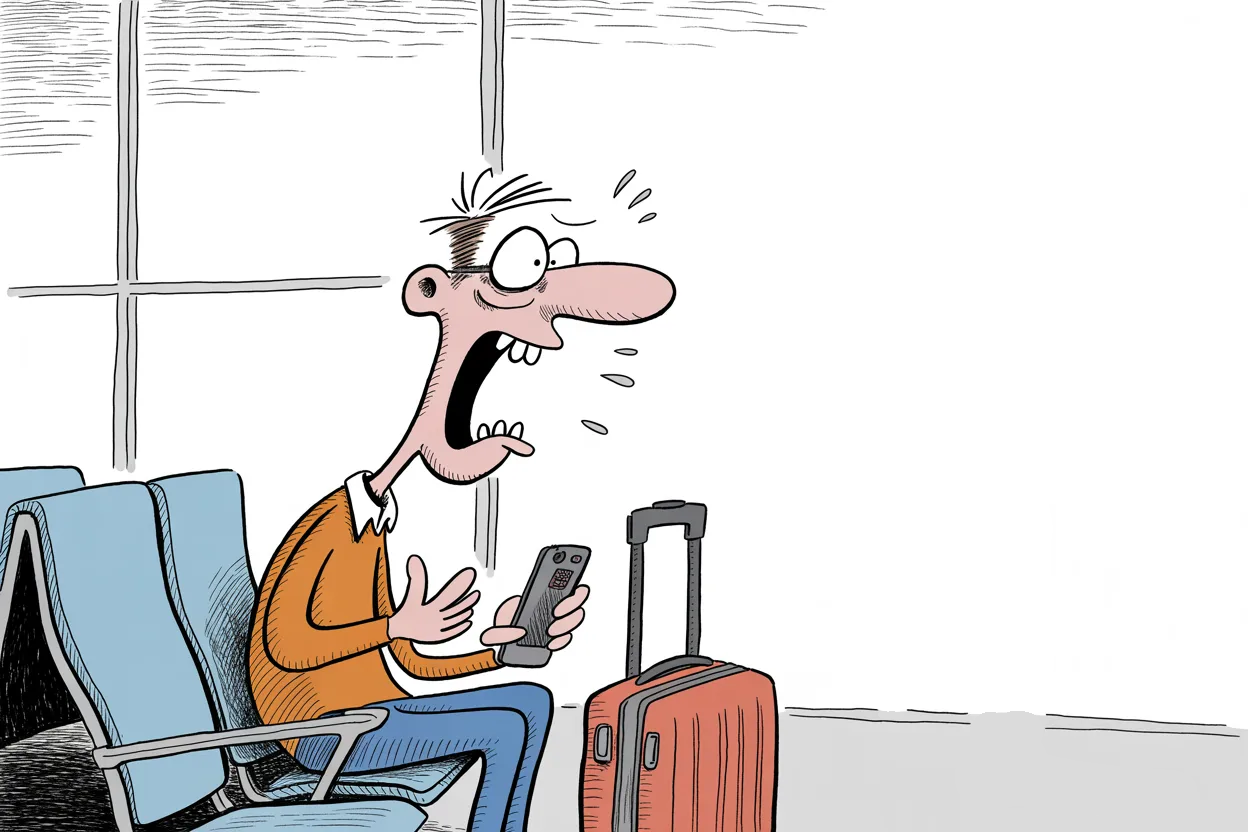
Cartoon of a panicked business traveler in a suit sprinting through an airport terminal dragging a rolling suitcase, with large RED ZONE signs overhead and a tense crowd waiting behind him.

The red zone: Why this part of air travel makes even the pros lose it

The red zone is that anxious stretch from your front door to your airplane seat, where normal people turn into nervous wrecks. It is a blur of high-stakes, time-sensitive decisions that overloads your brain, and it is stressful enough that most couples in one recent survey called travel the ultimate relationship test. It has even given rise to the airport divorce, where partners deliberately separate after security just to avoid an argument. We have all seen it: the passenger shouting at a gate agent over a delay, the family sprinting through the terminal with shoes half on, the quiet sob at the gate when a flight is canceled. With air travel booming this summer, the red zone is only getting more intense. There is real science behind why a security line can hijack your nervous system, and the surprising part is that even the most seasoned travelers, the ones with passports full of stamps, are not immune to it.

Cartoon of smiling sardines packed upright into narrow airplane seats in a tightly spaced cabin, illustrating how shrinking economy legroom crams travelers in like sardines.

Premium creep: How the travel industry downgraded you for profit 

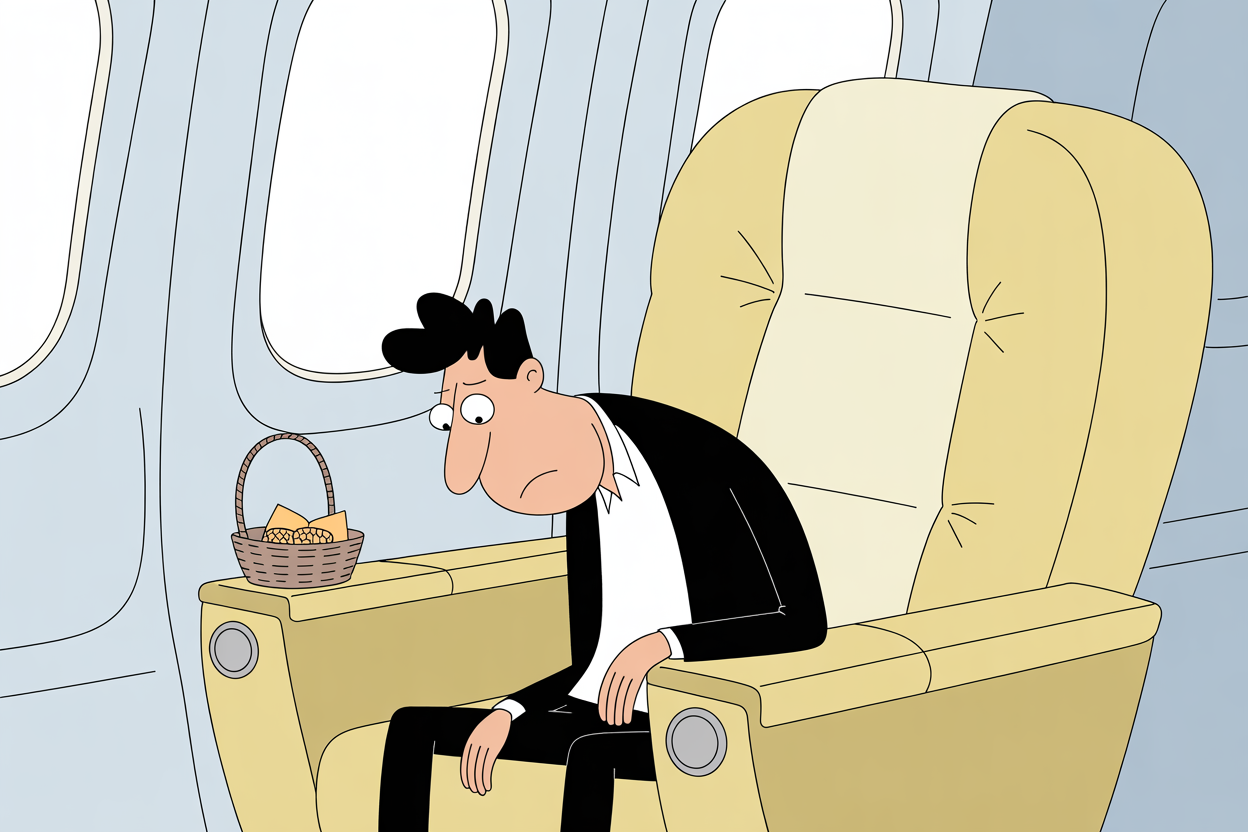
Remember when you could check a bag, choose your seat, and stretch your legs on a flight without paying extra? It is not an urban legend. You used to be able to do all three at no additional charge. A 34-inch seat pitch was once standard in economy class. Today the industry calls that same space premium economy and charges you more for it, while the 30-inch squeeze becomes the new normal. Call it premium creep, the quiet industry-wide pattern where yesterday’s basics quietly become today’s luxuries, wrapped in marketing language about choice and flexibility. And it is not just airlines: hotels, cruise lines, and even car rental companies have all found ways to strip out what used to be included and sell it back to you. Which raises the question worth sitting with the next time you compare two fares: are you buying an upgrade, or just paying to undo a downgrade the company handed you in the first place?

An angry airline passenger stands with a suitcase while holding a $10 voucher after a flight delay.

The delay tax: Why your airline voucher barely covers your expenses anymore 

When a flight is delayed or canceled, airlines cover only what they call duty of care: a meal voucher, sometimes a hotel, or a refund if the flight is canceled. Angela Justice received a $10 voucher after her Boston to Chicago flight was canceled. The real cost, the delay tax, is far larger. It includes nonrefundable hotels travelers cannot reach, lost wages, child care that keeps ticking, and the replacement flights passengers must book themselves when the airline’s rescheduling timeline proves useless. Airlines calculate compensation based on what it costs them to reschedule a flight, not what it costs the traveler to miss the reason they flew in the first place. The official story is that duty of care solves the problem and the Department of Transportation signs off. But the law was written in a different era, when travel was simpler and airlines were more generous, and regulators have not caught up now that delays are chronic and carriers watch every penny.

Editorial cartoon illustration of a smiling AI robot with "AI" labeled on its chest holding out a paper voucher in one hand and a colorful striped "Favor" shopping bag in the other, while a frustrated middle-aged man in a blue polo shirt stands with arms crossed next to his black rolling suitcase refusing the offer, illustrating how travel companies use automated systems to push customers into accepting vouchers instead of legally required cash refunds

Why are travel companies replacing real refunds with “coupon justice”?

Travel companies are increasingly replacing cash refunds with vouchers and goodwill credits when flights cancel, hotel rooms fail, and rental cars run out of vehicles. The practice exploded after the pandemic when companies pivoted to vouchers to hoard cash. The actual redemption rate for travel vouchers is below 10 percent, meaning a 90 percent chance the credit goes unused and the company keeps your money entirely. Under U.S. Department of Transportation rules, airlines must provide prompt refunds to your original form of payment when they cancel flights or make significant schedule changes. Airlines offering only vouchers without a genuine cash option violate these legal obligations. Hotels and online booking sites operate in a legal gray zone with few hard rules governing refund practices.

Editorial illustration showing four silhouetted figures with their hands raised to their heads in confusion or doubt, standing on concentric ring patterns and looking up at a large dark-blue globe of Earth with a giant white question mark hovering in front of it, illustrating how travelers are increasingly questioning the recommendations of professional travel experts in an age of paid influencers and commission-driven advice

Travelers are ignoring the advice of professionals. Here’s why that could be a mistake.

Travelers are increasingly skeptical of professional advice, ignoring travel agents who collect commissions, influencers paid by destinations, and points bloggers earning kickbacks from credit card companies. A Global Rescue survey shows 85 percent of travelers are concerned about geopolitical instability yet proceed with their plans despite the risks. Cautious skepticism is healthy when evaluating tourism-engine search results and influencer endorsements that dominate Google’s first page. But ignoring U.S. State Department advisories at Level 3 reconsider travel or Level 4 do not travel can lead to serious consequences. The chief medical officer at AXA Partners US says many travelers contract serious diseases and traumatic injuries in risky locations that were easily avoidable by following government advisories.

Editorial cartoon showing an anxious traveler in a blue polo shirt grimacing as he stuffs a large purple roller suitcase into an open green airport trash can, with empty seating areas and large glass windows visible in the background, illustrating the increasing trend of travelers abandoning their luggage at airports to avoid baggage fees

The great luggage abandonment: Why travelers are ditching their bags at the airport

Travelers are increasingly abandoning their luggage at airports and hotels to avoid baggage fees that can exceed the value of the bags themselves. Hotels in Tokyo and Osaka now post warning signs about luggage abandonment fees while Narita Airport reportedly stores dozens of unclaimed bags daily. Kansai Airport in Osaka and Chubu Airport in Nagoya report similar pile-ups. Asian carriers known for strict baggage fee enforcement contribute to the trend, along with Japanese tourists buying cheap rolling luggage for shopping trips and abandoning it before flying home. Airports hold abandoned bags 30 to 90 days before disposal.

Editorial cartoon showing a frustrated middle-aged guest kneeling on the patterned hotel carpet pointing a complicated remote control at a large wall-mounted TV displaying static, illustrating how smart hotel room technology fails guests trying to perform basic functions like turning on the television

Smart hotel room syndrome: Is technology making your accommodations unusable?

Smart hotel room syndrome describes the frustration when hotel technology designed to simplify stays actually makes them more complicated. According to a recent Hotels.com survey, 52 percent of hotels now offer tech walk-throughs at check-in because their rooms are too complex for guests to operate without tutorials. The technology saves hotels money on staffing and energy, increases sales through tablet upselling, and collects detailed guest data on usage, sleep duration, and bathroom time. Travel insurance does not cover damages from smart room failures, leaving guests to fend for themselves.