
in this case
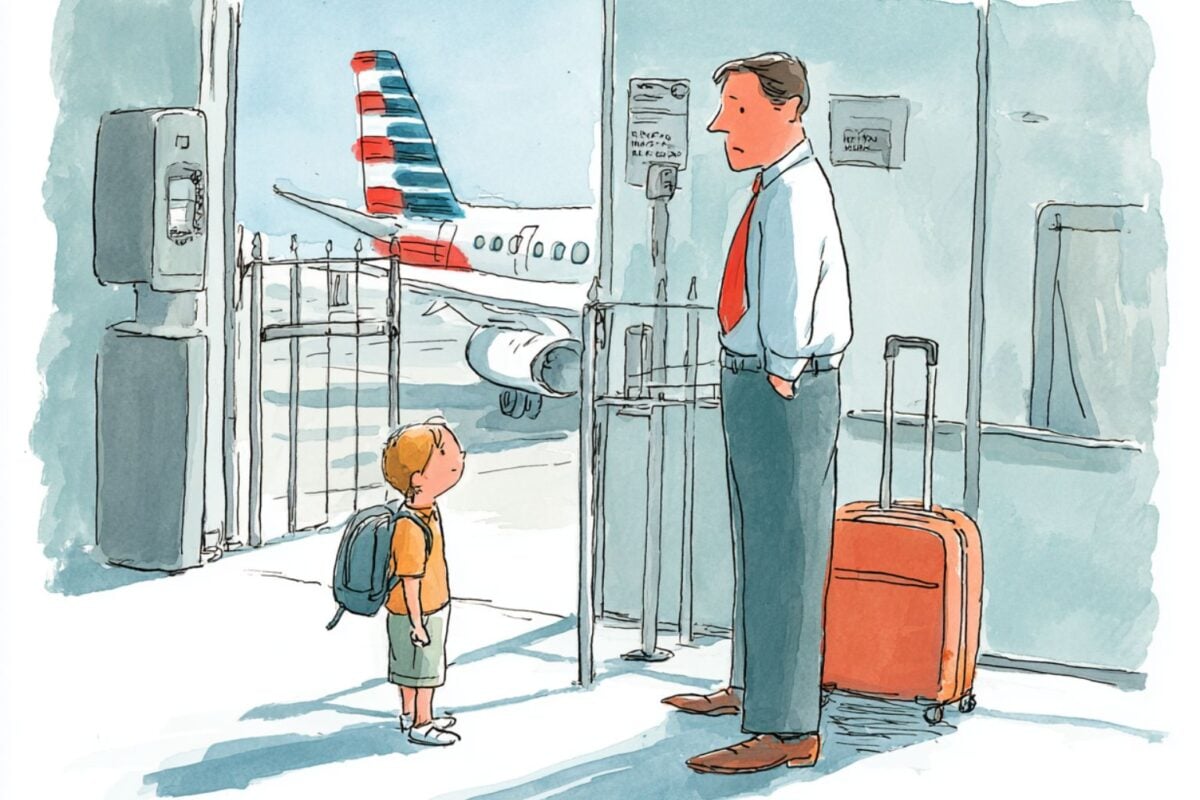
- Charles Shearer was traveling to Japan for his mother-in-law’s funeral when American Airlines pulled him and his young son from the boarding line in Cleveland.
- His grieving wife boarded alone while gate agents offered him a $500 voucher, with one even acknowledging the bumping was involuntary in spite of the offer.
- American Airlines later documented the incident as voluntary in its system, denying him the federal compensation of up to $2,150 per passenger that involuntary bumping requires.
American Airlines says Charles Shearer and his son voluntarily gave up their seats on a recent flight from Cleveland to New York.
Sherer says that’s a lie. He was on his way to Japan for his mother-in-law’s funeral, and his wife, who was accompanying them, ended up staying on the flight.
What’s at stake? Well, American gave him a $500 voucher, and it says that’s all it will give him since he voluntarily gave up his seats. Sherer says he’s owed more — a lot more — under federal law.
“American Airlines is claiming that, the day after my wife’s mother died in Japan, while we were en route, I decided to voluntarily let my grieving wife go on without us,” says. “And that now, I’m lying about it.”
Someone is lying, that’s for sure — and I have a pretty good idea who.
Welcome to the Orwellian world of airline bumping, where “involuntary” can magically transform into “voluntary” with a few keystrokes in an airline’s computer system. It’s a neat trick that saves airlines thousands of dollars per incident. And as Shearer discovered, it’s nearly impossible to prove otherwise after the fact.
This case raises several important questions about airline bumping practices and passenger rights:
- What’s the difference between voluntary and involuntary denied boarding, and why does it matter?
- How can passengers protect themselves when airlines mischaracterize an involuntary bumping as voluntary?
- What compensation are passengers legally entitled to when they’re bumped from an oversold flight?
When volunteering isn’t voluntary
Shearer, his wife, and son arrived at Cleveland Hopkins International Airport with plenty of time before their flight to New York. From there, they’d connect to Japan for his mother-in-law’s funeral. They checked in at the gate and received paper boarding passes.
Then they waited.
When their boarding group was called, they got in line behind Shearer’s wife. But when they reached the gate agent, something went wrong.
“The gate agent said that we didn’t have assigned seats,” Shearer recalls. “So they pulled us out of line.”
What happened next is where American Airlines’ version of events diverges sharply from the Shearer family’s experience.
According to Shearer, the gate agents told them only one seat remained available. They protested. The agents insisted finding two more seats was impossible. Shearer’s wife boarded alone, leaving her husband and young son behind as the gate door closed.
“Some time after the gate door had closed, one of the agents said something like ‘We can give you $500 for giving up your seat,'” Shearer recalls. “I know it wasn’t voluntary, but we can give it to you.”
That last phrase is the smoking gun. The gate agent verbally acknowledged the bumping was involuntary — but offered the voucher anyway.
Shearer accepted the $500 vouchers. At that moment, he wasn’t thinking about compensation. He was thinking about how to get his distraught son to Japan for his grandmother’s funeral.
They finally arrived in Japan more than seven hours late. To make matters worse, American Airlines had left their luggage at JFK.
“At the time, I wasn’t concerned about compensation but about how to get to Japan,” Shearer says.
After the funeral, Shearer researched federal regulations and discovered something troubling. Under federal law, passengers who are involuntarily denied boarding and arrive more than two hours late are entitled to 400 percent of their one-way fare, up to $2,150 per passenger. For him and his son, that meant $4,300 in cash compensation — not $1,000 in vouchers with restrictions and expiration dates.
Actually, the DOT or Congress could fix this easily by legally prohibiting overselling of aircraft seats. Or airlines could fix this by voluntarily giving up the practice.
But in today’s ultra-pro-business-profits political and economic climate, it has the same chances of happening as a snowball in hell.
Read more insightful reader feedback. See all comments.
He wrote to American Airlines requesting cash compensation.
The airline’s response was a form letter dripping with sympathy but offering only an additional $100 travel credit for each passenger. When Shearer pushed back, citing the specific federal regulation, American Airlines’ tune changed completely.
According to the airline’s records, Shearer and his son had “volunteered” to give up their seats. Therefore, they weren’t entitled to the federally mandated compensation.
Case closed.
“Our records indicate that you and Alan both volunteered to relinquish your seats for the Trip Credit compensation in the amount of $500 each prior to leaving the airport,” an American Airlines customer relations representative wrote.
But Shearer had evidence. He sent American Airlines screenshots of text messages he’d exchanged with his wife and father immediately after the incident. In one, his wife chided him for yelling at the gate agents. (“I was indeed furious,” Shearer admitted. “My wife was sobbing and my kid was panicking and confused.”)
Not exactly the behavior of someone who’d volunteered.
American Airlines didn’t budge.
The voluntary versus involuntary distinction
Understanding the difference between voluntary and involuntary denied boarding isn’t just semantic hairsplitting. It’s the difference between a few hundred dollars in restricted vouchers and thousands in cash.
When an airline oversells a flight — which is legal and happens regularly — it has to first ask for volunteers. The Department of Transportation defines volunteers as “passengers who respond to the carrier’s request to give up their seat willingly and accept the carrier’s compensation in exchange for relinquishing a confirmed reserved space.”
The key words: “request” and “willingly.”
If not enough passengers volunteer, the airline can bump passengers involuntarily. But that triggers strict federal compensation requirements that went into effect in early 2025.
For flights originating in the US that arrive at their destination more than two hours late. that’s 400 percent of the one-way fare, capped at $2,150 per passenger. The airline must pay this compensation immediately — at the airport, on the day of the flight. If the airline can offer substitute transportation that leaves before it can pay, it has 24 hours. Here’s more information on what your airline owes you when you get bumped.
The compensation for voluntary bumping? Whatever you negotiate. Could be $200. Could be $2,000. Could be a bag of peanuts. The government doesn’t regulate it because you’re supposedly entering into a voluntary agreement.
This creates a powerful incentive for airlines to characterize every bumping as voluntary, even when it clearly isn’t.
“When a flight is oversold, we ask for volunteers at the gate to relinquish their seats voluntarily in exchange for compensation,” an American Airlines representative wrote to Shearer. “If we do not get enough volunteers, it may become necessary to involuntarily deny boarding, which under federal regulations, requires that we provide compensation for those impacted.”
But here’s what the airline didn’t mention: Sometimes airlines pull passengers out of boarding lines, tell them there’s no room, offer them a token voucher, and then document the transaction as “voluntary” in their systems.
The practice exploits passengers’ ignorance of their rights and their emotional vulnerability. When you’re watching your crying wife board a plane to her mother’s funeral without you, you’re not thinking about federal regulations. You’re thinking about damage control. And when a gate agent offers you something — anything — you might accept it just to move forward with your life.
That acceptance becomes the airline’s get-out-of-jail-free card.
How to protect yourself from being bumped without compensation
Protecting yourself requires presence of mind that’s difficult to muster in crisis situations. But it’s possible.
- If you’re pulled from a boarding line, don’t panic. Ask explicitly: “Am I being involuntarily denied boarding?” Make the gate agent say it. If possible, record the interaction on your phone.
- Document everything immediately. Send yourself emails. Text family members describing what happened. Take video, if possible. The contemporaneous nature of these communications makes them powerful evidence later.
- Don’t accept anything at the gate without understanding what you’re giving up. Ask: “If I accept this voucher, am I waiving my right to denied boarding compensation under federal law?” If the agent can’t or won’t answer clearly, don’t accept the offer.
- Collect information. Your boarding pass. The gate information board. Any written offers from the airline. These documents can be crucial when the airline’s version of events contradicts yours weeks later.
Finally, know that accepting a voucher under duress doesn’t necessarily waive your rights to compensation. The regulation requires that passengers willingly accept the compensation. Being told “this is all we can offer” or “we can give you this since you got bumped” doesn’t constitute a voluntary, informed agreement.
But proving you didn’t volunteer? That’s the hard part.
What compensation passengers are really owed
For Shearer and his son, who arrived in Japan more than seven hours late after a domestic connection, the math was clear: $2,150 each, or $4,300 total was due them.
But there’s a catch. Well, several catches.
First, if you volunteer — truly volunteer, not “volunteer” in the way Shearer allegedly did — you’re entitled only to what you negotiate. That’s why gate agents love volunteers. They’re cheap.
Second, the regulations contain exceptions. Small aircraft with 60 or fewer seats are exempt for operational or safety reasons. If you don’t follow the airline’s contract of carriage requirements (missing check-in deadlines, being disruptive), you forfeit your rights. And if the airline denies you boarding for passport or documentation issues, even mistakenly, the rules get murky.
Third — and this is the biggest loophole — the airline gets to decide whether your bumping was voluntary or involuntary. Sure, you can file a DOT complaint and you can appeal to executives. But the airline’s contemporaneous records at the gate carry enormous weight.
“After a review of the flight information, it was revealed that the compensation you both were given for Denied Boarding was accurate,” American Airlines wrote. “We’ve reviewed our reports thoroughly, and we see you were both documented as volunteers.”
The DOT receives thousands of bumping complaints each year. In 2023, American Airlines involuntarily denied boarding to only 568 passengers out of millions transported — a rate so low it’s almost negligible. Either American has cracked the code on inventory management, or a lot of “involuntary” bumpings are being documented as “voluntary.”
Given the financial incentives, it’s not hard to guess which explanation is more likely.
Will they ever get their compensation?
After the DOT complaint went nowhere, Shearer reached out to our advocacy team. We reviewed his paper trail, including those damning text messages, and agreed to contact American Airlines on his behalf.
Our advocate, Dwayne Coward, sent a message to American’s executive customer service team, flagging the discrepancy between Shearer’s communications and the airline’s official records.
Then we waited.
And waited.
The airline initially confused Shearer’s case with another passenger’s issue. Then it promised to look into it. Then it went silent for two weeks while Shearer followed up, wondering if he’d ever see resolution.
Finally, two months after our team took the case, Shearer received an email from American Airlines that began with genuine contrition. After “further review” — interesting how these reviews keep finding new information — the airline acknowledged what should have been obvious from the start.
“As such, I’ve sent each of you a $2,150 check via postal mail to the address on file,” an airline representative wrote.
The total: $4,300. Exactly what federal law required. Plus, the airline let Shearer keep the $1,200 in vouchers it had already issued.
Victory? Absolutely. But it took two months, a DOT complaint, and intervention by a consumer advocacy organization to get an airline to comply with federal law.
And here’s the uncomfortable truth: Most passengers in Shearer’s situation don’t fight back. They accept the vouchers, internalize the airline’s version of events, and move on with their lives, thousands of dollars poorer than federal law intended.
The system works this way by design. Airlines have discovered that most involuntary bumpings can be converted to “voluntary” ones with the right combination of pressure, confusion, and nominal compensation. The odds of getting caught are low. The penalties for getting caught are negligible — they just pay what they should have paid in the first place.
It’s a risk-reward calculation that makes perfect business sense, even if it makes terrible ethical sense.
The DOT could fix this easily. Require gate agents to explicitly inform passengers whether they’re being involuntarily bumped and what compensation they’re entitled to before offering any vouchers. Require airlines to provide written notices at the gate, not just verbal offers in the chaotic moments before departure. Impose fines when airlines mischaracterize involuntary bumpings as voluntary.
Will it? Probably not.
Until then, you need to know your rights and stand firm. If an airline employee pulls you aside at the gate, or tells you there’s no seat available, you’re probably being involuntarily denied boarding — no matter what the gate agent calls it.
Don’t let them tell you otherwise. And definitely don’t let them compensate you otherwise.
Your voice matters
Airlines turn involuntary bumping into voluntary with a few keystrokes, saving themselves thousands per incident. American documented just 568 involuntary denials in 2023. Either inventory mastery or paperwork magic.
- Should airlines be legally required to provide written notices at the gate stating whether bumping is voluntary or involuntary before passengers accept any compensation?
- Should gate agents be required to explicitly inform passengers of their federal denied boarding compensation rights before offering vouchers or alternatives?
- Should airlines face automatic fines for mischaracterizing involuntary bumping as voluntary in their internal records to avoid paying federal compensation?
What you need to know about airline bumping and your federal compensation rights
Quick answers to the most common questions about airline bumping practices, federal compensation requirements, and how to protect yourself when airlines mischaracterize involuntary bumping as voluntary.
The Department of Transportation defines volunteers as passengers who respond to the carrier’s request to give up their seat willingly and accept the carrier’s compensation. Voluntary compensation is whatever you negotiate with the airline, ranging from a few dollars to thousands. Involuntary denied boarding triggers strict federal compensation requirements based on how late you arrive at your destination, with no negotiation involved.
For flights originating in the US that arrive at the destination more than two hours late, federal regulations require 400 percent of your one-way fare, capped at $2,150 per passenger. The airline must pay this compensation immediately at the airport on the day of the flight. If the airline can offer substitute transportation that leaves before payment is possible, it has 24 hours to pay.
Airlines cannot legally refuse federal denied boarding compensation when they involuntarily bump passengers. However, airlines often document involuntary bumping as voluntary in their internal systems to avoid paying. If this happens, file a Department of Transportation complaint and contact airline executive customer service with documentation. See Elliott Advocacy’s guide to how consumer complaints work.
Document everything immediately. Text family members with detailed accounts. Send yourself emails describing what happened. Take videos at the gate. If possible, ask the gate agent on the record: Am I being involuntarily denied boarding? Save all written offers, your boarding pass, and screenshots. The contemporaneous nature of these communications makes them powerful evidence when the airline’s records contradict your version weeks later.
Accepting a voucher under duress does not necessarily waive your rights to federal compensation. The regulation requires that passengers willingly accept compensation. Being told this is all we can offer or we can give you this since you got bumped does not constitute a voluntary, informed agreement. However, proving you did not volunteer becomes the difficult part once airline records claim otherwise.
Elliott Advocacy publishes a directory of American Airlines executive contacts including names, phone numbers, and email addresses on the American Airlines company contacts page. Use these contacts only after standard customer service has failed to resolve your issue. Send a polite but firm letter citing the specific federal regulation that supports your compensation claim.
Several exceptions apply to federal denied boarding compensation. Small aircraft with 60 or fewer seats are exempt for operational or safety reasons. Passengers who fail to follow the airline’s contract of carriage requirements like missing check-in deadlines or being disruptive forfeit their rights. Documentation issues like passport problems, even mistaken ones, create murky enforcement situations. Always check your specific situation against current DOT regulations.
What is the difference between voluntary and involuntary denied boarding?
How much compensation are you owed for involuntary denied boarding?
Can airlines refuse to provide federal denied boarding compensation?
How do you prove you did not voluntarily give up your seat?
Does accepting a voucher waive your right to federal compensation?
How do you contact American Airlines executive customer service?
What are the exceptions to denied boarding compensation rules?

Have a question about this story? Tell us what happened — we read every comment.
Join the conversation