
in this commentary
- The Wadden Sea is a UNESCO World Heritage Site and Denmark’s largest national park outside Greenland, hosting up to 15 million migratory birds on the East Atlantic Flyway annually.
- Sea levels could rise by 1.5 feet over the next 50 years, forcing Denmark to consider strategic retreat and giving land back to the sea instead of building bigger dikes.
- The park encourages tourists to forage and eat invasive Pacific oysters that are displacing native blue mussels, turning visitors into active conservationists.
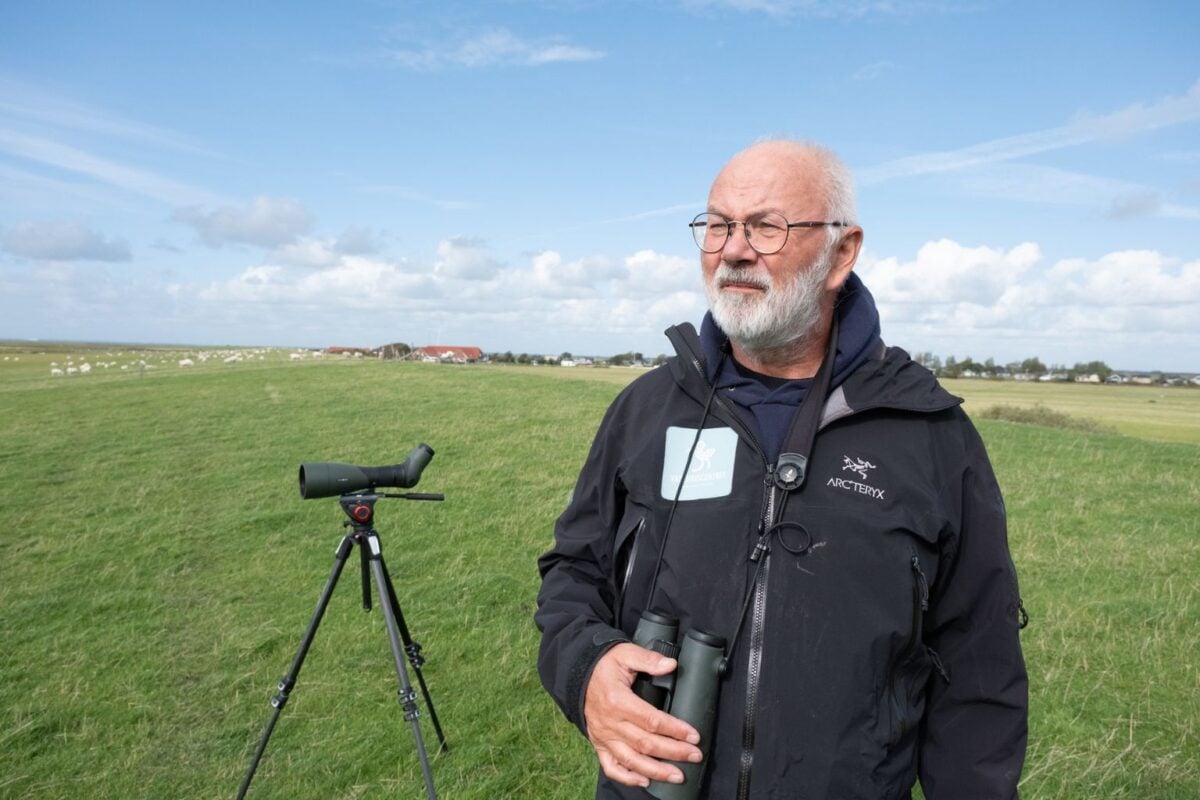
The North Sea edges closer to an overgrown dike, sending an occasional spray of frigid, gray water toward Klaus Melbye.
It brings back memories of a massive storm that struck this area a quarter century ago. Melbye recalls that water levels crested more than 7 feet above sea level, almost overwhelming the clay barrier that prevents the ocean from flooding Denmark’s farmland.
“We got lucky that day,” says Melbye, director of the Wadden Sea Centre, a visitor center in Ribe, Denmark, that serves as a gateway to the Danish Wadden Sea National Park. The storm lasted only a few hours and subsided during a low tide.
But that luck may not hold.
It isn’t a question of if the North Sea will flood this coastline, but when. This existential threat defines life in this Nordic country, where people have been pushing back against the water for centuries. For the residents of this UNESCO World Heritage Site, which is also Denmark’s largest national park outside of Greenland, sustainability is not a convenient catchphrase. It’s a matter of survival.
The Wadden Sea is also ground zero in a fight to preserve an entire ecosystem, which extends from the Netherlands to Germany and Denmark. This protected area is the central pit stop on the East Atlantic Flyway for up to 15 million migratory birds.
Visitors can see this urgent adaptation unfolding in real time, observing the shift from stubborn resistance to radical collaboration.
The failure of the walls
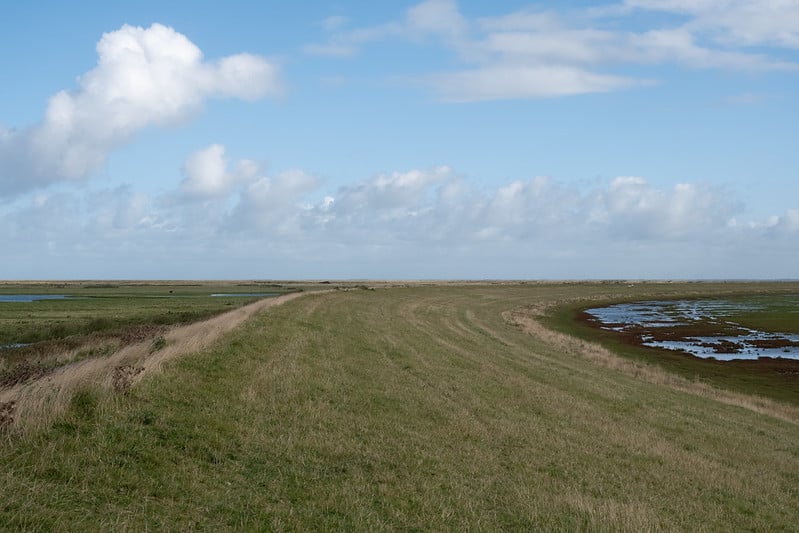
The sea-facing side of a dike near Ribe. (Photo by Aren Elliott.)
For generations, the solution to containing the sea has been massive engineering: building dikes to reclaim land. But recent experience suggests that method may no longer work.
While the last century saw sea levels rise by just 4 inches, Melbye estimates that the next 50 years will bring a terrifying acceleration. Sea levels could rise by as much as 1 ½ feet. (Related: Are the world’s most sustainable cities worth visiting?)
This dramatic forecast is forcing Europe to scramble. But traditional methods are already showing cracks. Germany and the Netherlands are building dikes up to 36 feet.
“But the seawater is going under the dikes,” says Melbye.
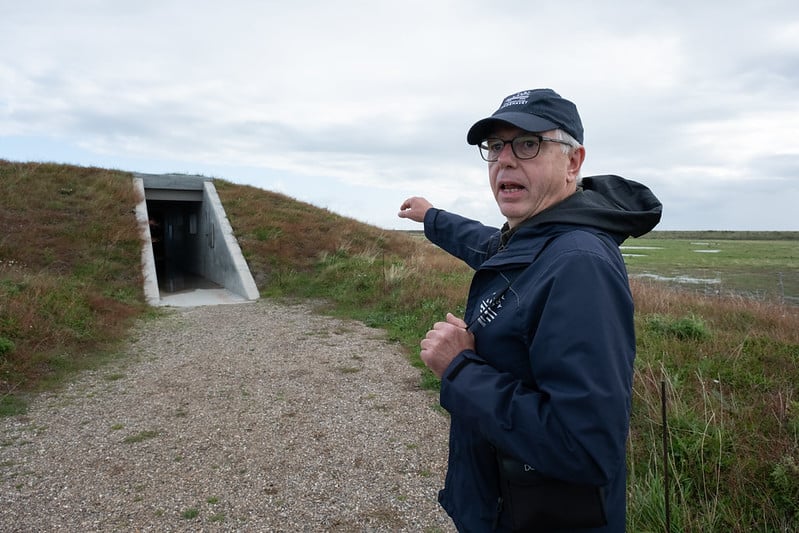
Jens Hansen points to a bird-watching building near a nature protection area in Wadden Sea National Park. (Photo by Aren Elliott.)
Is collaboration a radical cure?
Faced with a devastating climate crisis, Denmark is considering a counterintuitive and profound response: strategic retreat. The leading scientific discussion in Denmark is now focused on working with the sea, not against it.
This kind of radical, adaptive thinking — giving land back to the sea — requires a unique governance structure. It demands consensus, not compulsion, according to officials. This is where Jens Laurits Hansen, who works at the National Park Office on the island of Rømø, defines Denmark’s fundamental conservation strategy.
Hansen’s office is tasked with safeguarding the future of the Wadden Sea, but it operates without the kind of authority granted to other national parks.
Hansen explains that, unlike the much more top-down approach seen elsewhere, the Danish National Park model is built entirely on voluntary partnership.
“We don’t have the authority to dictate anything,” he says. “We have to do all our projects on a voluntary basis.”
This collaborative philosophy is the key to local sustainability. Hansen notes that while the process of securing an agreement with landowners can be lengthy, the final solutions are far more long-lasting because people are a part of it.
“When the community is involved, the conservation goals—like flood protection and ecosystem health—become inherently sustainable, ensuring they last long after the government funding runs out,” he explains.
You can see this strategy in action with the dike reinforcement on Rømø. Hansen’s team needed enormous amounts of clay, but they chose to dig it locally. This single decision saved them from hauling 13,500 truckloads of clay, dramatically cutting carbon dioxide emissions and simultaneously creating the Juvre Engsø bird refuge out of the excavated area. It plans the same approach when it comes to protecting the land against the ocean — and ultimately, how high to build the dikes.
I like that the article mentions the collaborative nature of the site between Denmark, Germany, and the Netherlands. Managing a natural resource across three different borders is a massive bureaucratic feat. It shows that environmental protection can transcend national politics.
Read more insightful reader feedback. See all comments.
Other projects include buying a 170-acre farm with plans to remove toxins and create wet areas to improve biodiversity.
The most important part?
“They will open the area to the public, so we can go and see the processes of nature restoration,” he says.
If you’re visiting the Wadden Sea, you might also get roped into being a conservationist for a day. Hansen’s office runs a program called BABINE, which recruits tourists to help clear open spaces to create more habitats for birds and butterflies. The goal is to promote sustainable conduct as the new normal. But it’s not the only program for visitors.
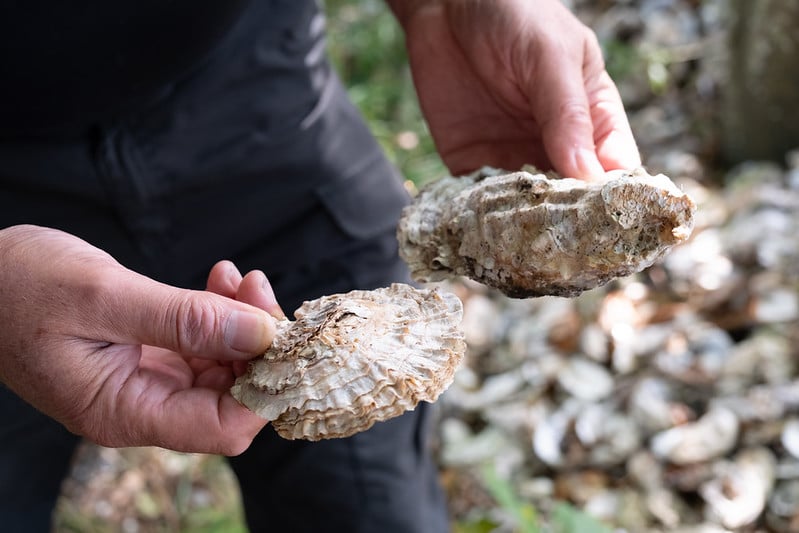
Pacific and Atlantic oyster shells, side by side at the Wadden Sea Centre. (Photo by Aren Elliott.)
The gastronomic intervention
The most immediate way tourists can witness and participate in the survival mission is by joining the hunt for the invasive Pacific oyster.
These foreign oysters, originally imported from Japan and Southeast Asia, spread rapidly after escaping from ill-conceived aquaculture projects. They now form massive reefs, displacing the native blue mussels that are a vital food source for ducks and other wading birds.
The solution is brilliant: The park encourages visitors to eat as many of the invaders as they can, for free. The national park offers oyster tours from October to March, when they are safe to consume. Visitors, equipped with buckets and knives, can walk out onto the seabed to forage for a free delicacy and also help the ecosystem.
This unusual blend of tourism and triage is key to the park’s function that extends to its buildings. For example, the Wadden Sea Centre, which acts as a key gate to the national park, was built using local, natural materials, relies on ground heat, and uses solar cells to maintain power.
What’s at stake in the Wadden Sea
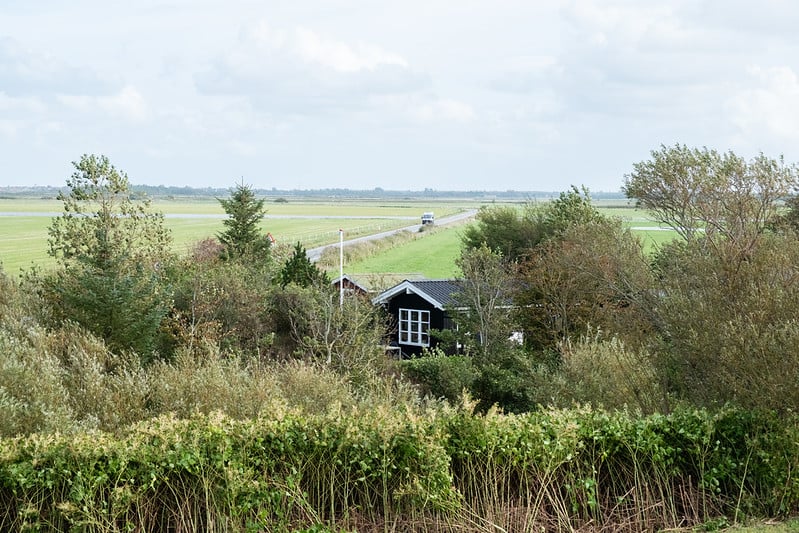
Behind the dike are kilometers of farmland, towns, and urban areas, all on flat terrain. (Photo by Aren Elliott.)
The Wadden Sea is under threat from all angles: an encroaching sea, invasive species and a shrinking ecosystem.
Melbye shared grim new scientific evidence that climate change is actually shrinking the bodies of the migratory birds. Because Arctic summers are warming, the insects they rely on are hatching earlier. When the birds arrive, they miss the peak food supply, which means the chicks are smaller and the adults are getting smaller.
Officials hope that tourism will help make the area sustainable. Visitors can come here to harvest invasive oysters, help create habitats for the migratory birds, and spend their tourism dollars and kroner.
The Wadden Sea is an irreplaceable larder. By turning tourists into active conservationists and daring to question centuries of engineering tradition, the Wadden Sea National Park is building the global blueprint for how humanity must adapt to the unforgiving pressures of a changed climate. Whether it succeeds remains an open question.
Your voice matters
Denmark is considering radical strategic retreat instead of building taller dikes. Tourists hunt invasive oysters as conservationists. Climate change is shrinking migratory bird populations.
- Should national parks be required to have authority to dictate conservation rules instead of relying entirely on voluntary partnerships with landowners?
- Should governments be required to publicly disclose climate adaptation costs and timeline projections for coastal regions facing rising sea levels?
- Should tourism programs that turn visitors into conservationists be standardized and expanded to all national parks facing ecological threats?
How does Denmark’s Wadden Sea balance tourism with climate adaptation?
Quick answers to the most common questions about visiting Denmark’s Wadden Sea National Park, its sustainable tourism programs, and how the region is adapting to rising sea levels.
The Wadden Sea is a UNESCO World Heritage Site spanning the Netherlands, Germany, and Denmark. It serves as the central pit stop on the East Atlantic Flyway for up to 15 million migratory birds annually. The Danish Wadden Sea is also the country’s largest national park outside of Greenland, making it a critical ecological zone for international biodiversity. See Elliott Advocacy’s coverage of Germany’s Palatinate sustainability efforts for related European conservation models.
Denmark is considering a counterintuitive strategy: working with the sea instead of against it through strategic retreat. While Germany and the Netherlands continue building dikes up to 36 feet, Denmark’s leading scientific discussion focuses on giving land back to the sea. Sea levels could rise 1.5 feet over the next 50 years, dramatically faster than the 4 inches seen last century, forcing radical adaptation thinking.
Yes. The park encourages visitors to forage invasive Pacific oysters that displace native blue mussels. The Wadden Sea National Park offers free guided oyster tours from October to March when the oysters are safe to consume. Visitors receive buckets and knives to walk out onto the seabed and forage. Eating these invasive oysters helps protect ducks and wading birds that depend on native blue mussels for food.
BABINE is a unique conservation tourism program run by Denmark’s National Park Office on the island of Rømø. The program recruits tourists to help clear open spaces and create more habitats for birds and butterflies. Visitors become temporary conservationists, contributing directly to the ecosystem’s health. The goal is to promote sustainable conduct as the new normal for travel rather than treating it as an optional add-on.
Unlike top-down conservation models elsewhere, Denmark’s National Park Office cannot dictate conservation actions. The park operates entirely through voluntary partnerships with landowners, requiring consensus rather than compulsion. While securing agreements takes longer, officials say the resulting solutions are more long-lasting because community involvement makes conservation goals inherently sustainable, surviving long after government funding ends.
New scientific evidence shows climate change is shrinking migratory bird populations physically. Warmer Arctic summers cause insects to hatch earlier than usual. When migratory birds arrive at their breeding grounds, they miss the peak food supply. This results in smaller chicks and gradually shrinking adult birds. The Wadden Sea hosts these threatened species, making it a critical site for understanding climate impacts on global bird populations.
Choose accommodations and visitor centers that use sustainable practices like the Wadden Sea Centre, which uses local natural materials, ground heat, and solar cells. Participate in conservation programs like BABINE oyster foraging tours. Visit during shoulder seasons to reduce overtourism pressure. Support local businesses that prioritize ecosystem protection over mass tourism. Elliott Advocacy’s guide to sustainable vacation practices provides additional frameworks for eco-conscious travel.
What is the Wadden Sea and why is it important?
How is Denmark adapting to rising sea levels at the Wadden Sea?
Can tourists really hunt for oysters at the Wadden Sea?
What is the BABINE program at the Wadden Sea?
Why is the Danish National Park model based on voluntary partnerships?
How is climate change affecting migratory birds at the Wadden Sea?
How can visitors travel sustainably to the Wadden Sea?

Have a question about this story? Tell us what happened — we read every comment.
Join the conversation