
in this case
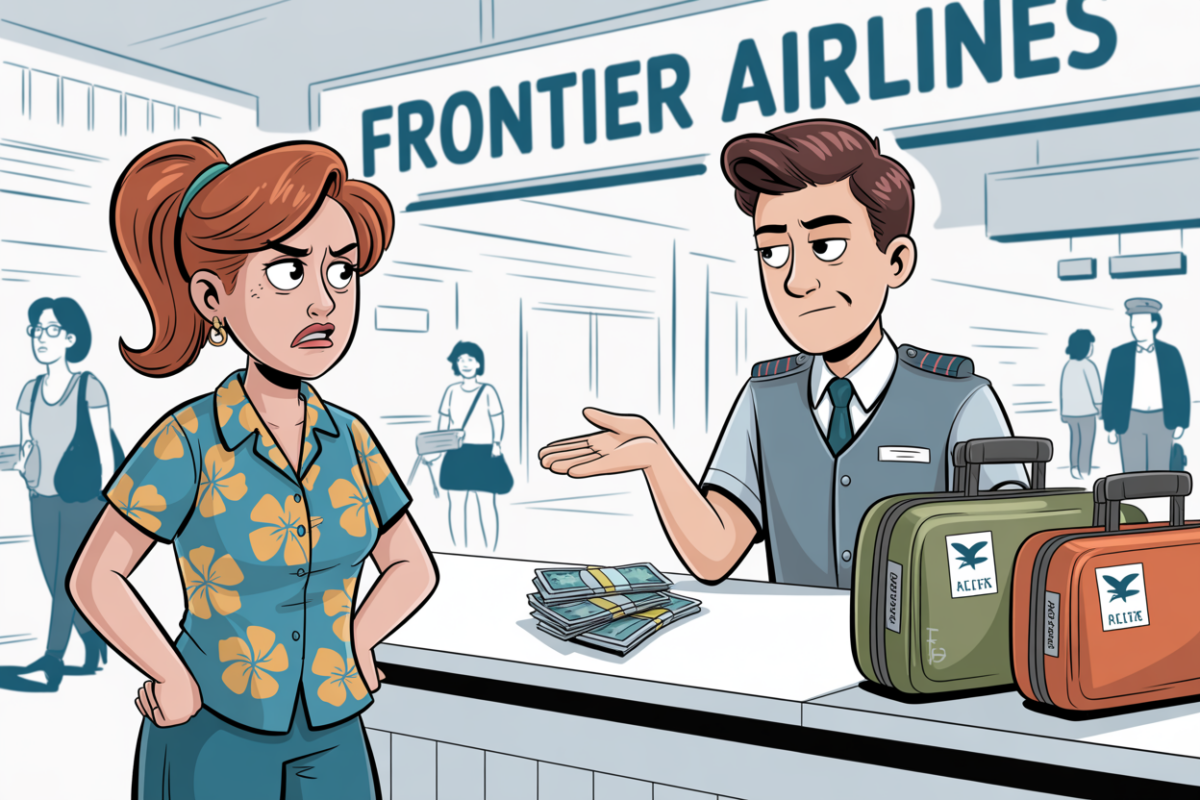
- Kristen Rodriguez prepaid for checked bags on Frontier Airlines at $29 each way, but her confirmation showed one bag jumped to $49 — a $20 overcharge she never agreed to.
- Frontier’s customer service acknowledged the error but refused a cash refund, offering only airline credit and citing dynamic pricing.
- After Elliott Advocacy contacted Frontier, it addressed her complaint — but will it fix its bait-and-switch pricing practices?
Kristen Rodriguez thought she had scored a deal when she prepaid for her checked baggage on Frontier Airlines.The airline app showed a straightforward offer: $29 for each checked bag, each way, for two passengers.
That should be $116 to get her bags roundtrip from Philadelphia to Cancun, right?
Wrong. It turns out Frontier had scored — on her.
Rodriguez clicked “add baggage” and entered her credit card information. When the confirmation email arrived, she did what every smart traveler should do — she checked the receipt.
The total was $136. The cost of one of her bags had mysteriously jumped from $29 to $49.
“I immediately reached out to customer service,” Rodriguez told me. “The phone wait was 168 minutes, so I tried the chat.”
The chat agent, Tushar, agreed Rodriguez had been overcharged and offered to refund the $20 difference. But there was a catch. It would come as a Frontier credit, not a refund to her original payment method.
“That was unacceptable,” Rodriguez said. “The app made an error. Why should I be stuck with airline credit?”
This case raises several important questions:
- How do airline baggage fees really work, and can they change during the booking process?
- What are your rights when an airline’s app or website overcharges you?
- How do you escalate a bait-and-switch case like this?
I’ve been reading this column for a while now, and I’ve started taking screenshots of just about every transaction I make. I had to come up with an organizational system to deal with the screenshots so I could see some empty space on my desktop again. Dynamic pricing is a crock. I have experienced it with Delta Airlines, when I started to book a flight and suddenly a message came up saying that the price was no longer available. However, Google Flights and Kayak were still showing the lower price, even after being refreshed. That’s bait-and-switch, pure and simple.
Read more insightful reader feedback. See all comments.
“He could only give me a travel credit”
When Rodriguez refused the credit offered by Frontier, Tushar fell back on the airline’s favorite excuse: dynamic pricing.
Frontier’s own FAQ confirms that “bag prices vary depending on your travel dates and when you purchase them,” but this doesn’t explain why baggage fees would change mid-transaction for passengers on the same reservation.
Rodriguez wasn’t buying it.
“There is no way airlines can have dynamic pricing for baggage and charge whatever they want,” she told the agent. “Especially when purchasing baggage for the same reservation.”
After Tushar refused to help, Rodriguez tried the executive approach. She emailed Barry Biffle, Frontier’s CEO, directly. (Here are Frontier’s executive email addresses.)
No response.
She attempted to fill out Frontier’s online refund form, but the system wouldn’t accept her reason for the refund request.
Growing desperate, Rodriguez got creative. She filed the refund request claiming she was overcharged for a “second seat” just to get the form to work. She also emailed two other Frontier customer service representatives. They also refused to help her.
Would Rodriguez be stuck in Frontier’s refund labyrinth forever?
How do airline baggage fees really work?
Airlines have transformed baggage fees from simple add-ons into complex revenue optimization tools. What started as basic charges for extra bags back in 2009 has evolved into a sophisticated pricing system that can change based on dozens of variables.
The dirty secret? Most airlines, including Frontier, use dynamic pricing for baggage fees. These fees are lowest when paid during booking and rise if paid later or at the airport.
But Rodriguez’s case reveals something more problematic — fees that change during the transaction itself.
Traditional airline pricing operates on a supply-and-demand model. Seat prices fluctuate based on booking patterns, seasonal demand, and competitor pricing. But baggage fees were supposed to be different — more stable and predictable.
Not anymore. Airlines have discovered they can apply the same dynamic pricing algorithms to baggage that they use for seats. The result: A system where your bag might cost $29 when you start the booking process and $49 by the time you finish.
This isn’t entirely random. Airlines track user behavior, monitoring how long you spend on their website, whether you’ve visited before, and even your device type. Some industry insiders call it “price personalization,” but passengers might recognize it by another name: discrimination.
In Rodriguez’s case, the pricing change happened within a single transaction for passengers on the same reservation. One passenger got the $29 rate; Rodriguez got stuck with $49 for the same service on the return flight. This suggests either a glitch in Frontier’s system or an algorithm that makes pricing decisions passenger by passenger, even within the same booking.
The Federal Aviation Administration doesn’t regulate baggage fee pricing. That’s left to market forces. The Department of Transportation (DOT) requires airlines to disclose fees clearly, but “clearly” doesn’t mean “consistently.” And DOT is also vague on the required timing of the disclosure.
Airlines defend dynamic pricing as a way to manage demand and maximize revenue efficiency. They argue it’s no different from hotels charging more for rooms during peak season or ride-sharing apps implementing surge pricing.
But there’s a key difference. When Uber charges surge pricing, you see the multiplier before you book. Rodriguez saw $29 and got charged $49.
That’s not dynamic pricing. It’s a bait-and-switch.
What are your rights when an airline overcharges you?
When an airline’s booking system overcharges you, your rights depend largely on what you can prove and how persistently you’re willing to fight.
The good news: Airlines can’t just keep money they shouldn’t have charged you. The Department of Transportation’s rules are clear on this point. If an airline makes a billing error, it must correct it.
The bad news: Proving a billing error can be surprisingly difficult, especially when dealing with dynamic pricing systems.
Rodriguez had an advantage many passengers lack. She took screenshots of the original $29 pricing before completing her purchase. Without that documentation, her case would have been almost impossible to prove. The airline could simply claim the pricing was correct based on their dynamic algorithms.
Whenever booking tickets, screenshots of every screen that shows prices are an important safeguard in case of an overcharge.
Contact customer service immediately. Unfortunately, airlines train their customer service agents to offer credits instead of refunds whenever possible. Credits tie you to that specific airline and often come with restrictions and expiration dates.
Don’t accept a credit if you’re entitled to a refund. Federal regulations require airlines to provide refunds to your original payment method when they’ve made an error. The key word is “error” — if the airline claims the pricing was intentional (even if it seems wrong to you), they can be more restrictive with refunds.
Keep a rock-solid paper trail. Save screenshots of pricing pages, confirmation emails, and any customer service interactions. If you’re dealing with chat support, copy and paste the entire conversation. If you’re on the phone, take notes with names, times, and reference numbers (though I don’t recommend doing this on the phone).
Know when to escalate your case. If front-line customer service can’t or won’t help, ask for a supervisor. If that fails, try the airline’s complaint department. Every airline is required to have a formal complaint process.
When internal escalation fails, consider external pressure. Social media can be surprisingly effective. Airlines often respond faster to public complaints than private ones. The Department of Transportation’s complaint portal is another option, though the process can take months.
In Rodriguez’s case, the airline’s formal response was a form letter essentially telling her tough luck: “Refunds for baggage fees are not eligible. These charges are considered non-refundable once the service has been selected and paid for.”
This response reveals a massive misunderstanding (or deliberate obfuscation) of the issue. Rodriguez wasn’t asking for a refund because she changed her mind. She was asking for a correction of what appeared to be a billing error.
The airline’s position might hold water if Rodriguez had simply decided she didn’t want to check bags anymore. But when your own system shows $29 and charges $49, that’s not a customer’s change of heart. That’s the airline’s mistake — or its dishonesty.
Is it time to call a consumer advocate?
Most advocates won’t take cases where passengers haven’t tried to resolve the issue themselves first. Companies need a chance to fix their mistakes before advocates get involved.
Knowing when to call in reinforcements can save you months of frustration and potentially hundreds or thousands of dollars. Consumer advocates aren’t magic, but they have tools and relationships that ordinary passengers don’t.
The decision to escalate should be based on three factors:
- The dollar amount
- The principle involved.
- The time you’ve already invested.
Dollar amounts matter, but they’re not everything. A $20 overcharge might not seem worth fighting for, but multiply that by thousands of passengers, and you’re looking at systemic problems that need addressing. Sometimes the smallest cases reveal the biggest issues.
More important is the principle. In Rodriguez’s case, the principle was clear—an airline’s booking system shouldn’t charge you more than it promises. If airlines can get away with this kind of pricing inconsistency, it sets a precedent that hurts all travelers.
Time investment is the third factor. If you’ve already spent hours on customer service calls and gotten nowhere, it’s time to consider outside help. Your time has value, and there’s a point where continuing to fight on your own becomes counterproductive.
Before contacting a consumer advocate, make sure you’ve built a credible paper trail. Advocates need documentation to make their case to companies. Screenshots, emails, chat transcripts, and phone call notes are all crucial.
When you do reach out to an advocate, be clear and concise about what happened and what you want. Don’t embellish or exaggerate — inflated claims hurt your credibility, and advocates can spot them quickly.
Finally, be realistic about outcomes. Advocates can’t guarantee results, and some cases simply can’t be won. But when a company messes up and refuses to fix it, advocates often have the relationships and persistence to get results.
Will she get her $20 back?
In Rodriguez’s case, our advocacy team contacted Frontier, explaining the situation and asking for comment. Within days the airline responded and issued a refund.
Rodriguez got her $20 back, but the bigger question remains unanswered: In an industry increasingly dominated by dynamic pricing and algorithmic decision-making, is bait-and-switch pricing becoming the new normal?
One thing is certain: The next time you book baggage on Frontier, take a screenshot first.
Your voice matters
Kristen Rodriguez’s Frontier app showed $29 per checked bag each way. When the confirmation arrived, one bag jumped to $49. Customer service agreed she was overcharged but only offered airline credit, not a refund. The FAA doesn’t regulate baggage fee pricing. The DOT requires clear disclosure but is vague on timing.
- Should airlines be prohibited from changing baggage fees during a single transaction?
- Should airlines be required to refund billing errors to the original payment method instead of offering credits?
- Should the FAA regulate baggage fee pricing to prevent bait-and-switch tactics?
What you’re saying
Readers now screenshot every transaction, shared their own price-change horror stories, and debated whether this is fraud or just broken software.
-
Screenshot everything or get burned
Trvlingrl now screenshots every transaction after Delta showed unavailable prices while aggregators still showed lower fares. Sheryl experiences constant mid-transaction increases.
-
This is fraud not just bad service
George Schulman called it outright fraud, not bait-and-switch. AJPeabody said dynamic pricing borders on fraud. GradUT advised simply avoiding Frontier.
-
Software bug or intentional scam
OnePersonOrAnother thinks it’s a bug, not intentional. Bruce Burger said she could’ve caught it before confirming payment.

Have a question about this story? Tell us what happened — we read every comment.
Join the conversation