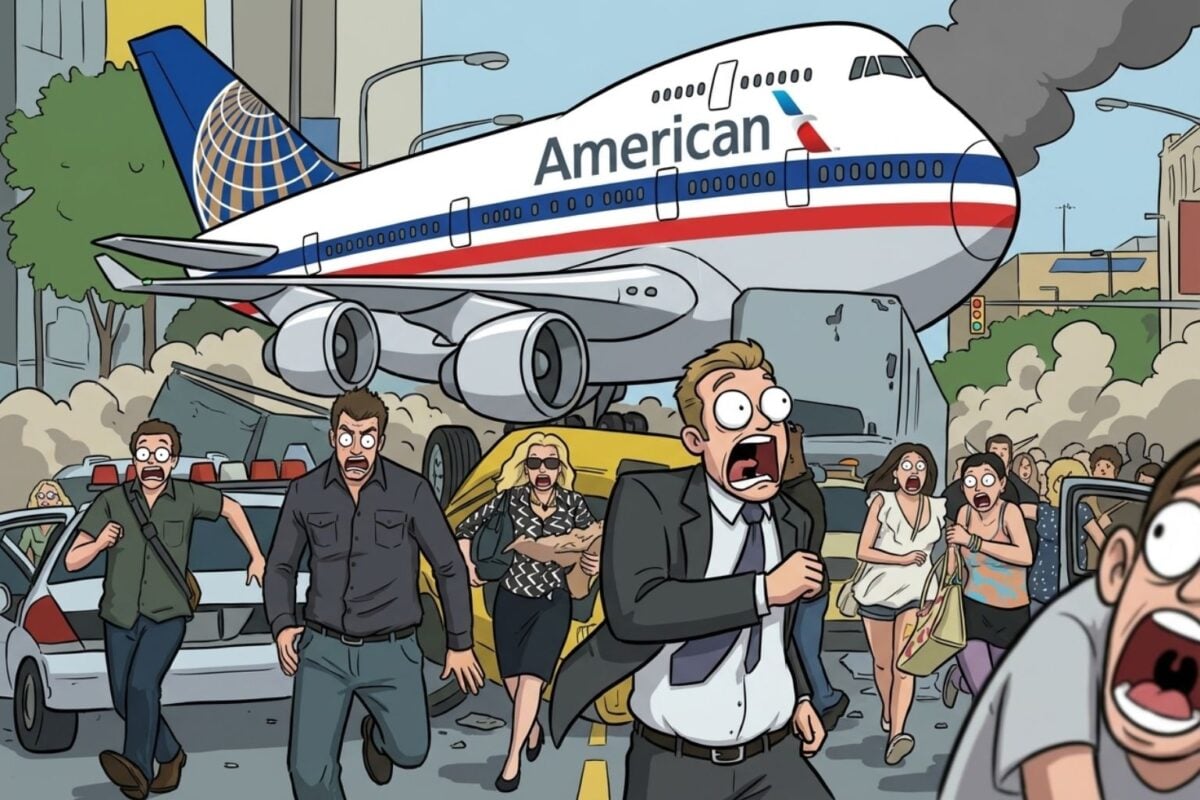

The United Airlines–American Airlines merger everyone feared may actually be happening.
United Airlines CEO Scott Kirby reportedly met with administration officials at the White House in February to float an audacious proposal: a combination with American Airlines.
Kirby, who has been quietly laying the groundwork for this since late last year, is pitching the deal as a way for a U.S. megacarrier to compete with foreign-flagged airlines on long-haul routes. But those of us who have watched this industry for decades suspect that this is more of a marriage of convenience that prioritizes corporate scale over passenger satisfaction.
(I noted in the last Consumer Alert that some carriers are increasingly likely to face bankruptcy, which might push regulators to be more open to these kinds of deals. I predicted two major airline mergers would hit the headlines this year. I hate it when I’m right.)
The United Airlines–American Airlines merger by the numbers
If this deal goes through, it will create a colossus controlling roughly 40 percent of the U.S. market. It would also combine the two largest sources of passenger friction in the country into one massive, unmanageable entity.
Here is how United Airlines and American Airlines compared on key performance metrics in 2025, including DOT complaint rates:
| Metric | United Airlines | American Airlines | Combined Airline |
| Annual Revenue ($billions) | $58.36 | $54.29 | $112.65 |
| DOT Total Complaints (2025) | 20,723 | 29,218 | 49,941 |
| DOT Complaint Rate (per 100k enplanements) | 8.55 (Rank: 7/10) | 14.12 (Rank: 9/10) | 11.62 (Est. Rank: 9/10) |
| Elliott Advocacy Cases (2025) | 294 | 674 | 968 |
| On-Time Arrival Rank* | 9th | 14th (Last) | N/A |
*Rankings based on the 10 largest reporting carriers. 1 is best, 10 is worst.
United will probably argue that a larger, more efficient network will provide better connectivity for international travelers and more stability for the domestic airline industry. By combining resources, it could claim to offer a more robust schedule that helps it stay viable against global competitors, which often receive government subsidies.
From a passenger rights perspective, the picture looks different. A combined entity would generate nearly 50,000 government complaints last year.
When airlines merge, they don’t adopt the best customer service practices. Instead, they almost always embrace the most restrictive policies and worst customer-service practices from each handbook to “synergize” costs. (Here is everything you need to know about booking your next airline ticket.)
History isn’t on the airlines’ side here. After the United–Continental merger in 2010, the combined airline was responsible for 43 percent of U.S. airline consumer complaints filed with the DOT by 2012. United even took out ads in newspapers admitting it “hadn’t lived up to expectations” of the merger. The American-US Airways deal didn’t go much better. Post-merger American saw a 5 percent increase in what passengers paid per mile—and that was after the DOJ had already forced the airlines to sell off slots at Reagan National and LaGuardia to protect competition. Clearly, mergers don’t produce better airlines.
After watching mergers in the defense industry for 40 years: The two companies claim we’ll take the best of each company into the new enterprise. The reality has been we assimilate the worst of each company into the new enterprise. And no company shows that more than Boeing after the merger with McDonnell-Douglas. That’s rightly characterized as McD management took over Boeing with Boeing’s money. And we know what happened to Boeing Commercial Aircraft as a result, 737 MAX crashes and 787 problems. I saw similar problems in Boeing Defense.
Read more insightful reader feedback. See all comments.
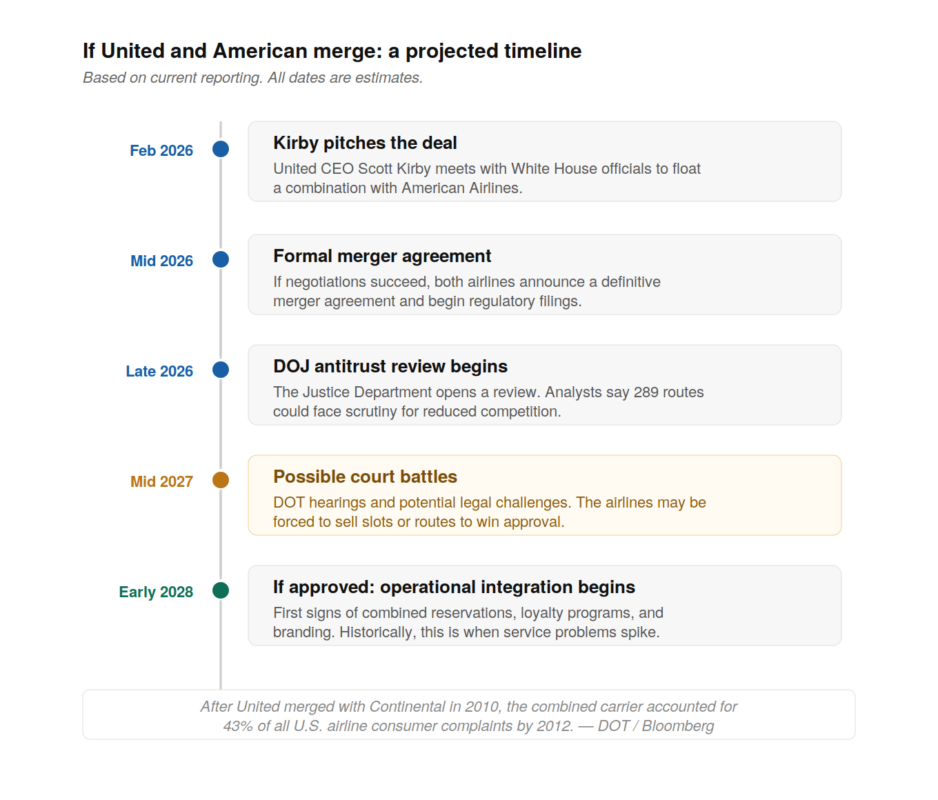
Here’s the American Airlines–United Airlines merger timeline
While Kirby is talking now, a merger of this size doesn’t happen overnight. If a formal agreement is reached later this year, the timeline would likely look like this:
Late Friday, American Airlines appeared to pour cold water on the merger talk, issuing a statement that it was “not engaged with or interested in any discussions” regarding a merger with United Airlines.
“While changes in the broader airline marketplace may be necessary, a combination with United would be negative for competition and for consumers, and therefore inconsistent with our understanding of the Administration’s philosophy toward the industry and principles of antitrust law,” it added.
Don’t believe it for a second. If American’s shareholders can get better deal by playing hard to get, they will. I’ve seen it before.
How to protect yourself before an airline merger
Passengers shouldn’t wait for the first “United-American” livery to appear to protect themselves.
- Don’t consolidate your loyalty programs—yet. While it’s tempting to move everything into one basket, keep your options open. Mergers often lead to points devaluations—where your miles suddenly buy much less than they used to.
- Consider a “third-way” airline. If you live in a hub like Chicago, Dallas, or Los Angeles, start looking at Delta, Southwest or even JetBlue. Competition is the only thing that keeps fares down, and this merger would effectively eliminate it on many routes. (Related: Yes, you can stop these airline mergers. Here’s how.)
- Manage your expectations. Would having United in control improve things? While United had a slightly lower complaint rate than American last year (8.55 per 100k complaints vs. 14.12), a lower rate of “bad” is still not “good.” History shows that the massive technical hurdles of merging two reservation systems almost always lead to a spike in lost bags and canceled flights.
Is the American Airlines–United Airlines merger good for passengers?
That brings us to this week’s question.
And a few follow-up questions:
- If you answered yes, why? Do you think a megacarrier is necessary to compete globally? Or do you think United’s management could fix American’s service issues?
- If you said no, what’s your biggest concern? Is it the inevitable fare hikes, the loss of competition in major hubs, or the technical nightmare of merging two reservation systems?
My take: From a consumer advocacy point of view, a United Airlines–American Airlines merger is exactly the kind of consolidation that hurts the average traveler. It eliminates choice, raises fares, and leaves you with fewer places to turn when things go wrong. Combining two airlines with poor on-time records and high complaint rates won’t create a better airline. It’ll just create a bigger problem.
Share your take on the American Airlines–United Airlines merger
What do you think? Is a United-American merger something that helps the U.S. stay competitive, or is it just a way to squeeze more money out of travelers? Join the discussion.

Have a question about this story? Tell us what happened — we read every comment.
Join the conversation