

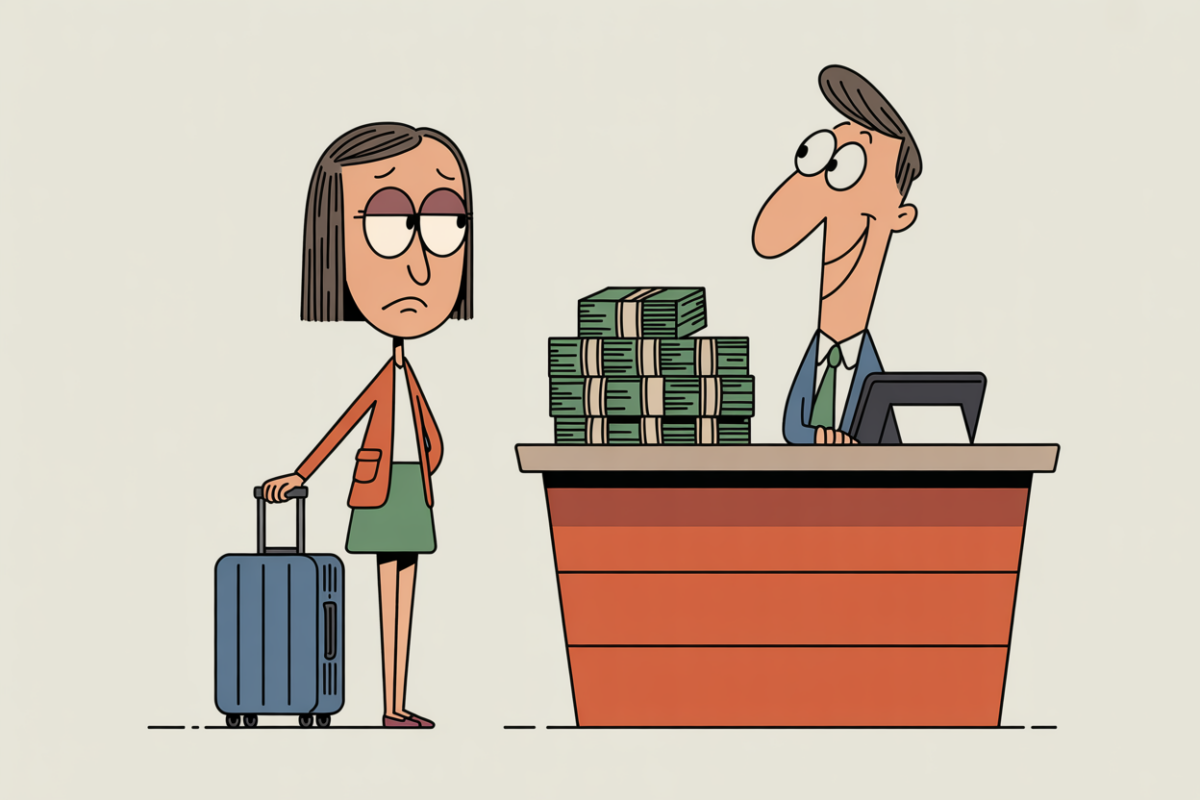

U.S. airlines this week raised their checked baggage fees to levels that would have seemed like a parody just a few years ago.
The industry’s latest excuse for these hikes is the rising cost of jet fuel following the outbreak of war in the Middle East.
American, Delta, United, and JetBlue have all pushed their first-bag fees to the $50 mark. Even Southwest, the long-time holdout that built its entire brand on “bags fly free,” has jumped on the bandwagon, now charging $45 for your first piece of luggage.
We’re witnessing the systematic repricing of the air travel experience that treats your suitcase like a high-end luxury item.
| Airline | New First Bag Fee | Previous Fee | Increase |
|---|---|---|---|
| United Airlines | $50 | $40 | $10 |
| Delta Air Lines | $45 | $35 | $10 |
| American Airlines | $50 | $40 | $10 |
| JetBlue | $49 (Peak) | $39 | $10 |
| Southwest Airlines | $45 | $35 | $10 |
| Alaska Airlines | $45 | $35 | $10 |
Baggage fee comparison: Who charges the most?
The rising cost of checking in
The justification from the C-suite is always the same: “evolving global conditions” and “industry dynamics.” Delta CEO Ed Bastian recently noted that fuel spikes added $400 million to operating expenses since late February.
The truth is more complicated. A 50-pound checked bag occupies space that could be sold as commercial cargo for as much as $120. By charging you $50, airlines claim they’re doing you a favor, even though the actual operational cost to move that suitcase—fuel, labor, and sorting—is less than half that. (Related: The great luggage abandonment: Why travelers are ditching their bags at the airport.)
Also, the major carriers aren’t just transportation companies anymore; they’re giant, flying credit card issuers. By jacking up the price of a checked bag, they’re creating a problem that only their co-branded credit cards can solve.
It’s the ol’ “create the itch, sell the scratch” trick. If you have the card, the $100 round-trip bag fee vanishes—making the $95 annual fee look like a bargain.
And boy, does it work for the bottom line.
- Delta Air Lines recently reported that its partnership with American Express generated a staggering $8.2 billion in revenue for 2025 alone—an 11 percent jump from the previous year. To put that in perspective, that’s more than many airlines make from selling actual tickets.
- American Airlines isn’t far behind. Its cash remuneration from co-branded credit cards and other partners hit $6.1 billion in 2024.
When an airline can make $8 billion from a credit card company, the bag fee is less of a cost-recovery mechanism than a nudge to get you to sign up for more high-interest debt. They don’t want your $50 at the check-in counter. They want your loyalty, your data, and your swipe fees for the next decade.
Thanks to Trump’s excursion into Iran without advance planning as to how to handle the Strait of Hormuz situation, the price that I’m now paying for a gallon of gasoline has increased from $2.70 to $4.00, that’s a 32% increase. The airlines are facing similar situations and some airlines have not increased ticket prices. Therefore, they need to recoup revenue to maintain the same levels of customer service that we have been experiencing. Based on the overall view of the situation, I believe that a $10 increase in the price to check a bag is justified.
Read more insightful reader feedback. See all comments.
How to avoid the fees without falling into the trap
You don’t have to give the airline what it wants. There are ways to beat the $50 bag fee that don’t involve signing up for a 24 percent APR credit card.
- Ship it ahead. For heavy items or long trips, door-to-door luggage shipping services can actually be 30 to 50 percent cheaper than some airline fees, especially if your luggage is on the heavy side.
- The gate-check gamble. If your flight is full, the gate agents will often beg people to check their carry-on bags for free to save overhead bin space. It’s a risk, but it’s a proven way to get a 50-pound bag to your destination for $0.
- Status match. If you have elite status with a hotel chain like Marriott, check if they have a partnership with your airline. United, for example, has long offered status matches that grant “free” bags to hotel elites.
- Prepay—or pay the price. If you must check a bag, do it when you book the ticket. Many carriers now charge $5 to $10 more if you wait until you get to the airport kiosk.
Are airlines overcharging for checked luggage?
That brings us to this week’s question.
- If you said yes, is there a specific price point where you’ll stop checking bags altogether?
- If you said no, is there a price where you think they would be overcharging? Or should they charge whatever the market will bear?
My take: The airlines are using a genuine geopolitical crisis as cover for a massive cash grab—and to prod customers into using their toxic financial instruments. I’ve seen this movie before: fuel prices go up, “temporary” fees are introduced, fuel prices drop, and the fees stay exactly where they are. I’ll have more on this in Sunday’s commentary.
Your turn
What’s your limit? Are you ready to become a carry-on only traveler, or have the airlines finally found a way to make that impossible, too? Join the discussion and let me know how these new fees are changing your travel plans.

Have a question about this story? Tell us what happened — we read every comment.
Join the conversation

What you’re saying
Readers debated whether fuel costs justify fee increases, shared strategies to avoid checking bags entirely, and questioned airline credit cards with hefty annual fees.
Carry-on only is the new normal
GradUT travels for weeks with only carry-on and personal bag without washing underwear in hotel sinks. Wuerzburg hasn’t checked a bag since 1983 when theirs went to Acapulco instead of Portugal.
Airline credit cards aren’t free bags
Wuerzburg noted Delta’s $350 annual fee means you’re prepaying for six or seven bags, not getting them free. Ann Foxen was told she couldn’t use her Southwest card because she wasn’t the primary cardholder.
Airlines acting like a cartel
Mark R said all airlines raising fees in unison reeks of anti-trust collusion. Tim questioned why fees are highest now when oil was more expensive four years ago.