
in this commentary
- Frankfurt wants to be a green destination with protected forests, bike superhighways, and Mobile Green Living Rooms that cool the hottest city in Germany.
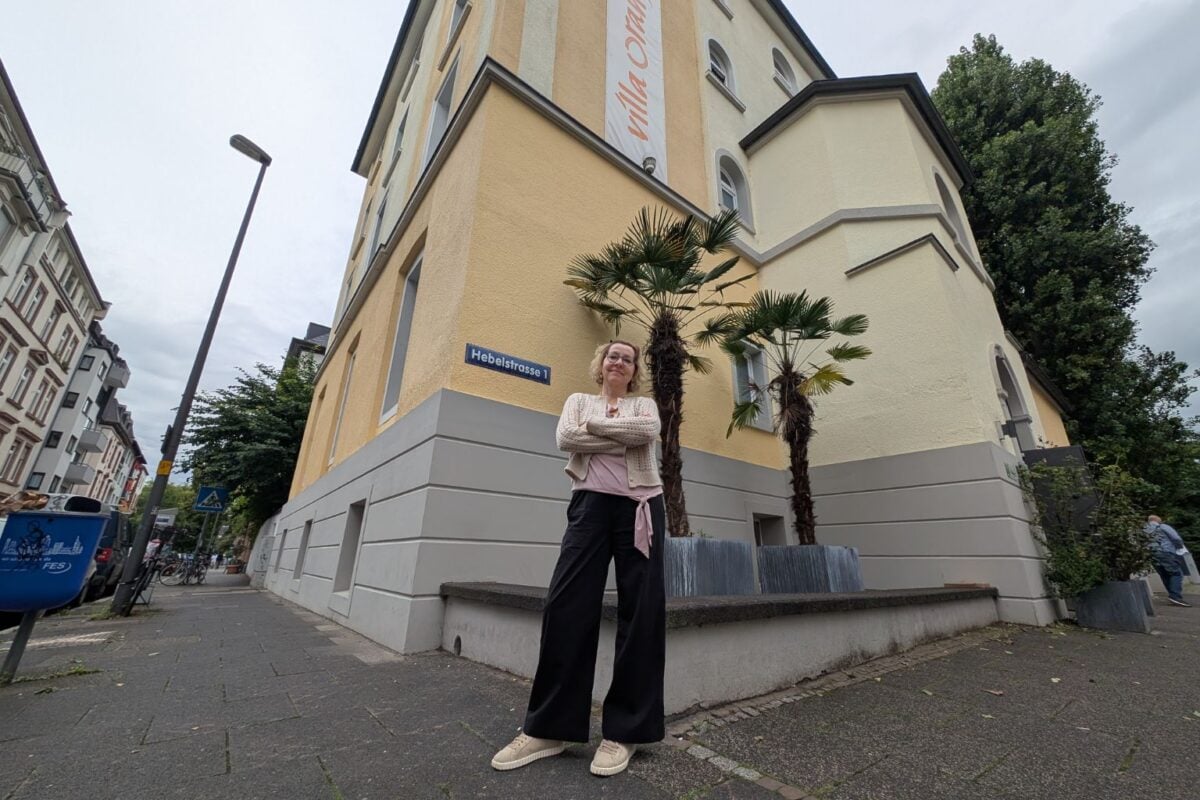
- Villa Orange is Frankfurt’s only certified organic hotel. Owner Christiana Hütte replaced every supplier unwilling to switch to organic products despite higher costs and guest complaints.
- But green infrastructure is easier to build than changing habits. Businesses resist costly sustainable products and guests prefer down duvets over plant-based alternatives and miss Nutella at breakfast. Would you give up Nutella to save the environment?
If you’re a guest at the Villa Orange in Frankfurt, Germany, you may have one question at breakfast: “Where’s the Nutella?”
The answer tells you a lot about this intimate, book-filled boutique hotel: It is certified 100 percent organic. And that means no palm oil–laden chocolate and hazelnut spread, no down-filled duvets, and no compromises on sustainable sourcing.
Since becoming fully organic in 2009, Villa Orange has held its ground amid higher costs and an occasional guest complaint. It’s an important outlier in a city that is trying to burnish its green tourism credentials.
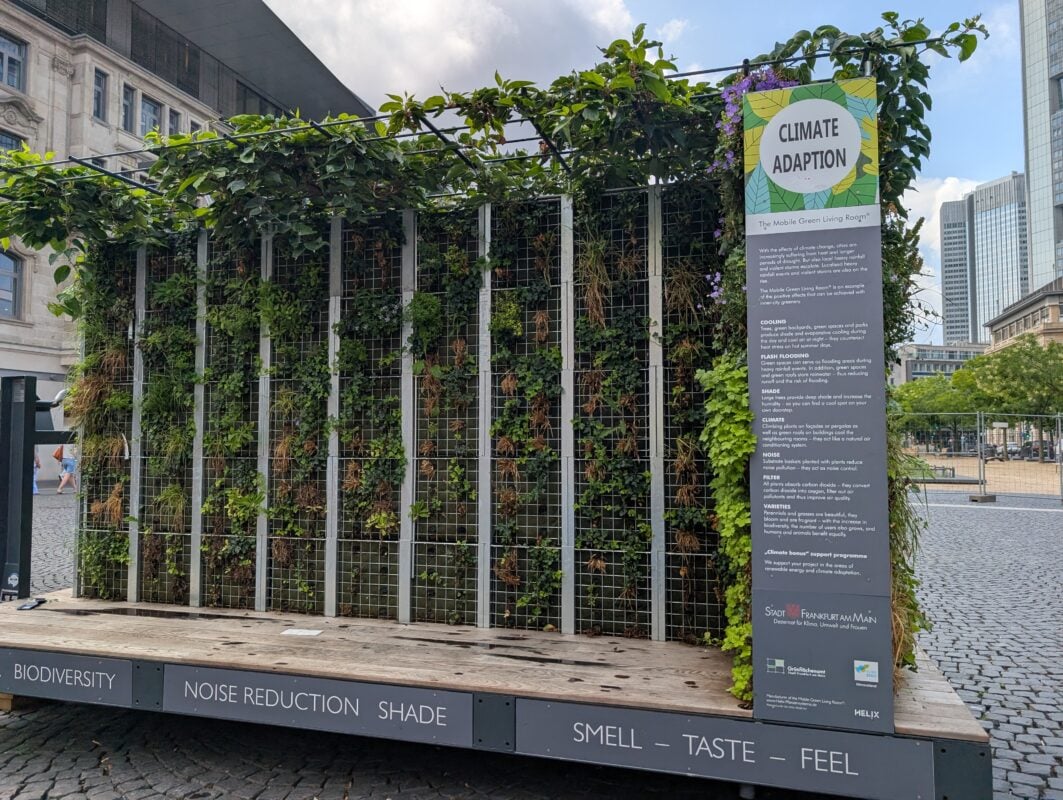
A mobile Green Living Room, a plant-covered structure outfitted with seating that offers a refreshing oasis in warm urban environments. (Photo by Aren Elliott.)
How is Frankfurt becoming a green tourist destination?
Like most German cities, Frankfurt wants to be known as a green destination. Here are the highlights of its sustainability resume:
- Nearly one-third of the city’s area is protected green space, including the sprawling Stadtwald forest and a green belt of meadows, wetlands, and riverside paths that are meant to improve air quality and offer relief from urban heat.
- There’s a $24 million municipal funding program to support climate-friendly projects, such as green roofs, solar panels, and water retention systems.
- Messe Frankfurt, Europe’s largest trade fair venue, switched to 100 percent renewable electricity in 2020, cutting nearly 19,000 tons of carbon dioxide emissions annually.
Frankfurt is also transitioning away from cars to more environmentally friendly ways of getting around. In addition to mass transit, there are bike superhighways and expanded cycling lanes that encourage eco-friendly mobility. Velotaxis and bike rentals make car-free travel easier.
I would gladly give up Nutella to save the environment. But I would also give up Nutella to destroy the environment—because I just can’t stand Nutella. I lived in Germany for 5 years (and still visit frequently) and I just don’t get the obsession with Nutella. (But the Germans don’t get my fondness for a jar of Skippy peanut butter either, so we’re even! 😆)
Read more insightful reader feedback. See all comments.
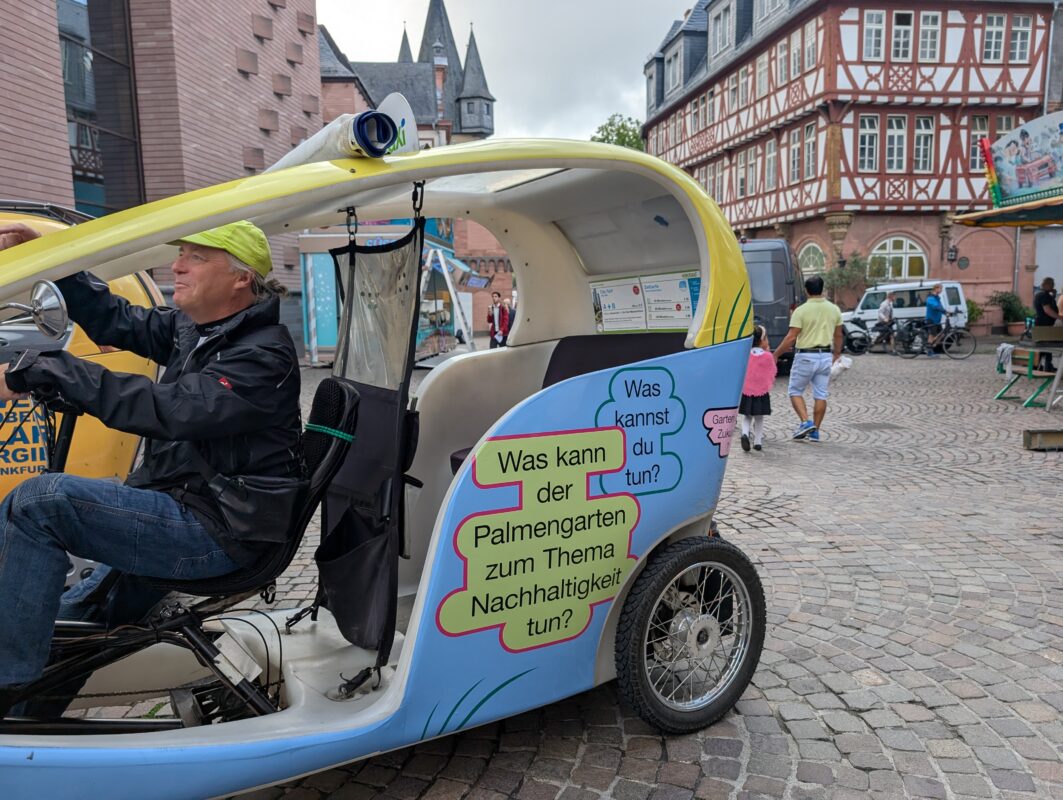
A velotaxi in Frankfurt’s New Old Town — proof that the city believes in green energy. (Photo by Aren Elliott)
A velotaxi tour of Frankfurt
One of the best ways to see the progress is by taking a Velotaxi tour of Germany’s financial capital.
There, you’ll see leafy parks, solar-paneled rooftops, and ecologically-friendly skyscrapers with open winter gardens, which drastically reduce energy costs.
One of the centerpieces of Frankfurt’s sustainability efforts is an initiative known as the Mobile Green Living Room. It’s a plant-covered structure on wheels outfitted with seating that offers a refreshing oasis in warm urban environments.
The living room is designed as a freestanding 3-D living wall overgrown with plants. Its purpose: to deliver a breath of fresh air, connect citizens to green infrastructure, and create comfortable social spaces. The Mobile Green Living Room is a semi-autonomous unit equipped with an irrigation system that contains enough water for a week. Some models are even self-sufficient, using a solar system to supply electricity for their water pump.
As summers in Europe get hotter, these green living rooms are being presented as one cooling solution. Frankfurt, identified as the hottest city in Germany, actively deploys these structures in summer to provide shaded areas for relaxation. But they also show residents that urban gardens can create their own microclimates and cool things down during the peak of summer.
Frankfurt’s New Old Town is the ultimate recycling project
You can’t talk about sustainability without discussing Frankfurt’s New Old Town. This quarter in Frankfurt’s inner city, once one of Central Europe’s best-preserved medieval old towns, was almost entirely destroyed during World War II. The brutalist Technisches Rathaus (Technical City Hall), which the public widely disliked, was constructed on this site in the 1970s.
The Dom-Römer Project, largely driven by civic engagement, began with the demolition of the Technisches Rathaus in 2010. The project’s goal was to restore the old city center, recreating the pre-war architectural style, bringing back its history, and replacing the unpopular brutalist edifice.
Today, you can see the recently restored buildings, including the Haus zur Goldenen Waage, which was the most complex individual reconstruction project and features an open-sided gallery. Other notable historical reconstructions include the Neues Rotes Haus, the Haus zum Esslinger, and the Goldenes Lämmchen, with their steeply pitched gable roofs and ornate facades.
These impressive buildings were thought to be lost forever. But their return is proof that Frankfurt believes in recycling.
During a tour of the New Old Town, our guide praised the city’s quiet commitment to sustainability but cautioned, “It’s easier to build green infrastructure than to change habits.” The city’s policies are bold, but they don’t always translate to everyday business choices.
Setting a green standard at Frankfurt’s only “bio” hotel
While Frankfurt’s government, cultural institutions, and event venues steadily push green initiatives, the hospitality industry still lags. Villa Orange owner Christiana Hütte says it’s an ongoing challenge.
A market researcher turned hotelier, she transformed a former retirement home into Germany’s first fully certified organic hotel. The process was not easy: She had to replace every supplier unwilling to switch to organic products, a costly and complex overhaul.
Villa Orange is a no-nonsense kind of hotel. The accommodations are roomy and comfortable and a little minimalist. Service is fast and efficient, but without the flair or pretension of some of the luxury chain hotels.
But the Villa Orange is a hotel with purpose. As the only certified organic hotel in Frankfurt, it has a reputation to uphold.
Hütte says that while many hotel and restaurant operators view organic certification as “difficult, complicated, and expensive,” with a little effort, almost any hotel can become a “bio” hotel. All it takes is determination.
But economic headwinds have only intensified skepticism, with businesses reluctant to invest in costly sustainable products when customers dine out less and budgets shrink. Even guests sometimes resist sustainable choices, preferring the familiar comfort of down duvets over cruelty-free, plant-based alternatives or lamenting the absence of Nutella at breakfast.
For hotel owners like Hütte, it is worth the effort because she is doing her part to make Frankfurt more sustainable.
In Frankfurt, a struggle to stay sustainable
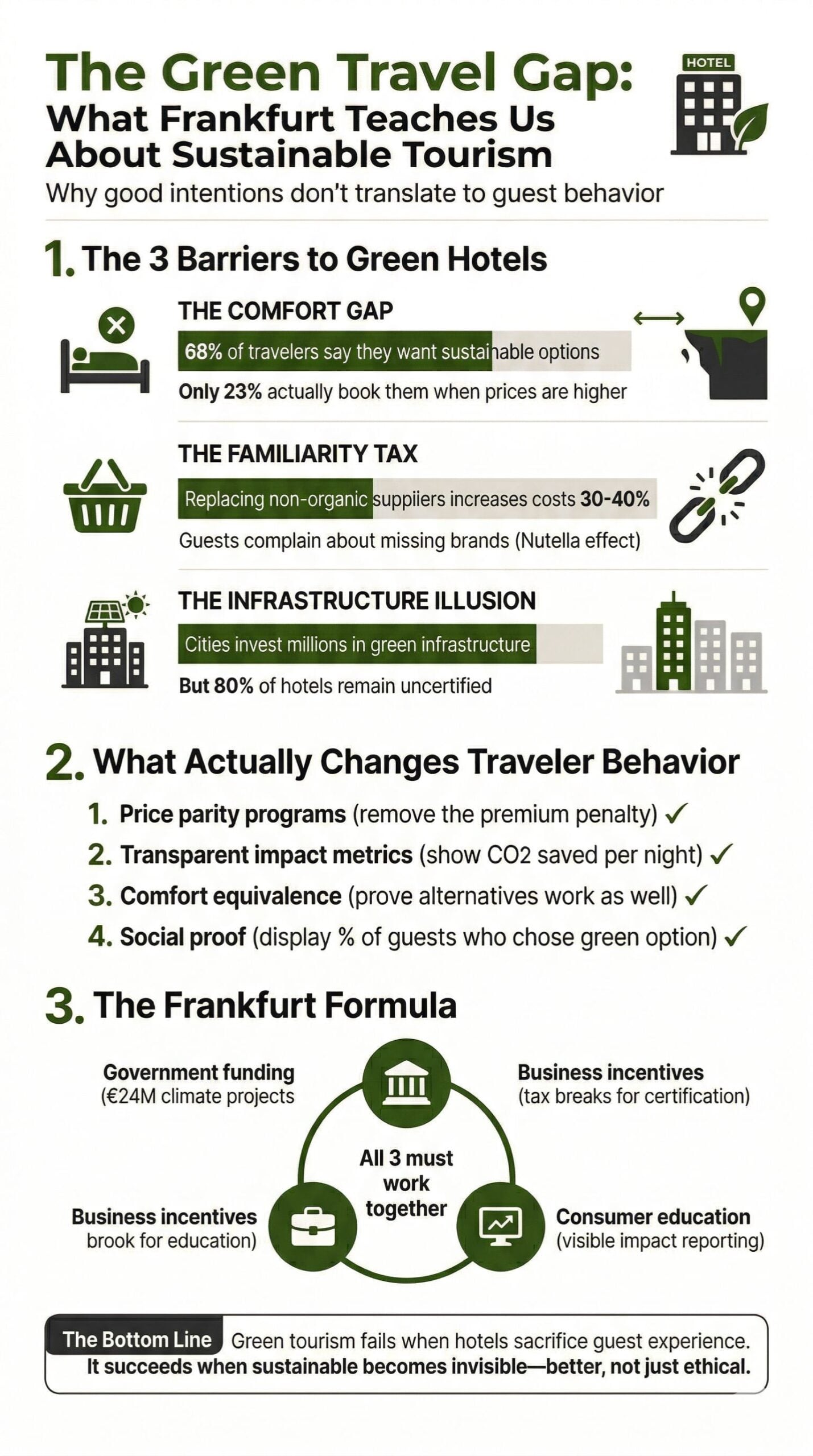
Frankfurt’s situation illustrates a common tension in green urbanism: ambitious, top-down policies and funding often struggle to penetrate everyday business operations and consumer habits.
The city can plant trees, install solar panels, and build bike lanes with relative ease. But turning those initiatives into actual widespread cultural change requires buy-in from local entrepreneurs and visitors.
Ultimately, the green future of Frankfurt will depend as much on consumer choices as on municipal programs. The sustainability of a trip starts not just with how many trees the city plants, but with where visitors choose to stay, how they get around, and what they consume while there.
In Frankfurt, as anywhere, true sustainability is a shared responsibility — between governments, businesses, and the travelers who will shape the city’s future.
Your voice matters
Frankfurt promotes green tourism with protected forests and bike superhighways. Villa Orange is the city’s only certified organic hotel. Owner Christiana Hütte replaced every supplier unwilling to switch despite higher costs and guest complaints about missing Nutella.
- Should hotels be required to disclose their sustainability certifications before booking?
- Should cities prioritize green tourism infrastructure over traditional tourist amenities?
- Should travelers accept higher costs and fewer familiar brands when staying at eco-friendly hotels?
What you’re saying
Readers debated whether they’d give up Nutella for the environment, questioned what “saving the environment” even means, and admitted many don’t like Nutella anyway.
-
Easy sacrifice for Nutella haters
GradUT would give up Nutella to save or destroy the environment because they can’t stand it. sister7 loves it but can’t buy it or she’ll eat the entire jar.
-
Habits matter more than policies
Mandy said sustainability only works if people change their habits, not just rely on green policies. Mary B noted bigger sacrifices will eventually be required or forced on us.
-
The poll needs a better definition
OnePersonOrAnother said without defining “save the environment” it’s impossible to answer. They’d quit Nutella if it stopped global warming but not for a 0.0000000000000000001% reduction.

Have a question about this story? Tell us what happened — we read every comment.
Join the conversation