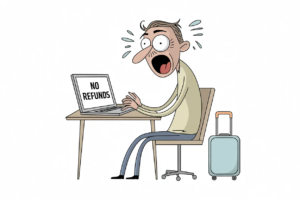
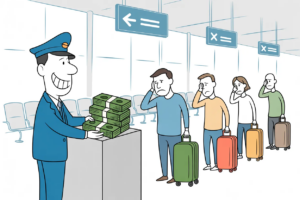
It’s easy to get treated like a second-class citizen when you travel: Just say the wrong thing.
That’s an undeniable fact that people are rediscovering during the busiest year in the history of modern travel.
Businesses would deny it, of course. Airlines, car rental companies, cruise lines and hotel chains would claim that they have a well-trained staff that provides top-notch customer service, always.
But who are they kidding? Their well-trained employees are only human, and when you disrespect them, they’ll find a way to get back at you. You’ll end up in a middle seat, in a Matchbox car, in a broom closet, or checking into a berth near the engine room.
Take that!
It’s getting worse, according to research by Christine Porath, a visiting professor at the University of North Carolina and co-author of “The Cost of Bad Behavior.”
“Incivility on the front lines of business is on the rise,” she noted.
How employees punish you with the worst treatment
How does it happen? Well, I could cite one of the tens of thousands of cases I handle as a consumer advocate every year. But I’m embarrassed to say it happened to me recently.
Here’s what happened: I was on assignment in Zürich, Switzerland, and I lost my credit card. My bank promised to overnight a new card to my address but then sent it to the wrong address — my U.S. residence instead of my Swiss address. (Related: Here are the air travel secrets I want to share with you.)
Then things took a turn for the worse. My bank needed to send me a text message to verify my identity, but the message never arrived. It then tried to enable tap-to-pay on my phone, but that didn’t work. Finally, I ended up speaking with someone who sounded like he was in a call center halfway around the world.
“You have to help me,” I told him.
“Let me transfer you to someone who can assist,” he promised.
Then he hung up.
I called back and waited in a long queue, and by now I was even more frustrated. Finally, I got through to someone in a call center who promised to transfer me. Another hangup.
I’m sure it was something I said. You never tell someone on the front lines how to do their job, even when you’re irritated — or maybe I should say, especially when you’re irritated. And by the way, I’m still waiting for my credit card as I write this, and maybe I deserve the wait. (Here’s our guide with the best travel advice.)
But there are other things you can say that will also get you into trouble.
“Why can’t you just do your job”
“That’s disrespectful and demoralizing,” says Mark Damsgaard, founder of Global Residence Index, a visa and migration agency. Instead, he recommends showing empathy and respect — and rephrasing the query to, “How can we fix this?” (Related: Why does everyone want to get off the plane first? It’s exit envy!)
“Do you know who I am?”
“That’s always a winner,” says Bob Bacheler, a frequent traveler and managing director of a medical transportation service. (He’s being sarcastic.) Travelers who have to tell you how important they are — whether they’re an elite-level frequent flier, an influencer or a thought leader — are just annoying. Employees will find a way to make their lives miserable. (Related: Pro tips for keeping your valuables safe when you travel.)
“I’ll sue”
This threat is usually accompanied by yelling and swearing. Barry Maher saw that happen on a recent flight to Chicago. A business class passenger was loudly berating the ticket agent, saying everyone who worked there couldn’t “do any *!*% thing right.” “He had important business in Chicago and if he didn’t make it there on time he was going to sue the airline and everyone responsible, including the airline agent,” says Maher, a professional speaker. It did not make the agent move any faster, and the loudmouth was eventually rebooked on another flight — in economy class. (Related: Don’t lose your valuables when you travel. Here are the rules.)
“It’s my anniversary”
Loudly declaring that it’s your special day can have the opposite effect. This is a well-known trick to get special treatment, says Kate Lacroix, a hotel marketer. “You should assume everyone in the room is on a vacation because they are celebrating a special occasion.” I’ll never forget visiting Disney World with a childhood friend and his family. As they pulled up to the parking attendant, she asked if they could park closer to the front of the lot. “We have kids,” she said. The attendant could hardly contain his amusement. Everyone there had kids. (Related: What is a travel advisor and do you you need one?)
“I know the CEO”
“It’s the wrong thing to say,” says Bill Luftig, a former customer relations director for an NFL stadium. “That will almost always guarantee a less-than-enthusiastic response to whatever the problem may be. Also, stating that they want the name of your immediate boss so he can fire you. Again, not effective — and my boss would most likely back me up anyway.” What’s the best way of getting what you want? Let the facts of your case speak for themselves. (Related: Travelers are having more “lost in translation” moments. What’s the fix?)
“But I’m American”
Your nationality is no one’s business, but with anti-American sentiment running high in some parts of the world, volunteering that information may translate into bad service. “Never flat-out say you are American,” advises Brandon Scivolette, a frequent international traveler who runs a moving company. “There’s nothing wrong with being an American, and most people accept us — but never say it as a qualifying statement.” Also, don’t assume everyone speaks English. Because they don’t. (Related: Can you trust those government travel advisories? Maybe not — and here’s why.)
Related reads
Here’s how to get better service
You’re probably wondering what you should say to get better service. If you can’t curse, yell, threaten, or wave your platinum card around, then what can you do?
- Be calm. Whether something has gone wrong or you just have a special request, emotion is the enemy. A level-headed, rational approach is always more effective. Employees are trained to handle angry and hysterical customers: They call security.
- Be factual. Describe what you want without embellishing. Let the facts speak for themselves. Don’t tell the employee that you’re important or that if you don’t get your way you’re going to sue. Every customer is important, and when things go wrong, you always have the option of going to court — so both these things are already implied.
- Be friendly. Employees are people, and they’re far more likely to go out of their way for you if you’re nice to them.
The unfortunate truth is: At a time of record travel, expectations are at a record high. Getting preferential treatment is hard, but getting the worst treatment is as easy as saying a few careless words.
✋ Your turn
Have you ever said something while traveling that completely changed your experience — for better or worse? Tell us how it went in the comments.
FAQ’s
While companies deny preferential treatment, frontline employees often respond to tone, language, and behavior — even subconsciously. A disrespectful remark can quietly shift how your issue is handled.
Threats and self-importance put staff on the defensive and rarely help. You’re more likely to get stonewalled, downgraded, or met with indifference — especially when empathy could have resolved the issue faster.
Yes. You can still stand your ground firmly without aggression. A calm, fact-based appeal backed by politeness often results in quicker resolutions than escalating emotionally.
You can share it politely, but don’t expect it to unlock special perks. These requests are common and often seen as manipulation when delivered with expectation.
Even simple, respectful English paired with good manners goes a long way. Avoid assumptions and don’t lead with your nationality — focus instead on connection and mutual understanding.
Pro tip: The secret to better service isn’t status or volume — it’s composure. Stay calm, be kind, and present the facts clearly. That alone can open doors most platinum cards can’t.
Key takeaways
- The way you speak to frontline travel staff has a direct impact on the service you receive.
- Entitled or aggressive language can lead to passive retaliation — like worse seats, slower help, or being ignored entirely.
- Common phrases like “I’ll sue” or “Do you know who I am?” usually backfire, no matter how justified your complaint may be.
- Getting better service requires calm, respectful, and solution-oriented communication.
- In today’s peak travel environment, staff are under pressure — and how you treat them matters more than ever.

Have a question about this story? Tell us what happened — we read every comment.
Join the conversation