in this commentary
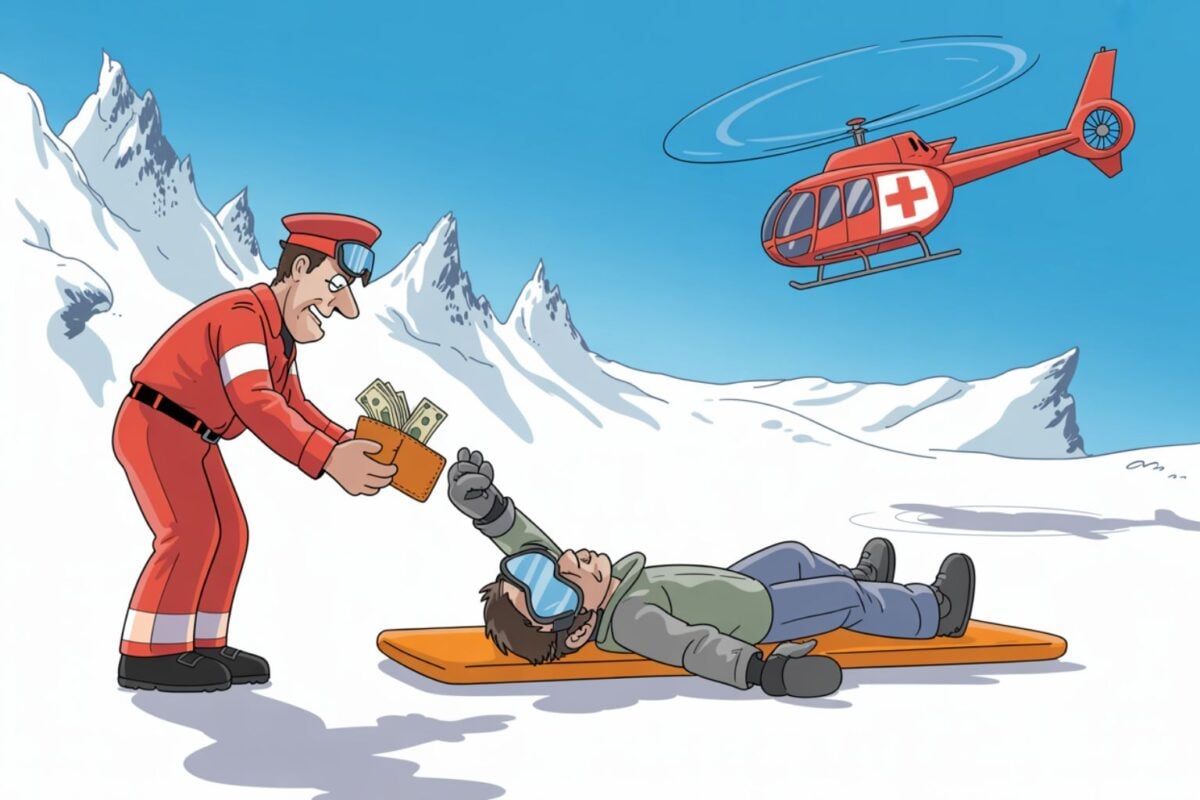
- A standard travel insurance policy might leave you stranded with a $30,000 rescue bill if you crash on the slopes, thanks to vague “hazardous activity” exclusions.
- Insurers are tightening restrictions on winter sports, meaning that venturing just slightly off-piste could void your medical coverage entirely.
- Experts reveal the essential add-ons and “stacking” strategies you need to protect your wallet from helicopter evacuations and broken gear.
When it comes to skiing, it may be impossible to have too much travel insurance coverage.
At least that’s what travel advisor Suzanne Moore will tell you. One of her clients crashed on her second day of a ski vacation in Park City. Fortunately, she’d stacked her protection: a policy with activity interruption coverage and a Medjet evacuation membership.
“Because we’d selected a policy with activity interruption coverage, she was reimbursed for her unused lift tickets and ski lessons,” says Moore. “We pivoted the rest of her trip to spa and culinary experiences — and she still left feeling like it was a success.”
Skiing is an expensive sport, so when you get injured, you could lose a lot..
“The right cancellation coverage can reimburse your nonrefundable travel costs, including your lift tickets, if you have to cancel your trip for a reason covered by your policy,” says Daniel Durazo, a spokesman for Allianz Partners USA.
Does travel insurance always cover skiing?
But travel insurance doesn’t always work when you go skiing or snowboarding. Standard travel insurance policies get a little funny when it comes to winter sports — and not funny in a “ha-ha” way. A “comprehensive” travel insurance may not cover you if you veer off the slopes for a moment and break a leg. The confusion has been getting worse lately as insurance companies have carved out more exceptions.
“Each carrier has its own specific list of exclusions,” notes Tim Dodge, chief marketing officer at Arch Insurance.
Not just that, but insurance companies are also getting stricter about which claims they process. “We’re seeing some insurers tighten winter sports coverage after a spike in claims post-pandemic,” warns Max Coupland, CEO of Insuranceopedia, an insurance media platform.
The good news: If you stick to the slopes, you’re probably covered by a standard policy.
“Most retail travel insurance plans cover medical treatment and medical evacuation for ski trips,” says Dan Skilken, president of TripInsurance.com. “Some may exclude helicopter skiing in the back country because it is more of an extreme sport. But if you are going to a marked ski resort, there generally are no exclusions.”
But there’s that word — probably — that will keep you up at night. What if it doesn’t? How do you know?
Insurance companies can be diabolical about covering things that almost never happen and excluding the things that are actually likely to happen. The main purpose of insurance is to protect you against very expensive events like evacuation or major medical bills.
I question the emphasis on insuring against every possible loss. Lift tickets are expensive, but if you can afford them in the first place, being unable to use them is not a catastrophe. As for the headline… at North America ski resorts, ski patrol WILL save you from a rescue bill. Their services are free. However, medical care, evacuation from the resort, trip cancellation, etc. can be expensive.
Read more insightful reader feedback. See all comments.
Why understanding winter sports coverage is like skiing in a blizzard
The insurance industry’s approach to winter sports coverage is about as clear as a whiteout on Whistler. Companies throw around terms like “hazardous activities” and “extreme sports,” often leaving travelers guessing whether their planned activities are covered until they’re injured on the mountain.
Terry Boynton, president of Yonder Travel Insurance, says skiers should never assume they’re covered by their regular travel insurance policy. And some activities are almost always excluded. (Related: This is what you need to know about your neighborhood before you travel.)
“This typically includes heli-skiing and heli-snowboarding, mountaineering, mountain biking, or other similar activities that involve greater risk,” he says. (Related: This is the most dangerous thing you can do when you travel.)
The confusion starts with language. What exactly constitutes “normal” skiing versus “extreme” skiing? The answer depends entirely on which insurance company you ask — and sometimes which claims adjuster handles your case.
That’s why it’s better to look for certainty in your travel insurance policy, experts say.
“You need a dedicated winter sports extension that names skiing, snowboarding, snowmobiling — and ideally avalanche rescue — as covered activities,” says Alex Dyer, managing director at Ski Vertigo, a U.K. tour operator. “That way, if you snap a ski or twist an ankle chasing powder, your medical bills, transport and even repatriation are taken care of without question.”
What do you really need in the mountains?
If you’re heading to snow country, you’ll need more than crossed fingers and a prayer. The experts I spoke with agree on several non-negotiable coverage elements that can mean the difference between a minor inconvenience and financial ruin.
A specific add-on for snow sports. Even though you might be covered, an add-on gives you added security and doesn’t cost much more. Daniel Green, CTO of Faye Travel Insurance, says the ideal rider will address the adventure sports that are covered already in your base plan, “and also, emergency medical evacuation, in case the worst happens.”
Higher medical and evacuation coverage. Jackie Mondelli, chief marketing officer of Squaremouth, underscores the importance of a generous evacuation limit: “Winter sports injuries can require complex medical care or evacuation from remote locations,” she notes. “Look for higher coverage limits for both emergency medical and medical evacuation, especially if you’re heading into backcountry areas.”
Gear coverage. The gear protection aspect often gets overlooked until it’s too late. “Winter gear isn’t cheap,” notes Suzanne Morrow, CEO of InsureMyTrip. “If your skis, snowboard, or goggles get lost or damaged, you’ll want reimbursement.”
Here are a few expert tips for buying travel insurance for a ski vacation
The newest travel insurance policies are becoming more tailored to skiing and snowsports. “Some plans now offer lost ski-day benefits, adding another layer of protection for travelers investing in winter getaways,” says Wendy Stahl, product director for travel insurance at AXA Travel Insurance.
Still, just because someone is selling you insurance for a ski vacation doesn’t automatically mean you’ll be covered. Here are a few things to keep in mind:
- Learn how to read the fine print. Mike Farren, digital marketing manager at Insubuy, emphasizes the importance of reading the fine print carefully. “Look for a plan that specifically mentions skiing or snowboarding — or your other winter sport of choice — and then dig into the details,” he advises. “Does it cover you for off-piste or backcountry adventures? Some do, but only if you’re with a licensed guide.”
- Remember, insurance may not be enough. Nickie Mabey, founder of the tour operator Mabey Ski, recommends a dual approach: “We always strongly advise our guests to take out two layers of protection: A comprehensive travel insurance policy that covers off-piste skiing, ski touring, heli-skiing — and a Global Rescue membership, which includes evacuation from remote areas.” Why the extra Global Rescue membership? Because regular insurance sometimes restricts the activities or the cost of an evacuation. Dan Richards, CEO of the Global Rescue Companies, told me, “If you get hurt, we’re coming to get you — no fine print.”
- Keep your receipts. If you have to file a claim, you’ll need all the paperwork. One common scenario is a denied claim for damaged skis. “We’ve seen cases where travelers damaged $3,000 worth of rented gear and assumed their policy would reimburse them only to find that “rental equipment” was not listed under covered items, or required itemized receipts and pre-declared value,” says Ofir Sahar, CEO of Insuranks, an insurance marketplace and education platform.
Timing is important, too. To get the most comprehensive protection, it’s best to purchase travel insurance as soon as you make your first nonrefundable payment, says Carol Mueller, vice president of strategic marketing and engagement at Berkshire Hathaway Travel Insurance. “Waiting until closer to your trip may leave you exposed to potential risks,” she warns. “The earlier you buy, the more protection you’ll have against unforeseen cancellations and interruptions.”
The biggest mistake you can make? You guessed it — not reading the fine print. “Read the exclusions,” says Robert Gallagher, president of the U.S. Travel Insurance Association. “Find out what is not covered. Don’t assume all coverage is the same.”
Moore, who works for a travel agency based in Franklin, Mich., says the most important thing to remember when you’re trying to insure a ski or snowboard trip is to assume nothing.
“If coverage isn’t explicit, it’s not guaranteed,” she says. “That’s where travelers get caught off guard.”
She personally makes sure every activity planned on the itinerary is covered — and if it isn’t, she contacts the insurance company to clear up any ambiguity. That’s what the pros do — and this winter, it might be a good idea to do the same.
Most travelers assume “travel insurance” covers travel. But on the slopes, fine print definitions of “hazardous activities” can leave you with a mountain of debt.
Readers debated the definition of “hazardous,” with many arguing that standard policies are intentionally vague to deny claims. The consensus was clear: if you plan to ski, assume your regular insurance is worthless and buy specific coverage.
M.C. Storm and The Brown Crusader criticized vague policy language, noting that people often discover what’s excluded only after they get hurt. If regular skiing can be deemed a “hazardous activity,” the policy is effectively useless for winter vacations.
Bruce Burger questioned the need to insure smaller losses like lift tickets or goggles, arguing that insurance should focus on catastrophic costs like evacuation. He noted that in North America, ski patrol rescue is usually free, unlike in Europe where they might charge you.
Jennifer and Jay Libove highlighted the danger of undefined terms. Jennifer argued that drifting a few meters past a marker shouldn’t void coverage, while Jay shared his frustration trying to get a straight answer from insurers about whether road cycling or hiking counts as “high risk.”
Your voice matters
What you’re saying
The “Fine Print” trap
What’s actually worth insuring?
The “Off-Piste” ambiguity

Have a question about this story? Tell us what happened — we read every comment.
Join the conversation