
in this commentary
- A taxi driver hesitated to leave Walter Meyer at his Lisbon vacation rental because the building looked so run-down. But inside, Meyer found a pristine, completely safe apartment.
- Safety apps and Google street views only tell part of the story. To get an accurate read on a neighborhood, skip the concierge—who might give cautious advice to avoid legal liability—and talk to the front desk clerks instead.
- A block that looks fine during the day can change completely after businesses close. Here are the five specific questions you should ask hotel staff to get an honest assessment of your surroundings before you go exploring.
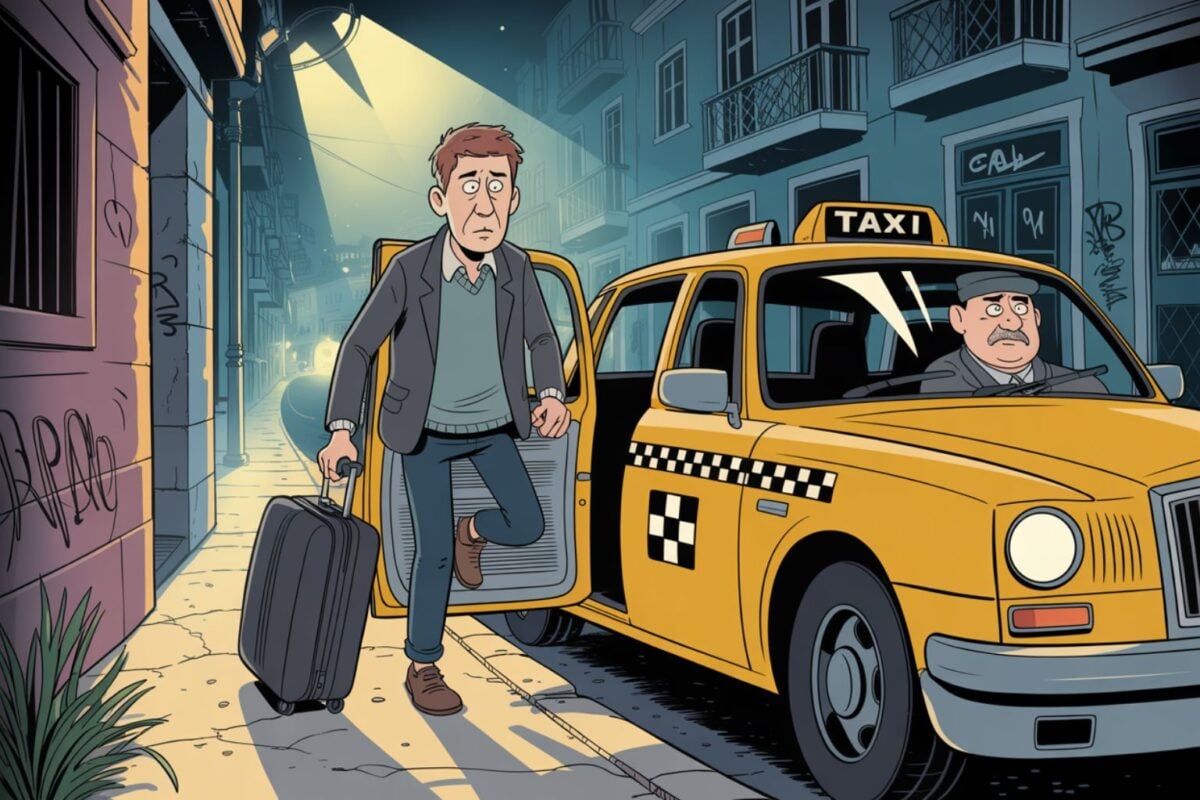
When his cab pulled up to a rental apartment in Lisbon, Walter Meyer knew he was in trouble. The building was crumbling, and the neighborhood looked sketchy. Even his taxi driver — a local who’d probably seen it all — seemed to hesitate before rolling to a stop.
“He didn’t want to let me out,” Meyer recalls. The cabbie offered to wait five minutes, just to make sure Meyer could get inside safely. If things looked too dangerous, he added, Meyer should come out.
Meyer felt he had no choice. He grabbed his luggage and walked toward what looked like the most questionable building he’d encountered in his travels. But what he discovered inside would teach him one of the most important lessons about safety he’d ever learn.
We’ll come back to Meyer’s story in a minute. But first, let’s talk about why stepping outside your hotel or vacation rental requires more than just a charged phone and situational awareness.
I have a tip, it’s not about safety, but it does involve inverse logic that was discussed in the story. I never ask hotel staff for recommendations for places to eat. First of all, there’s always a chance you’ll get touted to someplace that’s paying them off. But, far more likely, you’ll get sent to the boring, safe, no-risk place that they know tourists seem to like, and they know you won’t come back and be unhappy.
On the other hand, I have found that if I ask “Is there any place around here I should avoid?”, I almost always end up in some special place, off the tourist route. For some reason, posing the question in that way seems to immediately open up a personal connection and I have gotten some great recommendations.
Read more insightful reader feedback. See all comments.
What could possibly go wrong?
No two ways about it: When you travel, your accommodations might be located in a so-so part of town. That scenic route to dinner might lead straight through a red-light district. That highly rated café three blocks away? It might sit on the edge of a zone where taxi drivers refuse fares after dark. And those five-star Google reviews? They won’t warn you about the recent uptick in smash-and-grabs targeting tourists.
“You don’t need military training to protect yourself,” says Harding Bush, associate director for security operations at Global Rescue. “Situational awareness is a skill any traveler can build — it’s about being alert to your surroundings, reading subtle cues, and responding quickly when something doesn’t feel right.”
The concierge vs. front desk debate: Who really knows?
When you need local intel, whom should you approach first? The experts I spoke with have strong opinions.
“If you are visiting a locale where safety is a possible concern, it’s best to check with the hotel concierge first, since they are experts on the local area and trained to answer guests’ questions on a variety of topics, including safety and travel-related queries,” says Omar Choudhry, CEO of Comprehensive Security Services, a security consulting firm.
But others argue the front desk staff often provide more candid advice.
“Ask the front desk staff — not just the concierge — for their honest input,” says Mark Theuerl, founder of Max Tactical Firearms. “They often have the most practical, ground-level knowledge of nearby areas and will usually give you the real scoop.”
The truth is, both can be valuable — but for different reasons. Concierges excel at recommending safe walking routes and vetted dining spots, but they’re sometimes restricted from discussing specific crime concerns. Front desk staff, especially those who live locally, often share more unfiltered observations about which blocks to avoid after dark.
“Hotels must be careful about how they share information,” Choudhry explains. This legal caution sometimes means you’ll get sanitized advice rather than street-level reality.
You could also ask someone who usually doesn’t interact with guests, like a member of the housekeeping staff. Housekeepers are not trained to respond to this type of query, but experts say you might receive a thoughtful and candid reply that could be useful.
The Mexico City test: How to ask about safety without being offensive
Martin Weidemann runs a luxury private driver service in Mexico City, where cultural nuance matters as much as street smarts. He’s seen tourists make dangerous mistakes within minutes of leaving their hotels.
“One guest walked out of a luxury hotel and flagged a cab five minutes later — on a street known for kidnappings. No one warned him,” Weidemann recalls.
The key, he’s learned, is asking the right way. “In cultures like Mexico’s, people might avoid talking about crime to not make things uncomfortable. It’s not secrecy — it’s politeness.”
His approach: Frame safety questions as requests for local insight rather than warnings about danger. Instead of “Is this area dangerous?,” try “Where would you recommend walking?” or “What routes do locals use?”
“Ask nicely,” Weidemann advises. “When we pick up clients, we always offer a quick, honest safety rundown without being dramatic. A one-block mistake can ruin a whole trip.”
This cultural sensitivity matters everywhere, not just in Mexico City. A front desk clerk in Denver, a concierge in Paris, or a bellhop in Boston will respond better to curiosity than paranoia.
How technology is changing the safety game — and where it falls short
Technology is transforming how travelers assess risk, but it’s not replacing human insight, it’s supplementing it.
“AI tools like GeoSure or Noonlight can supplement — but not replace — local insight,” explains Daniel Kilburn, founder of Emergency Action Planning, a disaster preparedness and safety consultancy. “Trust but verify with people who live and work there.”
Travel insurance companies also provide security information. For example, World Travel Protection’s mobile app offers features like geo-fenced alerts for risk zones and real-time security updates.
Michael Becker, CEO of GeoSure, sees this evolution happening in real time. His app provides granular, street level safety scores, in over 400,000 cities and neighborhoods worldwide.
“AI contextualization in addition to safety reviews and safety scores, can empower approaches to localized safety understanding,” Becker says. About 80 percent of queries on his platform are related to security, which suggests travelers are often not sure if the place they’re visiting is safe.
The most sophisticated travelers are using a layered approach: apps for baseline data, then human verification for nuance and recent changes.
“AI tools can process thousands of recent traveler reviews, forum posts, and news articles to give a dynamic, constantly updated picture of safety,” explains Tom Abraham, founder of World Travel Index. “They can distinguish between serious crime and the sort of persistent harassment from vendors that never makes it to police reports but definitely affects a traveler’s sense of safety.”
But Abraham learned the limits of technology during eight years of almost constant travel. In Valparaiso, Chile, “a polite local gentleman stopped us and told us to turn right around. He explained that we were heading towards a prison complex, and the surrounding area was not a safe place for foreigners to walk. You’d never know it from a map or from any guidebook.”
The hotel industry’s awkward silence on safety
Most hotels avoid the topic of neighborhood safety entirely. It’s a business decision as much as a legal one. Nobody wants to scare away customers by admitting their property sits in a sketchy area.
But some properties are breaking this silence in smart ways. Liana Waechter, director of sales and marketing for L7 by Lotte in downtown Chicago, takes a balanced approach.
“At check-in, we’ll guide guests toward safer areas and mention which streets to avoid after dark,” she says. “It’s not about scaring anyone, it’s about being a good host.”
The most innovative hotels are providing practical tools. One property near Beverly Hills that Arsen Misakyan of LAXcar often recommends provides guests with a simple map of the surrounding blocks, highlighting places to dine and shop—and noting areas to avoid after 9 p.m.
“It’s not overbearing,” says Misakyan. “It’s smart.”
Even simple warnings make a difference. When Meyer worked as a desk clerk in Venice, California, he noticed four German tourists pooling cash in the parking lot after one paid for their room.
“I went out and suggested that they might want to take this transaction inside one of their rooms,” he says. “In the U.S., at least, it’s not a good idea to ever show that much cash in public.”
The five-question safety assessment
Before you step outside your hotel, ask these questions — either to staff or yourself:
1. If you were walking with your family, where would you go? Where would you avoid?
This frames the question personally, encouraging honest answers rather than liability-conscious responses.
2. What’s changed recently in this neighborhood?
Construction, new businesses, recent incidents — locals know what’s shifting that won’t show up in your research.
3. Where do you personally park/walk when you’re here after dark?
Staff often have different routes for day versus night, and they’re usually happy to share.
4. Are there any local events or situations I should know about?
Festivals, protests, road closures, or even sports games can dramatically change neighborhood dynamics. For example, Chicago is a very different place during Lollapalooza or the Blues Festival.
5. What would you do if you felt unsafe while walking around here?
This reveals escape routes, safe havens, and local resources you might need.
“Security doesn’t begin at your hotel room door — it starts the moment you walk into the lobby,” Bush reminds us. “I scan for red flags, keep my luggage between my feet, and never say my room number aloud. Discretion and awareness are the first steps to staying safe.”
Don’t judge a neighborhood by its appearance
Remember Walter Meyer, standing outside that sketchy building in Lisbon while his taxi driver waited nervously nearby? Here’s what he found when he finally walked through that decrepit-looking door.
“Far from scary, the inside was the most modern, nicest place I stayed in all of Europe,” Meyer recalls. “There were brand new appliances in the kitchen and brand new sheets in the bedroom. I later learned I was the first guest these Airbnb hosts had.”
The building that looked so dangerous from the outside housed a completely renovated, state-of-the-art apartment. Meyer’s hosts were extremely responsive when he messaged them about the neighborhood. When he reached out to local friends in Lisbon, they confirmed what his hosts had told him: the area was just old and scary-looking, not dangerous.
“I did not have a problem there,” Meyer reports.
His experience reveals the fundamental flaw in judging neighborhood safety by appearances, especially in Europe, where cities are hundreds of years old. Exteriors can look filthy while interiors are fully renovated. In the United States, Meyer notes, “some buildings have very nice facades, but inside look like hell, and the opposite can often be true.”
This is exactly why Meyer’s safety strategy focuses on conversations rather than assumptions. “I always ask the desk clerk or Airbnb host or concierge for any cautions they may have about areas to avoid, and most will be honest,” he says.
Those conversations led to his best travel discoveries. In Oaxaca, his Airbnb hosts warned him: “Don’t go south of here after dark.” But they also recommended hidden gems — places to eat that somehow didn’t make the guidebooks. In Venice, Italy, a Russian woman staying in the same building took Meyer to her favorite church, “one that was not listed anywhere that I had seen. It was one of the most beautiful small churches I saw in all of Europe.”
Your safety starts with a conversation
Here’s what Meyer, a frequent traveler and author of the book “If You Weren’t Here, This Would Not Be Happening,” learned in Lisbon: The most dangerous assumption you can make is that appearances tell the whole story.
Google Maps can point you to the best ramen within a 10-minute walk. But it can’t necessarily tell you that the route there passes through what locals call “iPhone Alley” because of frequent muggings. The pictures may show you a well-lit sidewalk. They can’t warn you that the street empties out completely after 9 p.m., when the businesses close.
Meyer’s story teaches us something more nuanced: sometimes trusting your gut isn’t enough. A sketchy-looking building can be safe. A street that looks fine during the day might turn dangerous at night. And even an app, a website or taxi driver might not know the difference.
Hotel staff and safety apps can only tell you so much about a new neighborhood. We want to know how you figure out if an area is safe to explore.
Your voice matters
What you’re saying
Readers shared their own strategies for staying safe in unfamiliar cities, from decoding European architecture to finding the most honest hotel staff members.
-
Looks can be deceiving
Mr. Smith and Tina noted that a crumbling exterior rarely means a neighborhood is dangerous, especially in historic European districts. The Brown Crusader added that a run-down facade usually just points to a lack of historical investment rather than an actual security risk, proving you cannot judge a street by its cover.
-
Finding the honest locals
M.C. Storm argued that concierges often direct guests to boring tourist traps to avoid liability, recommending that travelers talk to housekeepers or night-shift workers instead to get the real scoop. Blues Traveler echoed this skepticism of official sources, noting that even embassy warnings get watered down by diplomatic pressure, making expat forums much more reliable.
-
Trusting your gut over apps
While some travelers use safety apps, Miles Will Save Us All warned that digital scores simply cannot update fast enough during a sudden protest or crisis. Tim agreed, pointing out that local events like a baseball game can completely change a neighborhood’s dynamics in minutes, meaning there is no substitute for your own situational awareness.

Have a question about this story? Tell us what happened — we read every comment.
Join the conversation