

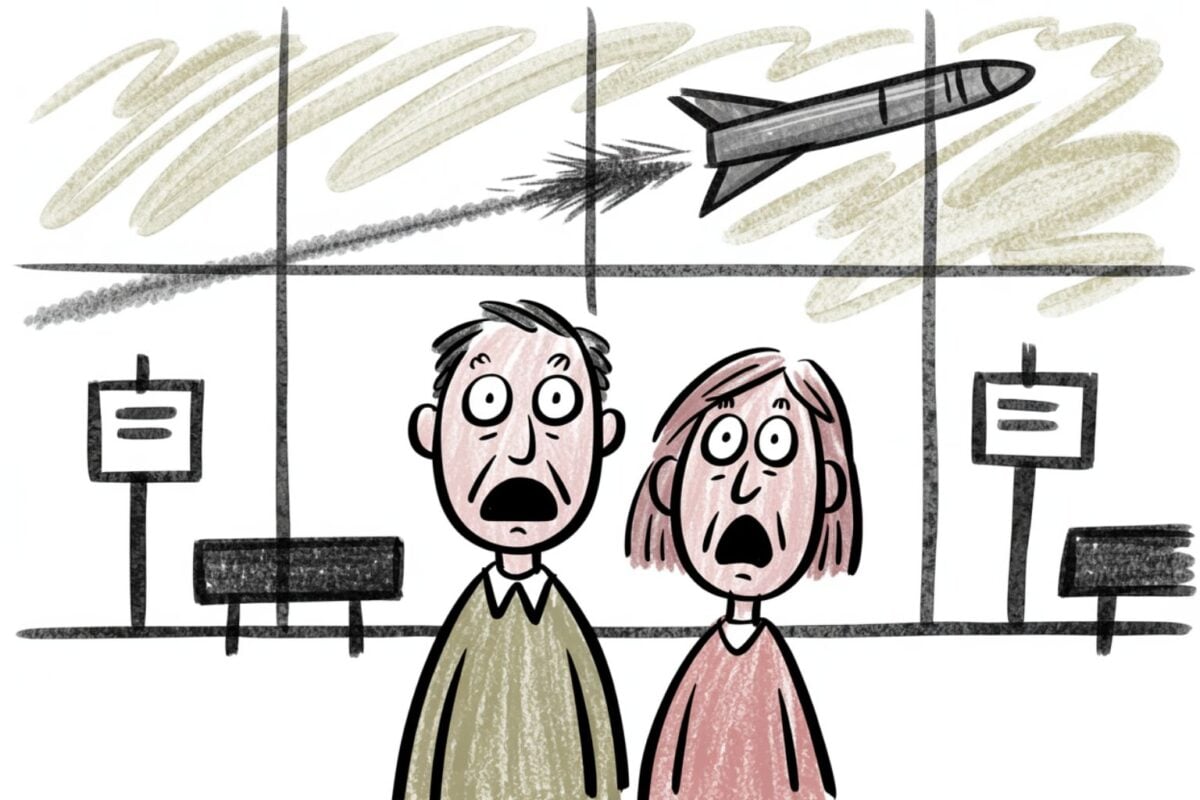

As the war with Iran escalates, hundreds of thousands of travelers have found themselves stuck between closed airspaces and indifferent carrier policies. You might think a global airline would prioritize getting you out of harm’s way, but the reality is much more cynical. Airlines are looking at their bottom line first—not your safety.
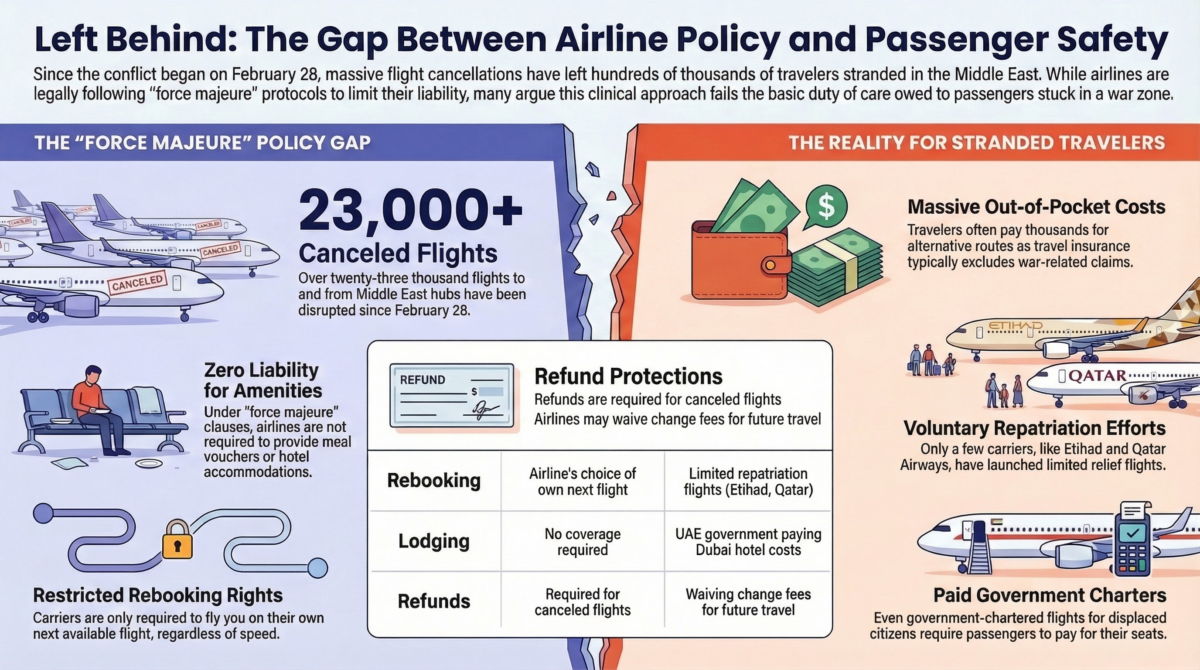
The scale of the disruption is staggering. Since the conflict began on February 28, more than 23,000 flights to and from Middle East hubs have been canceled. Major airports like Dubai International and Doha’s Hamad International have faced repeated closures, leaving passengers to scramble for any available seat.
The State Department’s advice to “depart now” feels hollow when there are no flights available. I’ve been in contact with many readers this week who are frustrated over the orders to leave immediately when they have no way to do so. (Late Thursday, the State Department began chartering flights for displaced Americans. But these are not free flights; you’ll have to pay for them.)
What are the airline policies during war?
Airlines are waiving change fees for travelers who want to postpone their trips to the Middle East. But when a flight gets canceled, the rules are clear: An airline is only required to fly you on a flight of its choosing, not necessarily the one that gets you home the fastest.
The airlines did not start this ill-advised, unnecessary war with Iran, so I don’t think they should be financially responsible for getting people home or feeding or housing them in the interim.
Since it was begun by the Executive Branch of the US government, it should be the responsibility of the USG to feed, house, and transport the people having to evacuate at no cost to them. (Of course, the cost then becomes that of the US taxpayers who should be irate about how our tax dollars are being spent in addition to funding this war.)
Read more insightful reader feedback. See all comments.
In airline parlance, war is a “force majeure” event—an event beyond the airline’s control. That means it doesn’t have to cover any expenses related to the delay. No meal vouchers, no hotel. This even applies to more heavily regulated airlines like those operating in Europe and subject to EC 261, the airline consumer protection law.
Many desperate travelers have paid thousands out of pocket for alternative flights to get home faster. Travel insurance generally doesn’t cover war-related claims, so they have to pay those bills on their own. (Related: Are airline tickets too expensive?)
To be fair, some airlines are offering more. Carriers like Etihad and Emirates have operated limited repatriation flights to help clear the backlog. Qatar Airways also launched relief flights to European cities like London and Berlin to assist those left in the lurch. And the UAE government is paying accommodation costs for stranded passengers in Dubai.
But the bottom line is: Airlines don’t have to do anything except put you on their next available flight, which might be tomorrow, or next week—or never.
Is that enough?
All of this raises a bigger question: Are airlines doing enough? Or are passengers expecting too much?
And a few follow-up questions:
- If you said yes, tell us why. Are you currently stranded or facing massive out-of-pocket costs?
- If you said no, same question. Has an airline gone above and beyond to rebook you?
Do you think the government should mandate that airlines fly passengers out of conflict zones on the first available flight, regardless of the carrier?
My take: I suspect airlines are hiding behind “force majeure” clauses to avoid any real responsibility for the humans they’ve left behind. It’s not enough to offer a refund for a canceled flight when a passenger is stuck in a war zone. The industry needs to provide a lifeline, and if it won’t step up, maybe the government has a bigger role to play in a resolution.
Your turn
What do you think? Is the travel industry failing its most basic duty of care, or are the airlines doing the best they can in an impossible situation? Our comments are open.

Have a question about this story? Tell us what happened — we read every comment.
Join the conversation


What you’re saying
Readers heavily debated who should foot the bill for stranded passengers, with a strong majority arguing that the government—not the airlines—bears the ultimate responsibility for wartime travel disruptions.
Pointing the finger at the government
GradUT, KanExplore, and CasaAlux argued that airlines did not start the conflict and should not have to pay for the fallout. George Schulman and EntAgency added that it is foolish to expect carriers to risk their flight crews and multimillion-dollar aircraft by flying into active war zones, placing the burden of evacuation entirely on the government.
Frustration with airline policies
Despite the physical limitations, some readers criticized how carriers handle the crisis on the ground. Blues Traveler and Miles Will Save Us All condemned the lack of communication and basic human support for stranded travelers. Tina and Dangerous Ideas accused airlines of exploiting “force majeure” clauses to hold passengers’ money hostage with expiring vouchers instead of issuing immediate refunds.
The reality of closed airspace
Pushing back against the airline critics, Berkinet and lostinlodos pointed out the mathematical and physical reality of the situation. With thousands of flights canceled and airports closed, they noted that airlines are losing massive amounts of money on grounded planes and literally cannot fly into restricted airspace, regardless of their customer service policies.