in this case
- Joe Burley buys a mini PC on eBay, but the seller ships it to a completely different address in his zip code to trick the tracking system.
- Despite USPS confirming the delivery wasn’t to him, eBay’s automated system denies his “Money Back Guarantee” claim because the zip code matches.
- Stuck in a loop of automated rejections and vanished appeals, he struggles to find a human at eBay willing to look at the evidence.
Joe Burley buys a mini PC on eBay, but the seller ships his package to another address. When USPS confirms the delivery wasn’t to Burley, eBay denies his refund, citing an exception in its policy. Can he get this sorted out?
Question
I bought a $152 mini PC on eBay for a project. The seller provided tracking showing delivery to my ZIP code, and I was home, but no package arrived. My security cameras proved it, and USPS confirmed the package wasn’t delivered to my address or even addressed to me. In fact, USPS told me the tracking number originated from an Etsy order in Hawaii, suggesting it was a scam.
I made a claim under eBay’s Money Back Guarantee, but eBay denied my claim because their system only checks if tracking shows delivery within the ZIP code — not whether it went to the correct person. The seller exploited this loophole.
eBay auto-closed my case in the seller’s favor, and it removed my negative feedback. I provided USPS’s direct phone line for verification, but eBay refused to call. I spent days calling, chatting, and emailing executives, but eBay continued to ignore me. Even after 23 years as a buyer and seller, eBay left me powerless. Can you help? — Joe Burley, Carlsbad, Calif.
Answer
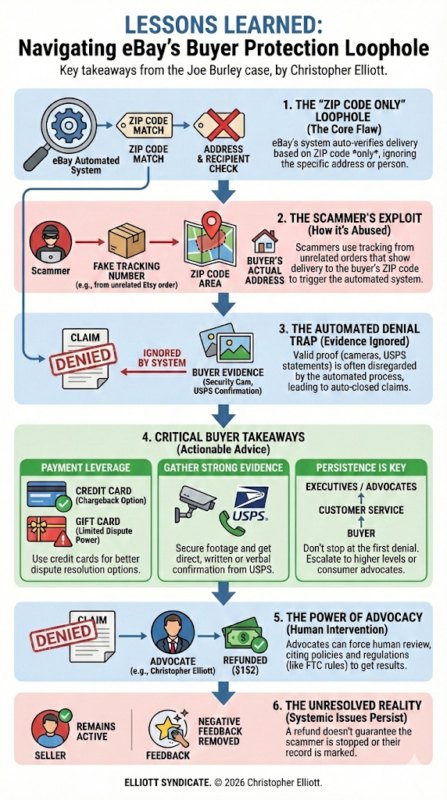
eBay’s Money Back Guarantee policy promises item delivery to the buyer — not just their ZIP code. The guarantee only says the delivery must have “the recipient’s address, showing the zip code (or international equivalent) that matches the one on the order details page.” It says nothing about only checking or verifying the ZIP code in a dispute.
When you provided USPS’s evidence, eBay owed you a human intervention. Federal Trade Commission rules against deceptive business practices require companies to honor advertised guarantees. By almost fully automating its investigation while ignoring USPS’s willingness to cooperate, eBay failed its own policy and basic consumer duty. (Related: StubHub’s FanProtect promise falls flat when I can’t see Jason Bonham.)
I like the way you handled this problem. You had security footage and a USPS validation. You attempted to escalate this within eBay’s system. I see that you split your payment between a gift card ($100) and credit card ($52), which slightly complicated things. When you pay with a gift card, you can’t file a credit card chargeback. For online purchases, I suggest that you use a credit card. It gives you more dispute leverage. (Related: Help! A $1,400 Frigidaire cooktop catastrophe sent me through a customer service maze.)
Once the normal channels have run their course, you still have options. You can escalate your claim, as you did, to one of the eBay executives. I list their names, numbers and email addresses on my consumer advocacy site, Elliott.org.
I reached out to eBay on your behalf. Within days, eBay refunded your $152 without explanation. Unfortunately, the seller remains active, with your negative feedback scrubbed clean.
When I purchase something online from a large organization, such as a national chain with brick-and-mortar stores, their internet store is able to verify my actual address. The fact that eBay won’t do this just adds to my long-held suspicion that there are a good number of fences/scammers selling on eBay and eBay is complicit with them.
Unfortunately, scams exist in every online shopping/selling site that tries to bring disparate buyers and sellers together. Unless the sites are willing to permanently exclude those conducting fraudulent transactions, there is no point in even attempting to use them.
Read more insightful reader feedback. See all comments.
What you’re saying
Readers expressed deep distrust in eBay’s automated protections. Many argued that the “delivered to zip code” standard is a known loophole that facilitates fraud, while others criticized the platform for scrubbing negative feedback, effectively hiding the danger from future victims.
-
The verification gap
BKMatthew noted that major retailers verify exact addresses, yet eBay settles for a zip code match. Tim added that since zip codes cover huge areas, using them as proof of delivery to a specific person is ridiculous.
-
Complicity via censorship
JenniferFinger and Jennifer criticized eBay for removing the buyer’s negative feedback. They argued that by scrubbing the record, the platform not only sided with the scammer but actively helped them trap the next victim.
-
The exodus of long-time users
DeltaDawn and Ben shared similar stories of being burned by “buyer protection” guarantees that failed. Both deleted their accounts after realizing that credit card chargebacks were the only actual safety net available.
Your voice matters
eBay’s automated system closed the case because the tracking zip code matched, ignoring the fact that the package never arrived at the buyer’s actual address.
- Should e-commerce platforms rely entirely on automated bots to decide the outcome of financial disputes?
- Is a “delivered to zip code” status enough proof for a seller to keep your money, or should they have to prove delivery to your specific door?
- Have you ever lost a dispute because of a technicality like a tracking number loophole?

Have a question about this story? Tell us what happened — we read every comment.
Join the conversation