

in this commentary
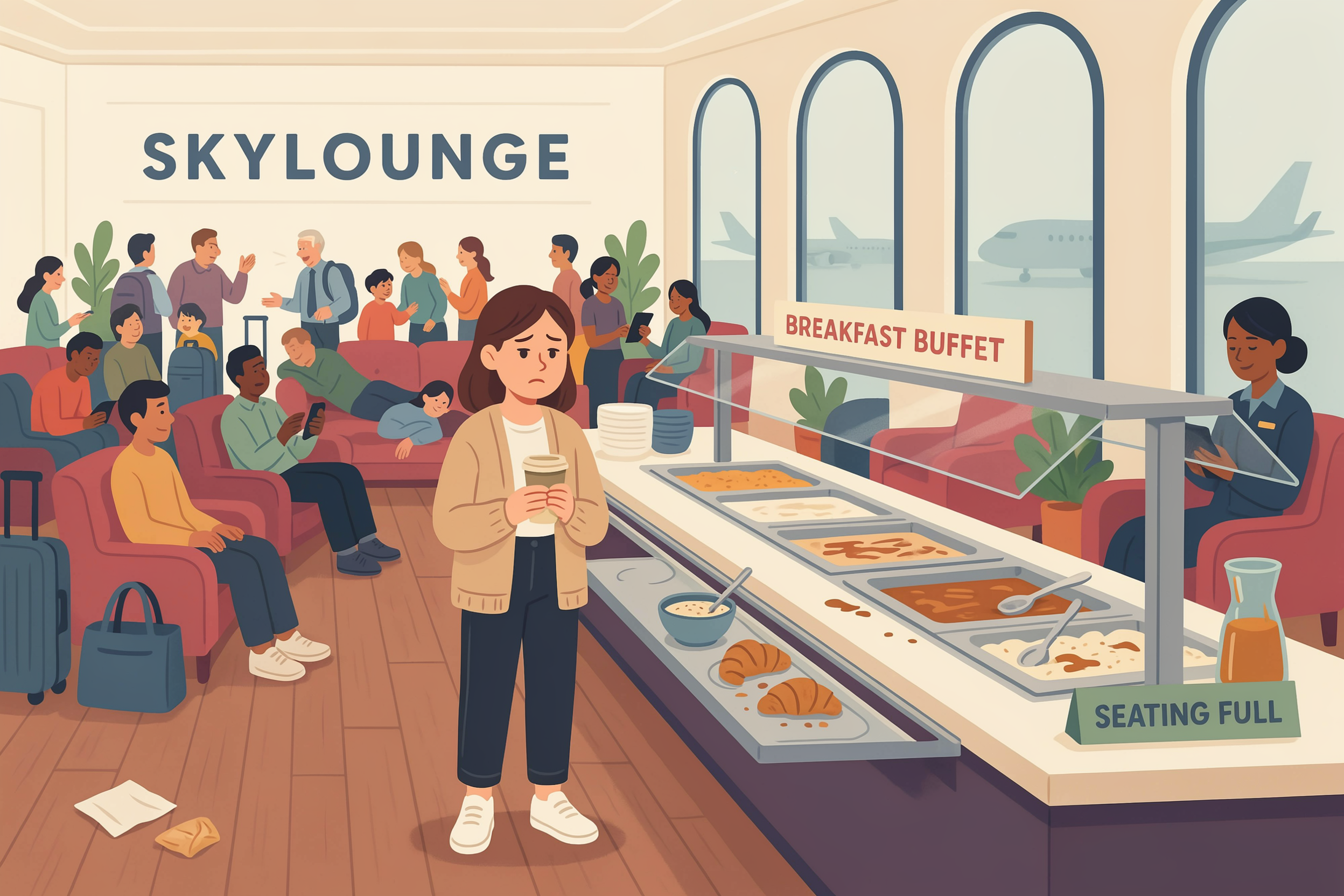
- Karin Kemp thought a four-hour layover was the perfect time to use her lounge pass. Instead she was told to wait, got in half an hour later, and found a picked-over breakfast buffet, if you could call it that.
- The airport lounge has gone from a quiet reward for loyalty to a crowded cafeteria with lines longer than the Starbucks queue, food gone by midmorning, and nowhere to sit.
- There is a clear reason the perk curdled, a real but eye-watering way to buy back true exclusivity, and a handful of tactics that can still rescue the experience if you know them.
The overcrowded airport lounge is no longer a perk. It’s purgatory.
Karin Kemp will tell you why. She had a four-hour stopover in Washington and thought it was the perfect opportunity to use her airport lounge pass.
She was wrong. The lounge was full; an agent ordered her to wait to get in. She finally was admitted half hour later.
“There was barely anything left on the breakfast buffet,” says Kemp, a retired graphic designer from Matthews, N.C. “If you could call it that.”
That’s the lounge letdown. What was once a quiet corner of the terminal—your reward for loyalty or a hefty annual fee—has turned into a cafeteria for the masses. The lines to get in stretch longer than the Starbucks queue. The food runs out by midmorning. Finding a seat requires the sharp elbows of a subway commuter.
Are airport lounges worth it anymore?
Blaming credit cards is easy, but the truth is complicated. Sure, the proliferation of plastic with lounge benefits drove more visitors to the airport lounges. But the slow degradation of air travel contributed, too. Passengers just want a little civility amid the chaos.
“Demand exceeds supply,” says Mike Taylor, an analyst at J.D. Power.
Banks discovered that lounge access drove credit card applications. They paid airlines substantial fees for entry rights. The airlines took the money and sold day passes to anyone with $50.
Capacity did not grow with demand.
“What changed wasn’t just credit card dilution—it was the shift from lounges as a rest space to lounges as a status performance space,” says Maury Blackman, a tech CEO who spent 20 years in constant travel. “People aren’t there to decompress anymore. They’re there to be seen having access, taking Instagram photos of champagne walls.”
The breaking point happened just before the pandemic, Blackman says. Business travelers stopped visiting lounges entirely.
“I’d walk past a packed Priority Pass lounge in SFO and head straight to an empty gate with power outlets,” he says.
Airport lounges seem to have followed the TV model of enshittification. TV was free but had commercials. Cable came and the commercials disappeared with your monthly fee. Then commercials came to cable. Then came premium channels. Then came commercials on the premium channels.
Airport lounges were wonderful, until they weren’t, because there always is money to be made by enshittification. I wonder what will be the next nice thing that gets deteriorated.
Read more insightful reader feedback. See all comments.
Walmart vs. Ritz-Carlton
The resulting product is a hybrid that satisfies no one.
“We used to have a saying in marketing: you can either be the Ritz-Carlton or Walmart, but you can’t be both,” says Danielle Styron, a retired private jet flight attendant and co-author of The Mile High Club: Confessions of a Private Jet Flight Attendant. “Airlines, it seems, have made a choice.”
Styron flew first class coast-to-coast recently. She paid extra for lounge access, only to find lukewarm scrambled eggs and a space that felt like a corporate office break room. On her return, an agent denied her entry entirely.
“The luxurious-experience-renaissance of modern travel is dead,” she says.
She’s right. The lounge letdown is mathematical. The global airport lounges market is projected to grow from $5 billion in 2025 to $20 billion by 2034, according to one estimate. Someone is making money. But it’s clear that customers are paying for gold and getting tin foil.
The $4,850 Solution
If you want real exclusivity, it exists. But you will pay dearly.
PS—formerly The Private Suite—operates private terminals at Atlanta, Dallas and Los Angeles. You check in at a separate entrance, clear TSA in a private screening area, and get driven across the tarmac to your commercial flight. You never set foot in the main terminal.
The Salon option starts at $895 per use. Annual memberships start at $1,250.
“The real solution is to ramp up exclusivity and develop private airport spaces just for the uber-rich,” says Susan Sherren, founder of Couture Trips.
For everyone else, the industry is moving toward a segmented model. High-end lounges will target elite travelers with enforced capacity limits. Everyone else gets the food court with nicer chairs.
How to beat the crowd
If you don’t have $1,250 to spare, you can still salvage the lounge experience. Here’s how:
- Call ahead. Pat George, a frequent flier, avoided a line at the Admirals Club in Miami because a representative called ahead to a second lounge near Gate D15 to confirm there was no wait.
- Pre-book your spot. “I do this as soon as I land,” says Matthew Justice, who runs the site LoungeNerd. Capital One and American Express now allow you to join waitlists via their apps before you arrive at the lounge.
- Scan and scram. If you can’t pre-book, move fast. Ilonka Molijn van Ginkel, a travel advisor, learned the hard way at Heathrow to scan the QR code at the lounge door immediately. “Then we get access within 30 to 60 minutes,” she says.
- Walk the floor. Once you’re inside the lounge, don’t take the first seat you see. “I set my bag in a corner out of the way and then walk the entire lounge,” Justice advises. He often finds hidden seating areas or outdoor patios that the mob missed.
What’s the future of lounge letdown?
Airlines know they have a problem, and they’re trying to fix it. Jeannie Walters, a customer experience expert, notes that lounges are introducing family zones and “quiet” areas where phone use is restricted.
But decoration doesn’t solve density.
“The exclusivity died the moment credit card companies started selling status as a perk,” says Deepak Shukla, founder of the travel agency Pearl Lemon.
It’s true. Credit card companies sold you a dream they can’t deliver, and airlines let them. Now they are figuring out how to take it back without admitting they oversold it in the first place.
If you are standing in line for a “VIP” experience, you are already the victim of the letdown. The lounge is full. Your text message inviting you to the lounge will never arrive. You are better off walking away.
“Much has changed in airport basic amenities,” says Donna Shelton, a banker from Chicago who gave up on the lounge chase. “Internet ports are pretty abundant, food service has improved.”
Shelton has a point. Find a quiet gate, buy a decent coffee, use your noise-canceling headphones. That may be the best way to get a VIP experience these days.
Your voice matters
The lounge that once felt like a reward now often feels like a crowded food court. We would like to hear whether the perk still pays off for you, and how you handle the crowds.
- Has an airport lounge felt worth it lately, or have crowds and picked-over food changed your mind about chasing access?
- What is your go-to move when a lounge is full: wait it out, pre-book or waitlist, or skip it for a quiet gate?
- Would you rather airlines cap lounge entry to protect the experience, or keep open access even if it stays crowded?
What you need to know about airport lounge access
Airport lounges are more crowded than ever, leaving many travelers wondering if the perk is still worth it. Here is what is going on and how to make the most of it.
Why are airport lounges so crowded now?
Demand has outgrown supply. Credit card companies discovered that lounge access drives card applications and paid airlines for entry rights, while airlines also sold day passes widely. Capacity did not grow to match, so the same spaces now serve far more people than they were built for.
Are airport lounges still worth it?
It depends on the lounge, the time of day, and your expectations. Many travelers report long entry lines, food that runs out by midmorning, and a scramble for seats. If you can pre-book or travel off-peak, a lounge can still deliver. If it is packed, the value largely disappears.
Why did lounge access get diluted?
Analysts and frequent travelers point to the spread of credit cards that include lounge benefits, combined with airlines selling broad day-pass access. The result is a hybrid space that tries to be both exclusive and mass-market, which tends to satisfy neither group.
How can I get into a full lounge faster?
Call ahead to check the wait or find a less busy nearby lounge, pre-book or join the waitlist through your card or airline app as soon as you land, and if you cannot reserve, scan in at the door immediately to start the clock. These steps can cut a long wait significantly.
How do I find a seat in a packed lounge?
Do not take the first open seat you see. Set your bag down in an out-of-the-way spot and walk the entire lounge. Frequent flyers say hidden seating areas, quieter back rooms, or outdoor patios are often overlooked by the crowd near the entrance.
Are there private alternatives to crowded lounges?
Yes, but they are expensive. Private terminal services let you check in at a separate entrance, clear screening privately, and reach your flight without entering the main terminal. Pricing typically runs from several hundred dollars per use to annual memberships in the four figures, so it is realistic only for a small group of travelers.
What if I just skip the lounge entirely?
That is often a reasonable call. Many airports now have abundant power outlets and improved food options, so a quiet gate, a good coffee, and noise-canceling headphones can rival a crowded lounge. For more trip-planning help, see our consumer guides for smarter travelers.