
in this commentary
- Wellington, New Zealand’s capital, is trying to become the world’s first zero-waste capital, and it is doing it in a way most visitors never notice. From a kitchen that turns food bound for the landfill into three-course meals to hotels that have quietly swapped single-use plastics for refills, the city has become a living laboratory for sustainable travel.
- Behind it sits a deliberate framework, a city climate program, refill-and-deposit systems, a community reuse hub, and a national museum that folds zero-waste principles into daily operations. The pitch is that being green can also be good business, and that travelers are part of the equation.
- This piece explores how a visitor can actually experience Wellington’s circular economy, where to eat, where to stay, and what to look for, and asks whether a compact, cooperative city like this one could become a blueprint for others.
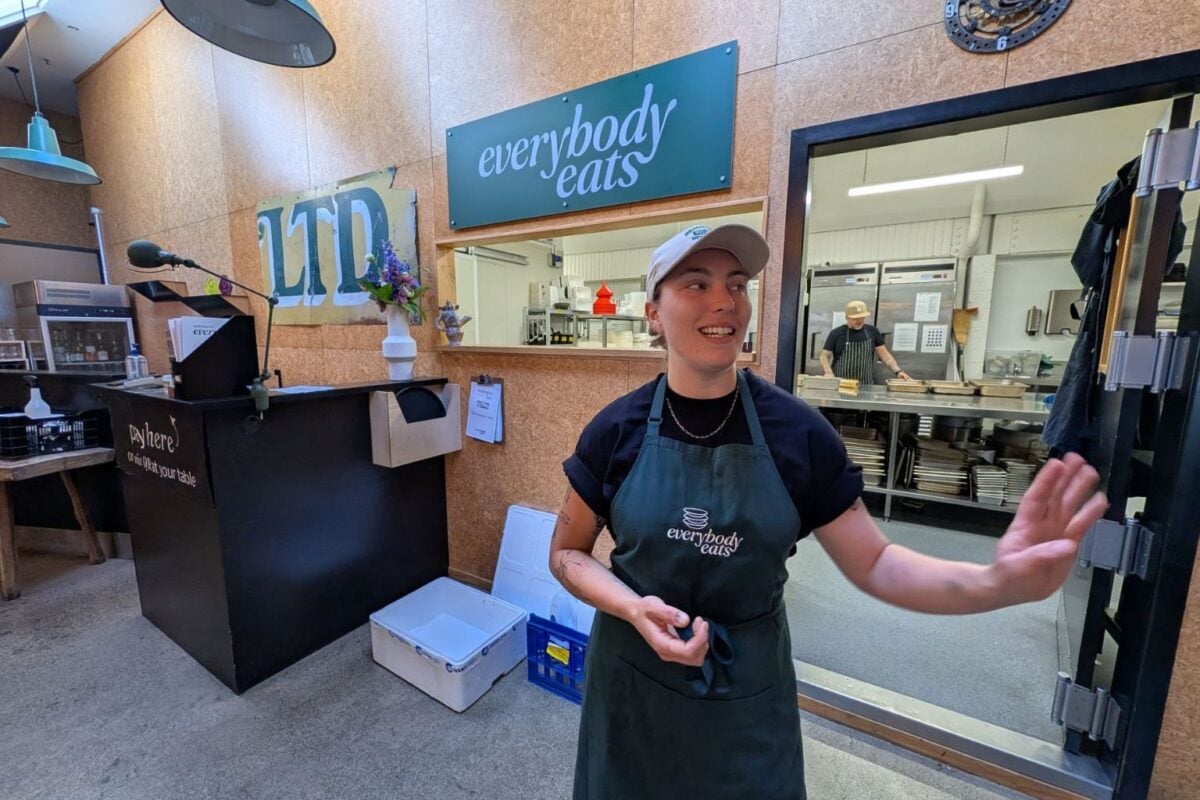
Inside a frenetic kitchen on Dixon Street, Harri Fletcher is turning trash into three-course meals. Fletcher, the head chef at Everybody Eats in Wellington, New Zealand, is part of a culinary experiment in extreme food waste reduction.
On a typical night, she serves up to 180 guests who dine on food that was destined for a landfill.
“We’re trying to prove that you can take what others consider waste and create something beautiful and nourishing,” Fletcher says. “It’s about changing how people see food—and each other.”
While the machinery of Wellington’s circular economy often hums quietly behind the scenes, Fletcher’s kitchen is where things get real. To visit New Zealand’s capital now is to enter a living laboratory for the future of sustainable travel. It’s a place where being green means reducing waste, saving energy and cutting emissions—often without anyone knowing.
Fletcher makes ricotta from milk reaching its best-before date, then uses the leftover whey for lemon and white sorbet. She chars vegetable peelings for salads, turns them into stock, or fries them into crisps. Her banana sugar—made by dehydrating peels into a powder mixed with icing sugar—displays a high level of technical resourcefulness.
Everybody Eats operates on a pay-as-you-can model. It’s a social dining concept that allows a homeless person to sit next to the prime minister, both sharing a gourmet meal. About half of the customers pay for their food, helping to sustain the operation alongside catering events like climate conferences. Supported by food rescue organizations like Kaibosh and Kiwi Community Assistance, the initiative has saved 418,000 pounds of food from going to waste, according to Fletcher.

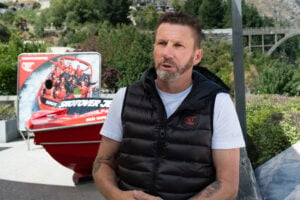
Chris Sperring, WellingtonNZ’s destination development project manager, gives a presentation on sustainability in Wellington.
The circular economics of the capital
Wellington’s success results from a calculated economic framework. The city operates under an ambitious program called Te Atakura – First to Zero, which sets targets for waste reduction. As regional landfill fees increase, local businesses find that saving waste is also a way to save money.
“Often a zero-waste business model is more economical than the alternative,” says Lizzie Horvitz, a sustainability expert and the founder of Finch, a product review site that focuses on sustainability. Places like Wellington are shifting from single sale to a repeat refill mode, from hotels to restaurants. And visitors to New Zealand are noticing.
There’s plenty to notice.
- The Lo-Carb Programme. (That’s carb as in “carbon.”) It’s a collaborative initiative led by WellingtonNZ and Hospitality NZ that provides resources to help local restaurants like Graze Wine Bar, Karaka Café, and Food Envy reduce costs. In these restaurants, converting food scraps and coffee grounds into compost can reduce waste fees by 40 percent and add up to 5 percent to monthly profits.
- Refill-and-deposit infrastructure: The city has normalized a repeat refill mindset through systems like Again Again and Cupcycling, which treat packaging as a reusable asset. This extends to the hospitality sector, where hotels in the Te Aro neighborhood have replaced single-use plastics with large refillable amenities.
- The Te Aro zero waste hub. This community center serves as a physical headquarters for the reuse economy, offering residents and businesses services for the repair and recycling of items ranging from electronics to textiles.
“We are responding to a clear need from our tourism and hospitality businesses who want to actively reduce emissions through things such as waste reduction and to monitor their carbon footprint,” says Chris Sperring, WellingtonNZ’s destination development project manager.
He says Wellington has doubled down on helping businesses decarbonize and contribute to the city’s climate goal to become net zero by 2050.
“We can achieve this whilst also helping businesses to identify ways to cut business costs and ultimately save money,” he says.
New Zealand, with its geographical isolation, has the “#8 wire mentality.” Creative innovation and thinking has long been a part of kiwi life. I used to live in Nelson at the top of NZ’s South Island. There was a great second hand store at the trash depot full of things discarded in the trash and in good condition, books, furniture, frames, dishes, silver, toys, a bit of everything. It was a nice way to upcycle things destined for a landfill. NZ works hard to be sustainable and green.
Read more insightful reader feedback. See all comments.
A zero waste national museum
At Te Papa, New Zealand’s national museum, zero-waste principles are folded into daily operations and public education. The institution maintains a rigorous sustainability policy. Last year, the museum donated approximately 1,700 food items from its café and venue operations to local communities through a partnership with Kaibosh Food Rescue, effectively diverting potential waste from landfills.
For visitors, this institutional mission is most apparent in the Te Taiao nature exhibition, a space that highlights research into climate change and materials science. The exhibit acts as a bridge between high-level science and public action, showing how new materials can reshape our world.
“Empowering New Zealanders to care for, protect, and restore Aotearoa’s environment and biodiversity is at the heart of what we do here, and exhibitions like this highlight ways to support a more sustainable future”, says Courtney Johnston, Te Papa’s chief executive.
The museum manages its physical impact with the same precision it applies to its collections. By integrating waste reduction into its functional framework, Te Papa has moved toward active resource recovery. These efforts suggest that even the largest cultural landmarks can function as lean, waste-conscious entities. The museum has become a quiet cornerstone for the city’s broader zero-waste identity.
Will visitors notice any of this?
For most travelers, the most successful zero-waste initiatives are the ones they never actually see. Wellington’s hospitality sector operates on the principle that sustainability should enhance a guest’s stay. At accommodations like those managed by the Village Accommodation Group, for example, the green initiatives happen behind the scenes. Guests enjoy the high-end amenities they expect while the hotel manages complex logistics in the shadows.
It’s more an issue of what’s absent. Hotels in the Te Aro neighborhood have moved away from single-use plastics, replacing them with large refill bottles and glass water containers. Some properties provide inconspicuous compost bins in guest rooms. These changes allow travelers to reduce their carbon footprint within the hotel.
“Wellington has done an impressive job of embedding zero-waste principles into its tourism infrastructure, making it much easier for visitors to travel responsibly,” says Lorena Basualdo, a luxury travel advisor.
Basualdo notes that because these circular practices are integrated into everyday life, the experience is seamless rather than burdensome.
Perfection is “nearly impossible”
A short walk from the central city, Max Gordy runs Graze Wine Bar with a perspective he describes as realist. While many luxury brands claim to be zero-waste, Gordy points out that perfection is “nearly impossible” in a commercial kitchen. Instead, he focuses on cutting waste by working with suppliers to reduce their packaging or transition to recyclable packaging.
Gordy, who moved to Wellington from Chicago at 14, finds the local hospitality scene cooperative. In Chicago’s Michelin-starred kitchens, he saw a constant, competitive hustle. In Wellington, chefs share information about local suppliers freely.
At Graze, the menu follows the seasons and Gordy’s direct relationships with suppliers. He avoids meat, opting for fish caught by spear fishermen who supply exactly what’s needed. This ensures they never take more than the demand requires. Gordy also notes that New Zealanders typically avoid the takeaway culture common in the United States. Customers generally order only what they can finish, which naturally reduces the need for disposable containers.
Gordy views this collaborative, waste-conscious culture as a natural evolution for the city.
“In other places, it’s all about the individual ego and the secret supplier,” Gordy says. “But here, we realize that if we all share our knowledge and cut our waste, the whole city becomes a better destination. We’re not competing to be the greenest. We’re working together to make sure there’s still a beautiful place left to cook in.”
A blueprint for global cities?
Wellington is trying to prove that a city transitions to a circular economy when policy, business, and community interests align. Tourists play an important part. Experts say they can choose hotels that refill, use public transport, and patronize businesses that make their waste metrics public.
Responsible travel expert Alyse Race says a visit to Wellington is an endorsement in and of itself—and an example to other cities.
“Within minutes you can be everywhere you need to be, with cafés, shops and your hotel packed close together,” she says. “Walk the same streets, and you’ll see places where people can refill pantry staples and household products directly into their own jars. In a place where everything is experienced as everyday and functional, waste is cut as a matter of course.”
Wellington is well on its way to becoming an essential destination for any traveler who cares about the environment. While much of the zero-waste machinery hums quietly behind the scenes, you’ll feel its presence in the streets you walk and the meals you share. You might not always see zero-waste in action, but you’ll leave with a clear conscience, knowing your visit supported a city that has embraced a circular economy.
Wellington is betting that sustainable travel works best when you barely notice it. We would love to hear how you think about greener trips.
Your voice matters
Visiting Wellington’s zero-waste scene: what to know
New Zealand’s capital has woven sustainability into everyday travel. Here is what curious visitors ask most.
Wellington is pursuing a citywide circular economy, aiming to reduce waste, save energy, and cut emissions across its hospitality and cultural sectors. It runs a formal climate program with waste-reduction targets, and much of the effort is designed to work quietly in the background so visitors benefit without extra effort. Everybody Eats is a pay-as-you-can restaurant in Wellington that turns rescued food, ingredients otherwise bound for the landfill, into three-course meals. It runs as a social dining concept where guests pay what they can, and it is open to visitors who want to experience food-rescue dining firsthand. Experts suggest choosing hotels that use refill systems rather than single-use plastics, using public transport, walking the compact city center, and supporting businesses that make their waste metrics public. Because Wellington is walkable, cafes, shops, and hotels are packed close together, which makes low-impact travel easy. Beyond Everybody Eats, the article highlights restaurants and wine bars taking part in local sustainability programs, a community reuse hub in the Te Aro neighborhood offering repair and recycling, and Te Papa, the national museum, which folds zero-waste practices into its operations and public exhibitions. According to travel advisors quoted in the piece, not really. The idea is that sustainability should enhance a guest’s stay rather than burden it. Many green practices happen behind the scenes, so the experience feels seamless, and what you mostly notice is the absence of single-use plastics rather than any inconvenience. Not perfectly. One Wellington restaurateur in the article describes perfection as nearly impossible in a commercial kitchen, and focuses instead on practical steps like reducing supplier packaging and following the seasons. The takeaway is that meaningful progress, not perfection, is the realistic goal. Wellington is a year-round destination, and its walkable core makes it easy to explore in any season. New Zealand’s seasons are opposite the Northern Hemisphere’s, so plan around the experiences you want and check current conditions before you go. For more travel features, see Elliott Advocacy’s travel coverage.What makes Wellington a zero-waste destination?
What is Everybody Eats and can visitors go?
How can I travel more sustainably while I am there?
What sustainable places can I actually visit?
Is a “zero-waste” trip going to feel restrictive?
Is a fully zero-waste business realistic?
When is the best time to plan a trip?

Have a question about this story? Tell us what happened — we read every comment.
Join the conversation