
in this commentary
- To understand how a Christchurch convention center earned a carbon zero certification, you have to meet Oscar.
- Oscar sits in the back of house at Te Pae Christchurch, a building that opened in 2022 as the cornerstone of the city’s rebuild.
- A look at how a city rebuilt from rubble became one of the most sustainable destinations in the southern hemisphere.
To understand how Te Pae Christchurch became a carbon zero certified convention center, you need to meet Oscar.
Oscar is about the size of a commercial dryer, but instead of laundry, he dries hundreds of pounds of food waste in a 30-hour cycle. He heats, mixes, and shreds food scraps to remove moisture, and then converts them into a dry, odor-free, nutrient-rich fertilizer.
“The food goes in and it comes out as something that looks like coffee grounds,” explains Gillian Officer, the center’s director of business development.
The two make an unlikely pair in the convention center’s back-of-house area. Oscar is a rugged, industrial-looking machine, a large gray box with a heavy lid and caution stickers that hint at the heavy lifting it does behind the scenes. Beside him, Officer—looking sharp in a light-colored linen blazer—leans against him with a familiar pride.
A green pivot from the bottom up
Oscar might not be quietly grinding away behind the scenes in a dark room, nor would Te Pae Christchurch be a certified Toitū carbon zero operation – believed to be the first convention center in the world to achieve such a rating—if it weren’t for a shift that started from the bottom up after the devastating earthquakes of 2010 and 2011.
Te Pae is a Māori phrase that means “gathering place,” and its opening in 2022 was the cornerstone of the city’s rebuilding efforts. Nearly half the staff is under the age of 24, and this younger workforce accelerates the building’s sustainability mission, according to Officer. It’s a phenomenon happening across the city, and it’s turning Christchurch into one of the most sustainable destinations in the southern hemisphere.
“Sustainability is important to us,” explains Kath Low, head of destination at ChristchurchNZ, the city’s economic development agency. This ethos is visible everywhere. It matches the progress at Christchurch Airport, which made headlines for slashing its operational emissions by 92 percent and becoming the first in the world to reach the highest level of international carbon accreditation.
While the airport tackles the technical hurdles of green aviation and solar parks, Te Pae handles the footprint of the people those planes bring in.
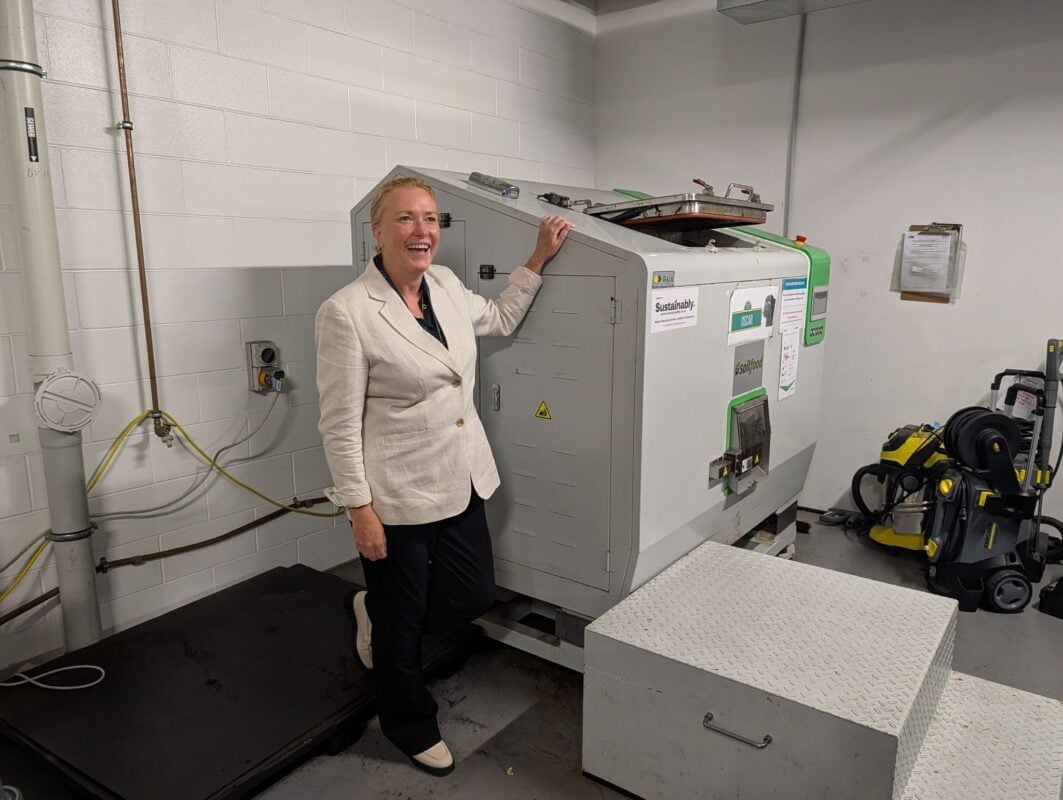
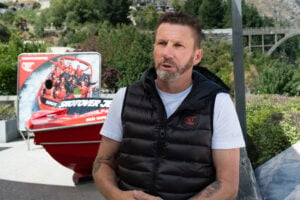
Gillian Officer and Oscar, a machine that processes Te Pae Christchurch’s food waste. (Photo by Aren Elliott)
How Te Pae became a net carbon zero operation
Officer remembers the moment when the convention center pivoted to a sustainability mission. A young staffer nicknamed the “Bin Chicken” spent her shifts meticulously auditing the facility’s waste, ensuring every scrap ended up in the correct recycler. Her obsessive attention to detail pushed the business to look deeper at its own systems.
“It starts with something as small as that,” Officer says, “and next thing you know, we’re going down the whole track of being a carbon net zero operation.”
Today, that commitment is baked into the facility’s daily logistics. International trade shows are notorious for using miles of single-use plastic carpeting that is tossed into a landfill after 48 hours. Te Pae ended that cycle by installing permanent, high-quality carpeting throughout its 35,000 square feet of exhibition space. The choice has a lingering sensory reward, too. Officer notes the building still retains a distinct “new car” fragrance, a fresh-fiber scent that anchors the center’s modern, clean identity.
Even the coffee you drink at a conference here is part of the system. The center switched to a local milk keg system that keeps around 2,500 plastic milk bottles out of the trash every year.
“People want to come to a place where they know the environment is being looked after,” Officer says. “They don’t want to feel like they’re contributing to a problem.”
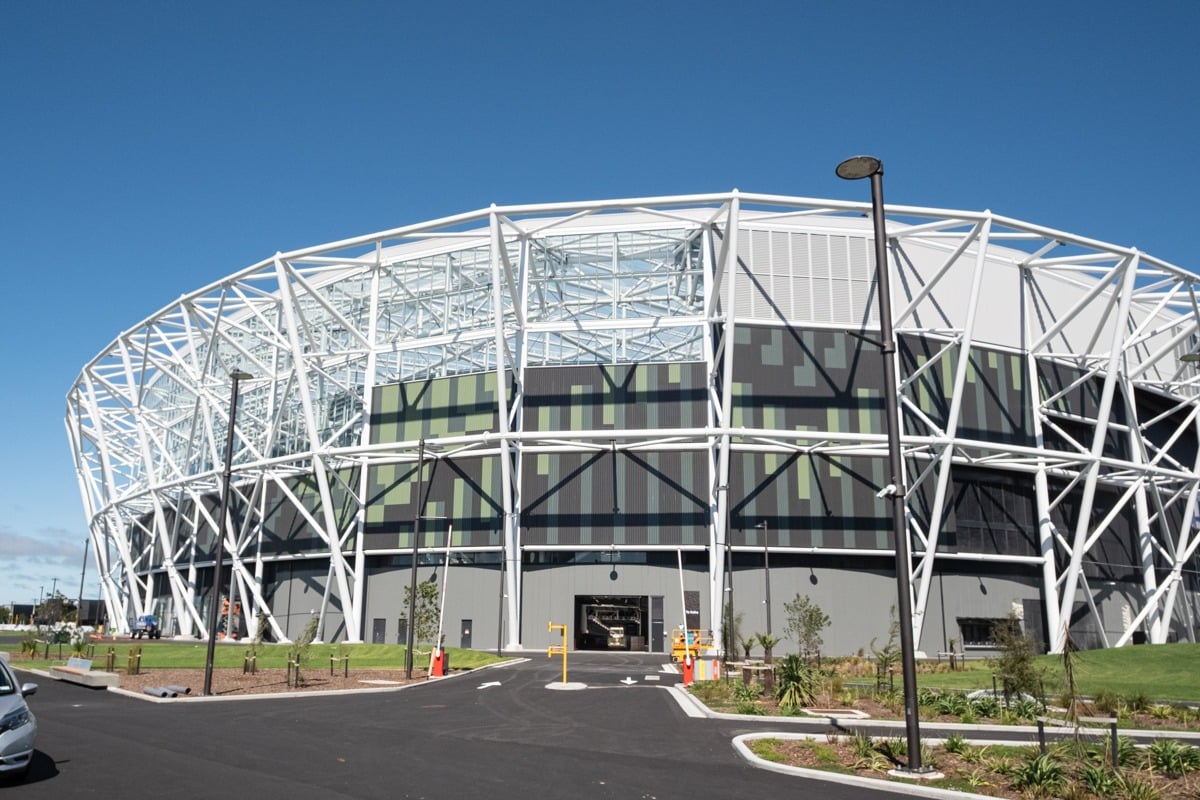
One New Zealand Stadium at Te Kaha, which opened in April, is New Zealand’s most sustainable stadium. (Photo by Aren Elliott)
Sustainability is built into a new city
The intentionality at the convention center is a reflection of a city that was forced to reinvent itself after the 2011 earthquake. One-third of Christchurch’s buildings were lost in the earthquake, which gave the city an opportunity to rebuild itself according to 21st century standards. Sustainability is key.
The result is a compact city center focused on walking and biking first.
“We’ve got a modern city,” Low says. “Sustainability is a big part of it, and it’s part of our future.”
Visitors find that enjoyment in the wide sidewalks, the energy-smart design of the Tūranga Library, and the “Red Zone”—once a residential area hit hard by the quakes, now being converted into a massive green space of wetlands and native forest.
Travel expert Jiayi Wang notes that this design ensures guests interact with the local ecosystem in a way that is “more knowledgeable and more respectful.” In Christchurch, there’s no need to be a sustainable traveler; the city’s infrastructure handles it for you.
You can see the transformation happening in Christchurch even today. Walk past Hagley Park, one of the most impressive urban green spaces in the southern hemisphere, and into the city. Nearby, the One New Zealand Stadium at Te Kaha is rising from the dust. When it opened in April, it became the country’s greenest sporting arena, capped with a fully enclosed roof and 215,000 square feet of vegetation designed to slash carbon emissions by 17 percent.
Great article, Chris! Christchurch’s earthquakes were truly devastating. So much of the city, its buildings and history, was destroyed, and the city was left stunned. I am pleased to read how Christchurch just did not rebuild and replace what was lost, but put thought and innovation into building for the future. New Zealand has always worked to be clean and green. Christchurch is showing how clean and green can even rise from rubble and sorrow.
Read more insightful reader feedback. See all comments.
What Oscar means to Christchurch
The sensory experience of Te Pae is one of intentional contrasts. While the interior retains that pristine new carpet smell, the exterior tells a story of the Canterbury Plains.
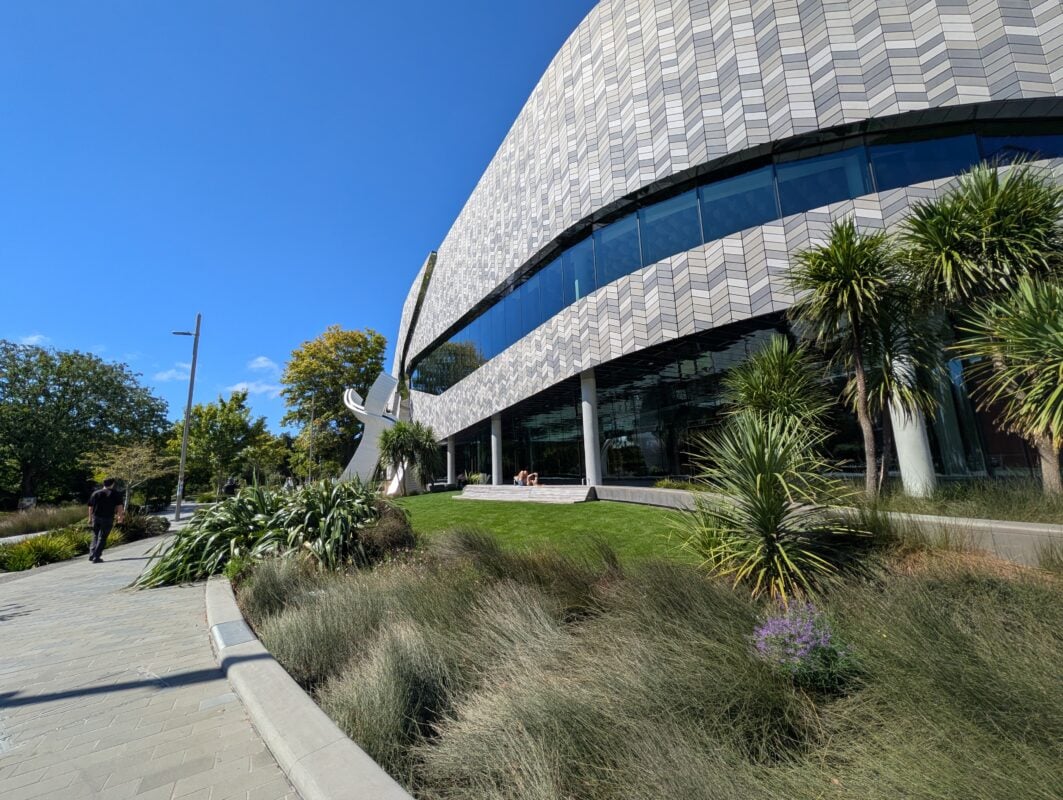
The facade is a tactile, river-contoured skin made of 43,000 tiles. Their curves and shades of gray are inspired by the region’s braided rivers, and they make the massive structure feel less like a block of concrete and more like a shimmering extension of the Avon River.
As skies darken over the city, the lights at Te Pae begin to glow against the tiles. The delegates are gone, but the work continues. In a dark room, Oscar is still there, humming through his 30-hour cycle.
He is quiet, a little grumpy-looking in his industrial gray metal coat, and entirely indifferent to the accolades the building receives. But as he churns through the day’s leftovers, he represents the unglamorous, essential future of travel. In a city that has seen the worst of nature’s power, Oscar proves that the best way to rebuild a world is one carefully sorted, carbon-neutral scrap at a time.
Christchurch is betting that the best sustainability is the kind you never notice. We would like to hear how you see it.
Your voice matters
Visiting Christchurch: the greener city, and what to see
A city rebuilt after disaster has become a case study in low-impact travel. Here is what curious visitors ask most.
Because it had to be rebuilt. The earthquakes of 2010 and 2011 destroyed roughly a third of the city’s buildings, and the reconstruction was planned around modern standards: a compact central city designed for walking and cycling, energy-conscious public buildings, and large areas of restored green space. Much of the environmental work is built into the infrastructure rather than left to visitors. It is the city’s convention center, opened in 2022 as a cornerstone of the rebuild, and it holds a Toitū carbon zero certification. Te Pae is a Māori phrase meaning gathering place. Behind the scenes the building runs a food-waste processing system, uses permanent exhibition carpeting instead of the single-use plastic carpet common at trade shows, and has switched to a local milk keg system to cut plastic bottle waste. Oscar is the convention center’s food-waste processor, roughly the size of a commercial dryer. Over a 30-hour cycle it heats, mixes, and shreds food scraps to drive off moisture, turning them into a dry, odor-free, nutrient-rich fertilizer that staff describe as looking like coffee grounds. It is a good illustration of how most of this work is invisible to guests. Unusually so for an airport. It began tracking its emissions in 2006, was the first airport in the world to reach Level 4 of the international Airport Carbon Accreditation programme in 2020, and in 2023 was among the first group of airports globally to reach the programme’s highest level, the first in the southern hemisphere to do so. It has cut its own operational emissions dramatically and is developing a large solar project nearby. Hagley Park, one of the largest urban green spaces in the southern hemisphere, sits right beside the central city. The Tūranga library is worth a look for its design. The former residential red zone, hard hit by the quakes, is being converted into wetlands and native forest. Te Pae itself is striking from the outside, with a tiled facade whose curves and grays echo the braided rivers of the Canterbury Plains. Yes. One New Zealand Stadium at Te Kaha, the last of the major post-earthquake rebuild projects, was formally opened in late March 2026 and hosted its first sporting events in April. It is fully roofed, and its design includes extensive planting intended to reduce the building’s carbon footprint. Not really, which is the point that experts quoted in the article make. Because the low-impact choices are built into the city’s layout and its buildings, a visitor walking the compact center is already traveling lightly without having to plan for it. For more travel coverage, see Elliott Advocacy.Why is Christchurch considered a sustainable destination?
What is Te Pae Christchurch?
What is the story with the machine called Oscar?
How green is Christchurch Airport?
What should a visitor actually go and see?
Is the new stadium open?
Do I need to do anything differently as a traveler?

Have a question about this story? Tell us what happened — we read every comment.
Join the conversation