
in this commentary
- The FBI marked the start of summer with a public service announcement urging cruise passengers who are assaulted or otherwise victimized at sea to report the crime right away. Sound advice, as far as it goes.
- What the announcement leaves out is what happens next. The 2010 law meant to track crime at sea only counts a narrow slice of what occurs, generally reaches incidents involving U.S. nationals, sets a dollar floor on thefts, and leaves a key term like “serious bodily injury” undefined, a judgment call left to the company with the most at stake.
- The FBI tells passengers to report incidents to the cruise line, and the cruise line reports to the government. This commentary examines what that arrangement produces, why so few people report at all, and whether the resulting statistics tell travelers anything true about safety at sea.
The FBI has a message for you: As summer vacation season kicks off, cruise passengers who are assaulted, kidnapped or sexually assaulted at sea should report the crime right away.
That’s the gist of a public service announcement the agency posted to its social media account recently. It’s good advice—of course you should report a crime.
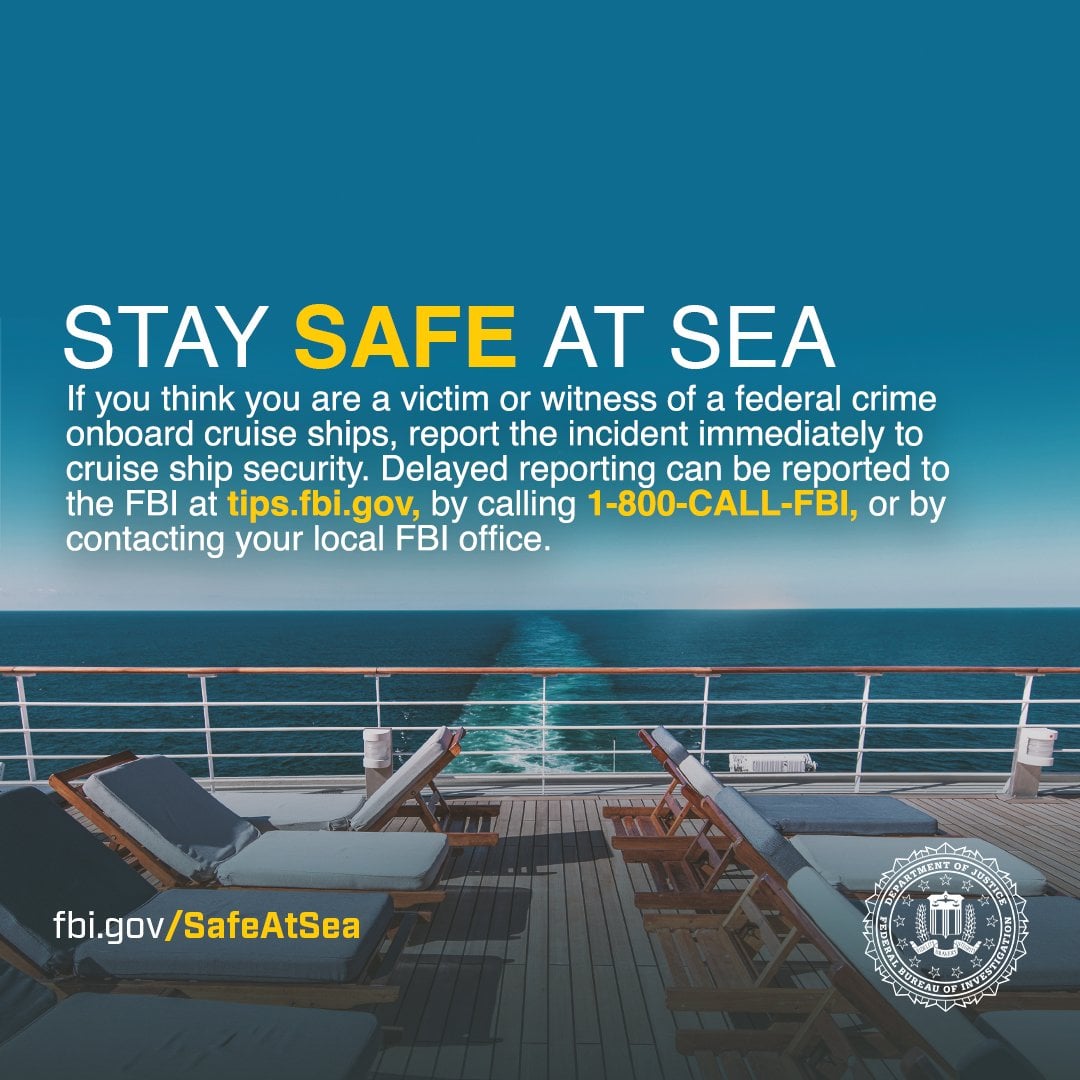
But the FBI left out one teensy detail. Once you say something, chances are nobody outside a windowless federal office will ever know it happened.
Here’s what the government won’t put on a beach-chair graphic on social media: The law that’s supposed to track crime at sea is engineered to make cruising look safer than it is. It lets the accused company act as a gatekeeper for complaints, counts just a sliver of what happens, and whitewashes the details in a generic, anonymized report.
How the cruise industry’s numbers distort the truth about safety
The Cruise Lines International Association, the cruise industry’s trade group, claims cruising is one of the safest vacations in the world. And the federal data seems to agree.
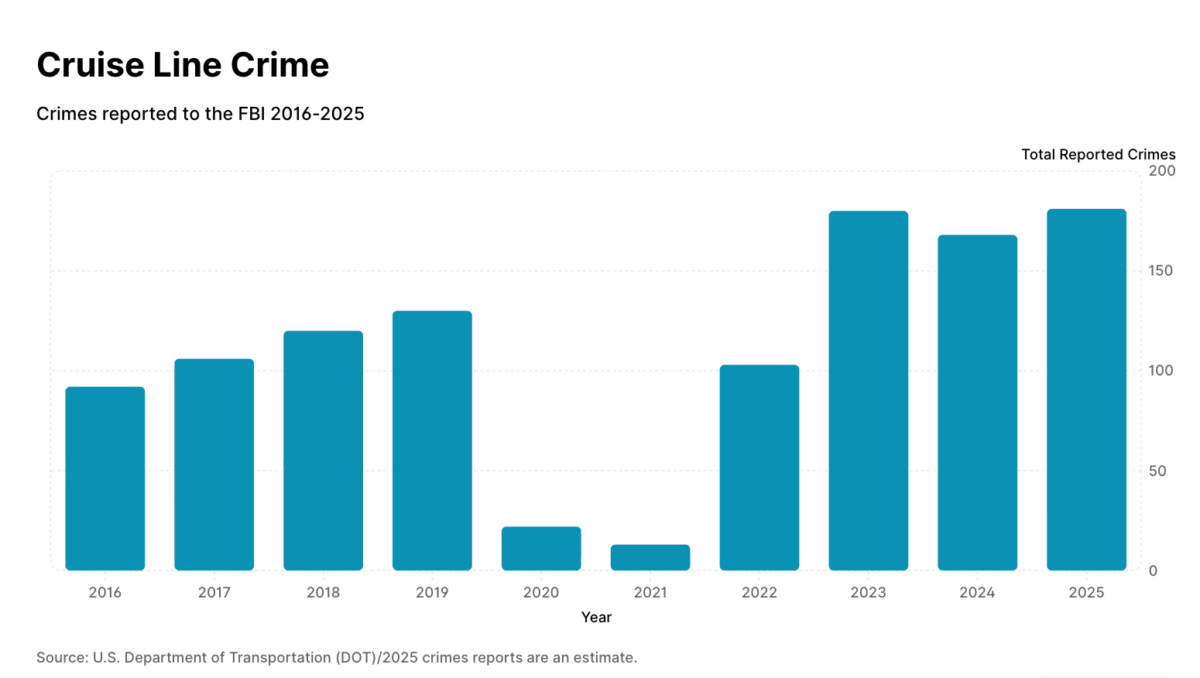
The Department of Transportation posts a quarterly report under the Cruise Vessel Security and Safety Act, the 2010 law that governs this. It logged just one homicide, one suspicious death and zero kidnappings for all of 2025. The first quarter of this year is also squeaky clean.
Feel safer already? Maybe you shouldn’t.
The data exclude any crime in which the victim isn’t a U.S. citizen, which wipes out nearly every crew member and plenty of passengers. It reports only a short list of the most serious categories. For example, thefts must exceed $10,000 in value to be reportable.
There are other loopholes. Cruise lines must report a physical assault only if it causes “serious bodily injury,” and the law never defines the term. So a beating becomes a judgment call, made by the company with the most to lose.
If a crime is committed on board, report it to the cruise line and whatever authority covers the crime if at sea. The cruise line has no incentive to report crimes and an incentive to underreport crimes. Self monitoring has never proved to be successful for the purpose it was enacted.
Read more insightful reader feedback. See all comments.
Is the fox taking inventory of the henhouse?
The FBI is urging passengers to report incidents directly to the cruise line while they’re at sea. But that’s problematic, because the cruise lines then report the crimes to the government.
Let’s think about that arrangement for a moment. A company sells you a “safe” vacation. Then that same company decides whether the thing that happened to you counts as a crime worth reporting. It’s like letting a restaurant grade its own health inspection, and then acting surprised when it gets an A.
The numbers hint at how well that works out. For the last quarter of 2025, for example, Carnival reported only three crimes across its entire fleet of 29 ships. The company’s tally was its lowest since the pandemic shut the industry down. But attorneys who track these cases found at least five reportable crimes on Carnival ships in that same window, including assaults that sent passengers to the hospital.
Do you really believe there were only three serious crimes on a fleet of cruise ships in a three-month period? Neither do I.
The real reason no one is reporting these crimes at sea
The problem isn’t entirely selective reporting or a complicit federal government. It’s the cruise experience itself.
Imagine you’re far from home, in an unfamiliar place, often after a few drinks the ship was delighted to sell you. You can’t call 911 after an incident. The security officer taking your statement works for the company you might one day sue. Witnesses scatter to different hometowns the moment the ship docks. And thanks to the fine print you accepted when you clicked “book,” most disputes get funneled into private arbitration, where the outcome stays sealed.
So where’s the incentive to report a theft or sexual assault? If you say something, there’s a pretty good chance it never becomes public, never gets prosecuted and nothing changes.
The cruise industry created this system when it voluntarily agreed to a weak set of regulations under the Cruise Vessel Security and Safety Act in 2010. It is enjoying the dividends of your silence every time the system makes reporting feel pointless. There are fewer reports—or none at all—cleaner statistics, and happier cruise line shareholders.
That’s the real scandal behind the FBI’s cheerful summer reminder. They’re begging people to report crimes into a machine designed to process them into a meaningless spreadsheet.
How to fix it
The Cruise Passenger Protection Act, introduced last year in both the House and Senate, would hand oversight to an independent Department of Transportation office instead of the cruise lines, expanding the list of reportable crimes to match what a U.S. city tracks. It would also end the arbitration clauses that keep the records sealed.
Congress should add one more requirement. If a cruise line wants to brag that it’s safer than your hometown, make it release every incident to U.S. law enforcement and to the public. The cruise industry should prove its claims.
The bad news is that the bill has been sitting in committee, dead in the water, just like the four or five versions that came before it over the past decade. Congress reintroduces it, the cruise industry lobbies against it, and it sinks.
So enjoy your next cruise. Just remember that if something happens to you at sea, you’ll report it to the same company that decides whether it happened at all.
How crime at sea gets counted shapes what travelers know before they book. We want to hear where you land on the reporting rules.
Your voice matters
Crime at sea: what the law actually requires
Cruise crime reporting works differently than it does on land. Here is what travelers ask most. This is general information, not legal advice.
Under the Cruise Vessel Security and Safety Act, the law passed in 2010, a vessel owner must contact the FBI after an incident involving homicide, suspicious death, a missing U.S. national, kidnapping, assault with serious bodily injury, certain federal sexual offenses, firing or tampering with the vessel, or theft of money or property worth more than $10,000. A written report also goes to a federal portal. Because the list above is narrow. The reporting requirements generally attach when the vessel is in U.S. waters or when the victim or assailant is a U.S. national, which leaves out many international passengers and much of the crew. Thefts under the dollar threshold are not reportable at all, and lesser assaults fall outside the categories entirely. The result is a count of a slice, not a picture of everything that happens. The statute uses the phrase without a clear onboard definition, which is the crux of the criticism in this commentary. Whether a given assault clears that bar becomes an interpretation, and the interpretation is made in the first instance by the cruise line, the party with an interest in the outcome. You can report to onboard security, and the cruise line has legal obligations to notify the FBI for the covered offenses. Importantly, you are not limited to the ship’s chain of command. Passengers can contact the FBI directly, including a field office or legal attache, and the law also requires cruise lines to provide victims of sexual assault with confidential access to law enforcement and support services. Because the company selling the vacation is also the first filter on what counts as a reportable crime. Critics argue that a business with a commercial interest in low crime numbers should not be the one making that determination, and point to gaps between the incidents cruise lines report and those documented by attorneys who track these cases. Several reasons compound. Passengers are far from home and cannot simply call 911, witnesses disperse when the ship docks, and most cruise contracts route disputes into private arbitration, where outcomes are not public. The federal report that does get published is an anonymized numerical tally rather than a narrative record. Legislation known as the Cruise Passenger Protection Act has been introduced in both chambers of Congress. It would move oversight to an independent office within the Department of Transportation, widen the list of reportable crimes, and invalidate the pre-dispute arbitration clauses that keep records sealed. Similar bills have been introduced repeatedly over the past decade without passing. For more consumer travel coverage, see Elliott Advocacy.What crimes must a cruise line report?
Why do the official numbers look so low?
What does “serious bodily injury” mean in practice?
Who do I report a crime to on a cruise ship?
Why does the reporting arrangement draw criticism?
Why do so few incidents become public?
Is anything being done to change it?

Have a question about this story? Tell us what happened — we read every comment.
Join the conversation