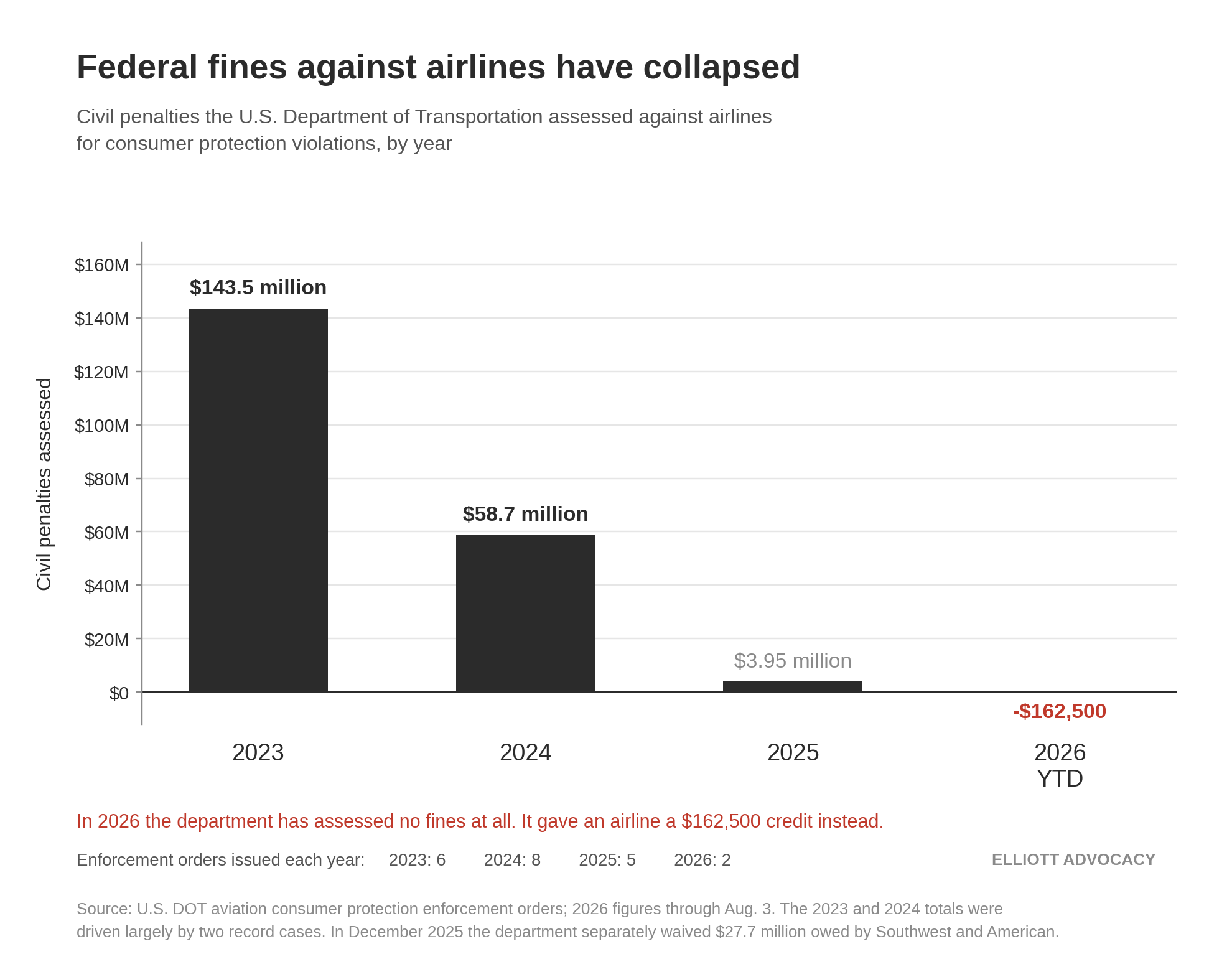
The government hasn’t assessed a single civil penalty against an airline for violating consumer protection rules this year.
The Department of Transportation (DOT) has also summarily dismissed numerous formal complaints filed by passengers.
On a single day this June, DOT closed out 10 passenger grievances, four of them refund demands filed back in 2020. Not one produced an enforcement action. The government took almost six years to tell those travelers what they already knew, which is that nobody was coming to help.
It gets worse. Instead of issuing fines, the government is giving money back to airlines. The DOT has forgiven nearly $28 million in the last five months.
What’s going on?
Earlier this year, the DOT rewrote its enforcement policy, shifting its focus to ensuring compliance with consumer protection rules rather than finding and penalizing companies that break them. Violations now draw a warning letter first. Civil penalties are reserved for conduct the office calls “widespread, systemic, egregious or intentional.” An airline that turns itself in gets strong consideration for no penalty at all.
It’s a sharp contrast with the rule it replaced, written three years earlier. That one promised to enforce the law vigorously and to intensify enforcement actions. It said penalties had to be large enough that airlines wouldn’t write them off as a cost of doing business.
That explains the lack of fines and the mass dismissals of consumer complaints. But what about that generous credit?
What airlines are getting
On December 5, DOT waived the final $11 million Southwest Airlines owed on its $140 million penalty for the December 2022 holiday meltdown that stranded more than 2 million passengers. That was the largest consumer penalty ever levied on an airline. The department credited Southwest for the $112 million it invested in its network operations center.
Four days later, DOT released American Airlines from nearly $17 million still owed to the U.S. Treasury. That money came from a $50 million penalty issued in October 2024 for mishandling wheelchairs and failing to assist passengers with disabilities. When the department announced that fine, it called it 25 times larger than any previous disability penalty and said it set a new precedent. Instead of paying, American now spends $16.8 million on lifts, tracking software and mobile devices it will own and operate.
And we are surprised? The current administration is never gonna go after big business. This is the most corrupt government that the United States has ever had, they make Richard Nixon and his crew look like amateurs.
And to address today’s question, yes the government should let consumers sue airlines, but again see above comment.
Then came Frontier Airlines on April 17, the smallest but perhaps the most revealing of the orders. In January 2025, just before the new administration came into office, DOT fined the airline $650,000 for operating three chronically delayed flights. It suspended half the penalty and made the rest due in two installments of $162,500. Frontier paid the first one that March.
This spring, DOT canceled the second one. It credited Frontier $85,534 for compensating passengers on those three flights and $76,966 for improving push notifications in its mobile app.
Here’s how the credit worked: Frontier owed the Treasury $162,500. Instead of writing that check, the DOT allowed it to subtract what it had already spent on passengers and on its own app. Cash refunds counted dollar for dollar. Vouchers and travel credits counted at 80 cents on the dollar, so the government is at least conceding that a voucher is worth less than real money. Frontier added it up, had a company officer certify the total, sent in the paperwork, and the bill disappeared.
That’s nearly $28 million forgiven by the government in about five months.
Six thousand complaints but zero penalties
DOT reports consumer travel complaints every month. In May, the most recent month available, it logged 6,448 complaints. That’s a pace of more than 77,000 a year.
The top category was refunds, at 1,881 complaints, nearly a third of the total. Refund rules are the most specific consumer protections the department writes, but they’re the ones travelers say airlines keep breaking.
DOT notes in the report that a complaint isn’t proof of a violation. Fair enough. But 6,448 people sat down and filed in a single month, and the agency receiving them has fined nobody all year. You don’t have to be a consumer advocate to see that there’s something wrong with this picture.
Think of it as the highway patrol no longer enforcing speed limits. Then imagine a trooper pulls you over for doing 90 through a school zone, walks up to your window and hands you money. You get full credit for the new brakes you bought and 80 cents on the dollar for the defensive driving class you took on your own.
It’s actually worse than that. A driver who catches a lucky break still lives in a world with courts and a state attorney general who can enforce the law. Air travelers have none of that. Federal law hands consumer enforcement to the transportation secretary, and courts have turned away passengers who tried to sue on their own. When DOT gives the money back, there’s no second squad car up the road.
Fix the deal instead of scrapping it
Congress could repair this with a quick tweak of existing statutes if it wanted to.
It can start by requiring the DOT to credit airlines only for cash that reaches passengers, at full value, never for a company’s own equipment or software. It can bar retroactive credits, so any offset gets negotiated into the original order in daylight. And it can require DOT to publish an easy-to-read annual scorecard: complaints received, cases opened, cases dismissed, penalties assessed and penalties collected.
And if you’re an airline passenger who runs into bad service, complain to the government. The DOT is required to record it and respond. If nothing else, it creates a full record of what the government is not doing for you when you travel. And at a time like this, everyone should be taking notes.

Have a question about this story? Tell us what happened — we read every comment.
Join the conversation