Just a few minutes after Howard Gross picked up the keys to his Alamo rental car in Nice, France, a tire pressure warning light flared up. He photographed the console and showed it to a car rental agent, who checked all four tires and assured him it was probably a false alarm.
It wasn’t. A week later, one of the tires went flat. The tow truck driver looked at Gross’s photos and said it couldn’t possibly be his fault. Even the rental company’s own manager noted in writing that the warning light was on at the time of pickup. But then it charged his credit card $752 anyway.
Car rental companies now act as both prosecutor and judge in damage disputes, and they’ve armed themselves with new tools to win. A company decides whether you damaged the car and what the repair costs, then charges your card directly. If you object, you appeal to the company that billed you. It’s time to give renters something they’ve never had: rules of evidence.
The robots will see you now
Rental companies are enforcing damage policies more aggressively, with help from artificial intelligence. Hertz and Sixt use drive-through scanners that photograph a returned car and flag anything resembling a dent. The scanners are good at finding dents, but they’re not as good at finding the truth.
This summer, a Hertz customer in Atlanta was reportedly billed $350 for two hood dents 17 minutes after drop-off, without any “before” photos for comparison. A Sixt customer in Florida got a bill for about $1,500 for two scratches.
Both claims disappeared after a reporter’s inquiry.
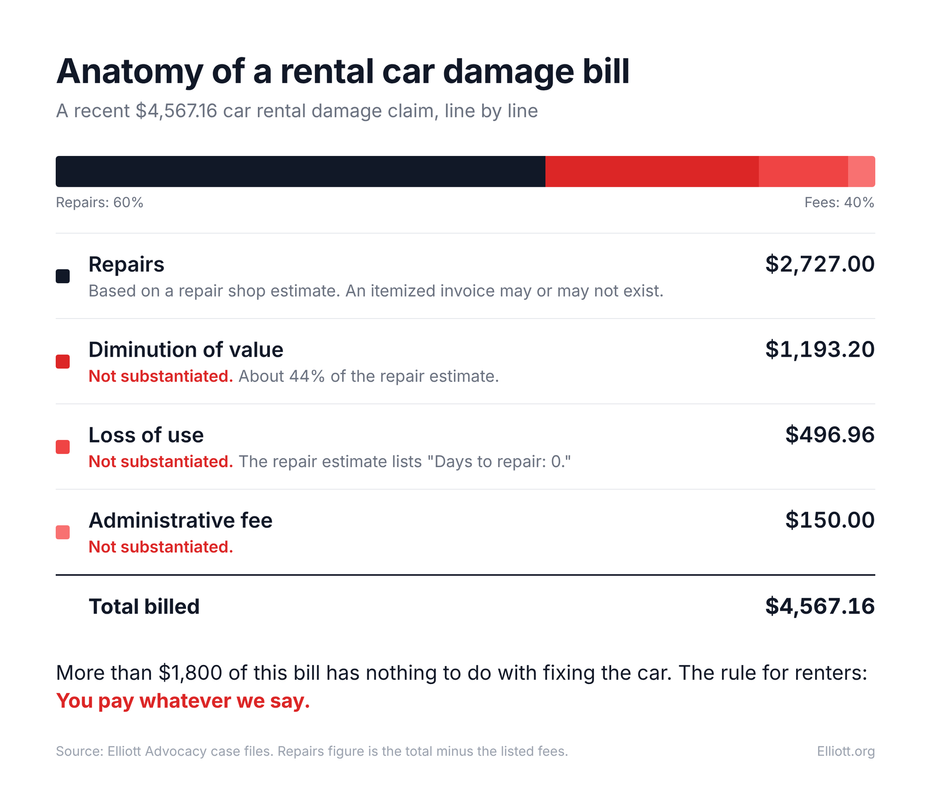
A reader I’m helping now got a $4,567 bill from Hertz after a scanner flagged 11 dents on the hood and roof of his pickup. His bill includes $497 for “loss of use.” The repair estimate Hertz sent him lists the days to repair as zero. That’s a neat trick: losing rental income on a car that never left service.
The renter asked for a person to check it.
“There will not be a human review for this claim,” a claims specialist wrote back.
So I asked for a human review. Hertz told me the damage included in the claim was not present before the rental and occurred while the vehicle was in the customer’s possession. Therefore, he was responsible.
A representative told me that it believes the claim is valid. It also noted that diminished value and loss of use calculations are estimates based on a variety of factors but said its claims team has reached out to my reader about that portion of the claim.
Welcome to the deductible zone
The car rental damage cases I see follow a predictable pattern. When a claim is smaller than your car insurance deductible, the rental company has the advantage. It can charge the card on file, and no adjuster will ask awkward questions. Call it the deductible zone.
Once an insurance company gets involved, the rental company often backs off because it can’t substantiate the damage, let alone the junk fees associated with a claim, like loss of use or diminution of value. Adjusters know to ask for invoices and fleet records. Most renters don’t. Your credit card company is supposed to be the backstop, but as Gross learned, it may also side with the car rental company.
Rules of evidence for rental cars
Congress should set minimum evidence standards for rental car damage claims, enforced by the Federal Trade Commission. Before a company can charge you a cent, it would have to give you:
- Time-stamped before-and-after images of each damaged area.
- For AI scans, the actual measurements of the alleged damage and the right to a human review.
- An invoice for repairs that were actually made, not an estimate for repairs that might be.
No evidence, no charge.
Congress should also ban two fees: loss of use and diminution of value. In my view, the rental industry invented both to bill you for things that haven’t happened. Loss of use charges you for rentals the company says it would have made. Diminution of value charges you for money it says it’ll lose when it sells the car someday. Neither comes with a receipt.
New York already bans one of them. Its law says loss-of-use damages “and related administrative fees shall not be recovered from any authorized driver.”
Rental companies will say some renters lie. Some do. (I’ve seen it.) A company with proof should have no trouble showing it.
A nice ending to a flat-tire story?
Gross, a health care manager who lives in Acton, Mass., disputed the $752 with his credit card company. It reversed the charges but then put them back after his car rental company responded to the dispute.
Then he called Alamo’s customer service and wrote to the chief executive. Crickets.
“The amount of time and effort this has taken,” he told me, “is beyond absurd.”
So I asked about his claim. Alamo reviewed his case, including his photos of the warning light, and decided to back off. It fully refunded his money and some of the expenses incurred as a result of his flat tire.
“We are always open to further conversations with customers regarding damage claims if they believe they are not at fault,” a representative told me.
Gross isn’t so sure.
“Without your help I sincerely doubt I would ever have been reimbursed for their screw-ups,” he wrote to me.
A renter with time-stamped photos and a written admission from the company’s own manager shouldn’t need a consumer advocate to prove he didn’t damage a tire. Until Congress acts, shoot a walk-around photo session at pickup and drop-off. It’s your own damage scanner, and unlike the ones at the airport, it works for you.

Have a question about this story? Tell us what happened — we read every comment.
Join the conversation