in this commentary
- We explain why you’re paying more for fewer services, like checked bags and standard amenities.
- We break down the industry tactics and psychological tricks that leave you feeling powerless against junk fees.
- Get practical strategies to fight the “pay more, get less” trend and claim the value you deserve.
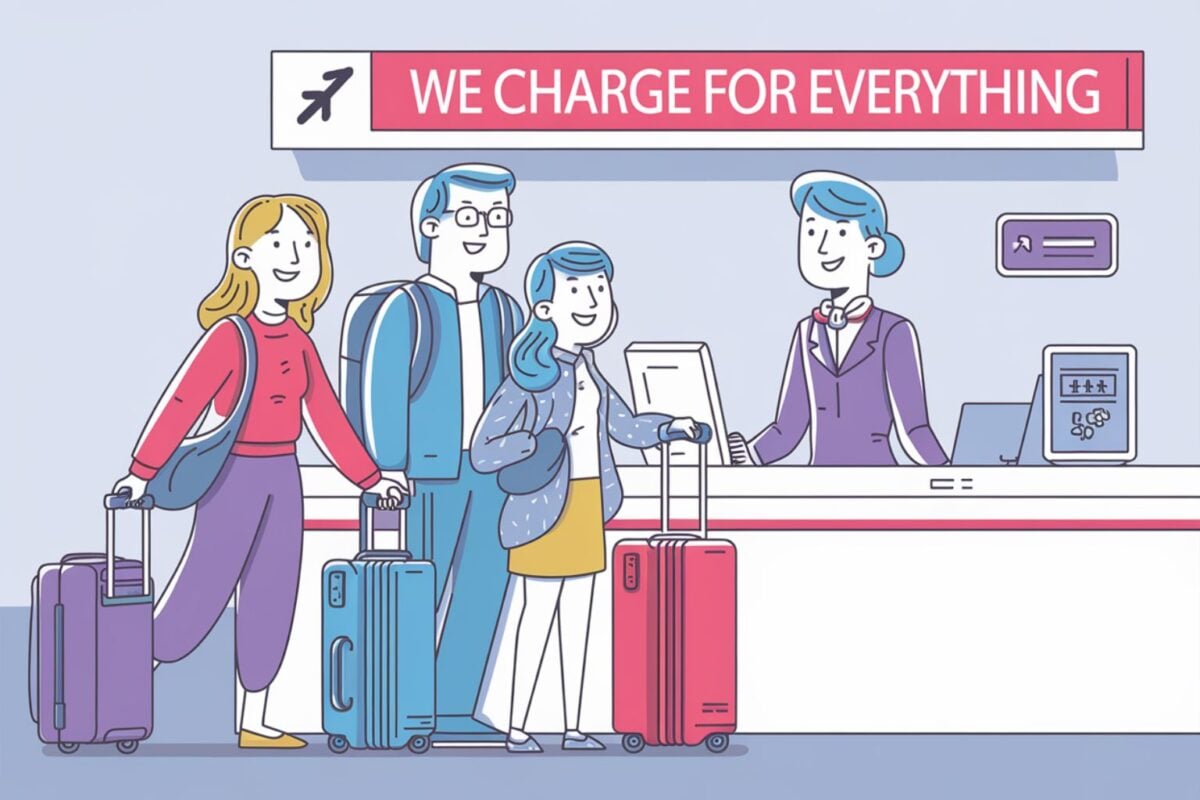
Don’t look now, but air travelers are paying more and getting less — and they’re fine with it.
Sure, when Southwest Airlines killed its “bags fly free” policy earlier this year, there was a brief outcry from passengers. But then they went right back to booking on the former low-fare carrier — and paying extra for checked luggage.
Here’s the reason, according to experts: There’s a growing sense of resignation among American travelers. Simply put, they think they deserve both the expensive prices and the extra fees. After all, they kept making booking decisions based solely on price — and the airlines took advantage, making super-low fares prominent but then piling on surprise surcharges.
“It’s disheartening,” says Anton Radchenko, CEO of AirAdvisor. “The increasing trend of cutting back on essential services — like free checked baggage or basic seat selection — is undermining what used to be a standard part of air travel.”
This idea that travelers deserve to pay more but get less extends beyond the airline industry. Hotels do it when they start charging their guests for extras that used to be standard amenities, or imposing “resort” fees. Cruise lines do it when they add mandatory tips to your folio. It’s been going on for years, but now it’s finally stuck, say experts.
But why are people being such pushovers? Is anyone resisting this ridiculous trend? And what can you do about it? It turns out you are not powerless, even though you may think you are.
Your voice matters
The trend of paying more for less in travel — from airline bag fees to hotel resort fees — has become the new normal. We want to know how you feel about it.
- Have you noticed a decline in service or amenities even as travel prices go up? Share your experience.
- Do you feel that consumers are partly responsible for this trend because they prioritize low base prices?
- What’s one fee or service cut that you absolutely refuse to accept?
Why travelers think they deserve to pay more and get less
Why are travelers so accepting of this idea that they should pay more and get less?
“Years of conditioning and poor customer service have led consumers to believe that the travel industry standard is paying more for less,” explains Mario Matulich, president of CMP, a customer service consultancy. “Airlines and hotels want consumers to select the lowest upfront price, so they can then nickel-and-dime them with hidden fees on the back end.”
Breaking out the extras is something J.D. Power calls disaggregation. It’s driven by the way that consumers shop for airfare. Air travelers have more information than they used to, but fares to a given destination are usually ranked by ticket price, with the lowest first.
I bought my first plane ticket for $180 round-trip. Included luggage, a full meal, the works. Using inflation as the only measure, that same ticket would cost $800 today. I last flew that same route 3 months ago for just over $300 base, not including any extras. I’m not sure what the solution is, but id happily pay a bit more & get everything included again.
Back then there used to be those wonderful sales that travelers looked forward to. Every winter, for about a decade, the main carriers had sales to Europe. For about $500 to $600, you’d get coach air, hotel, transfers & breakfast for 5 days & 4 nights. We went to London, Paris, Copenhagen, Stockholm, Amsterdam, Rome, Milan. It was a whirlwind, but what fun!
Read more insightful reader feedback. See all comments.
“Airlines quickly realized that their airfares needed to be near the top of these lists before consumers would choose their brand,” says Michael Taylor, a senior managing director for travel and hospitality at J.D. Power.
So unbundling services could allow the airline to lower the basic fare, causing their flights to rise to the top of the search results. (Here is our best guide to planning a trip.)
But there’s also a psychological aspect to this. Because travelers choose these low prices, they are often made to feel that they should also accept lower service levels along with higher costs, once you’ve factored in all these fees. (Airline apologists alternate between praising the “miracle” of air travel and scolding with a “you-get-what-you-paid-for” lecture.)
“Research suggests travelers feel guilty because they’ve always chosen price over overall service quality,” notes Kevin Shahnazari, CEO of the financial advice site FinlyWealth. “But with each instance of customers choosing the lowest fare ticket or bed rate, they inadvertently send the message to businesses that cost is more significant than overall service.”
But travelers shouldn’t feel responsible or even guilty. Just because someone chooses a lower fare doesn’t mean they asked for — or that they deserve — a degraded product at a higher price.
Some travelers are not OK with the new reality
Not all travelers are OK with the pay-more-get-less reality. Frequent, experienced travelers like Stan King don’t like this trend. “The whole value proposition has been lost,” he says. And he chafes at the idea that passengers somehow deserve less service when they pay a lower price..
King says for him, the only way to escape the reality is to upgrade to a bigger room or a better seat. But even when he does, he says travel companies are still stingy.
Gerri Hether, a frequent leisure traveler, chafes at the suggestion that somehow she’s responsible for the state of affairs.
“How can customers be remotely responsible for junk fees?” she wonders.
But the reality is this: Despite the anger and complaining, travelers continue to buy fares and book rooms from companies that have stopped caring about a quality product. And that’s all that matters.
What can you do to escape a buy-more-get-less travel industry?
This will only end when travelers say “enough,” according to industry experts.
- Look for ways to beat the system. “There are measures you can take to get around the service cuts,” says Frances Rahaim, a financial coach and consumer advocate. For example, she sidestepped luggage fees altogether by buying an underseat-sized bag from IT Luggage and used vacuum seal bags to minimize clothing space, allowing her to fit in more of her belongings. You can also try wearable luggage by apparel companies such as Scottevest.
- Reject bad service. “Don’t accept service cuts without question,” says AirAdvisor’s Radchenko. That’s especially true if an airline reduces service by downgrading you or canceling your flight but is required to pay you under the law. Radchenko says that’s an area where many passengers are under-informed — and they leave money on the table.
- Find the honest companies and give them your business. “Reward companies with transparent pricing models,” says Shahnazari of FinlyWealth. There are still airlines and hotels that don’t believe in the pay-more-get-less-model, but you have to do some research. Full-service hotels like Marriott and InterContinental still offer a more inclusive experience, and international airlines like Qatar Airways don’t nickel-and-dime you for luggage. But they’re few and far between.
But the biggest way to disrupt this dangerous trend is to say “no” whenever you see it, according to experts.
“Passengers have to insist on greater openness and reject nickel-and-diming as the standard,” says Deepak Shukla, CEO of Pearl Lemon Adventures, a travel agency.
Do we have to accept this?
All of this raises a bigger question: Have customers lost their power? I’ve been covering the travel industry for three decades, and travel companies — particularly airlines — have consistently tried to charge passengers more while delivering less. And the rest of the travel industry has followed along.
But in the last year, it feels like businesses have felt more empowered to deliver substandard service at a higher price. It also seems as if customers have given them permission, if not their approval. The evidence of that is obvious: They are rewarding these travel companies with their business.
Unfortunately, this will continue until consumers realize that they are the only ones who can reverse course and return to a time when airlines, hotels and cruise lines delivered a quality service at a fair price.
In other words, no one is coming to save you. Maybe we have to save ourselves.
How to fight the ‘pay more, get less’ travel trend
You have the power to demand better value. Here’s how.
Be smarter than the fees
Beat airlines at their own game. Use vacuum-seal bags and compact underseat luggage to avoid paying for checked bags. Don’t give them an extra dime if you can help it.
Know your rights
Don’t accept service cuts when you’re protected. If an airline downgrades you or cancels a flight, research the rules. You are often owed compensation under federal law.
Vote with your wallet
Seek out and reward honest companies. Support airlines and hotels with transparent, all-inclusive pricing. Your spending sends a powerful message to the entire industry.
Just say ‘no’
The ultimate power is yours. Refuse to pay junk fees and choose another option if you can. When enough travelers push back, companies will have to listen.
What you’re saying
This debate has you deeply divided. Many of you, like our top commenter, are nostalgic for a time when a plane ticket included everything, while a vocal contingent argues that travelers have no one to blame but themselves for the current state of a-la-carte service.
-
Many of you miss the “good old days”
Michael Anthony’s memory of all-inclusive fares for a fraction of today’s inflation-adjusted price struck a chord. Many of you would “happily pay a bit more” to get luggage, meals, and other basics included again, fondly recalling a simpler time of package deals to Europe.
-
But others say, “you get what you pay for”
A strong counterargument from readers like CasaAlux, Joe X, and Ben is that consumers have driven this change. As Ben puts it, people “still shop for the lowest dollar fare before fees.” You point out that flying is cheaper than ever in adjusted dollars and that those who want the old-style service can find it in premium cabins.
-
Is the system itself the problem?
Some of you argue the issue is bigger than individual choices. The Brown Crusader suggests travelers have been “trained to think that ‘cheap’ means progress.” Others, like Mr. Smith, blame a lack of real competition from airline mega-mergers, creating a system where average travelers are nickel-and-dimed while elites with premium credit cards bypass the fees.


Have a question about this story? Tell us what happened — we read every comment.
Join the conversation