In this commentary
- An analysis of why travel is becoming more nonrefundable, from new pricing models to risk management by travel companies.
- Actionable strategies to get your money back on a nonrefundable booking, including how to negotiate for a travel credit.
- A look at how travel insurance, especially “cancel for any reason” policies, can be your ultimate safety net in a nonrefundable world.
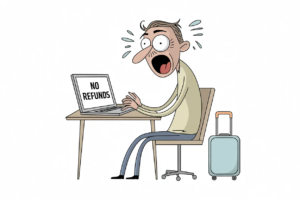
Christina Anderson thought her hotel room in Reykjavik, Iceland, was refundable. But when her flight to Iceland was canceled because of bad weather, she made a stunning discovery: It wasn’t.
Anderson, a retired nurse from West Lafayette, Ind., booked her room at the Iceland Parliament Hotel through a travel website affiliated with Priceline, and she didn’t realize that all rooms were nonrefundable.
“Now I’m out over a thousand dollars for a trip I couldn’t take,” she says. “I’ll never make that mistake again.”
But anyone could make that mistake. With airlines, hotels, and booking platforms tightening their refund rules, consumers are finding it harder than ever to get their money back, even when circumstances are beyond their control.
Is 2025 the year of nonrefundable travel?
“2025 is shaping up to be the year of no refunds — and no exceptions,” says Charlie Neville, a marketing director at JayWay Travel.
No one knows the exact extent of travel nonrefundability today because travel companies don’t release that information.
But we can connect the dots. The travel insurance platform Squaremouth reports an 18 percent rise in paid claims this year compared to 2024, with total payout amounts jumping by 37 percent, to $2,609. Notably, over 40 percent of these claims involved trips that were canceled or cut short, like Anderson’s. (Related: My Getaroom reservation became nonrefundable — but I want my $3,228 back!)
Neville says he’s noticed many boutique and family-run hotels, especially in high-demand spots like Dubrovnik, Prague, and Santorini, booking out earlier than ever, requiring full deposits up front, and enforcing strict cancellation policies. And based on the consumer complaints I’ve received at my nonprofit advocacy organization, I can also confirm that more travel products are becoming nonrefundable, perhaps not coincidentally in time for the busy summer travel season.
Have you ever been stuck with a nonrefundable ticket or hotel room? Do you book nonrefundable travel to save money, or do you always opt for the refundable option?
And what’s your best strategy for dealing with the rise of nonrefundable travel?
Share your thoughts in the comments.
Why is travel becoming more nonrefundable?
You might be tempted to blame greed for the nonrefundability crisis. It’s not that simple. Here’s what’s driving this trend:
You’re buying more nonrefundable tickets and rooms. New AI-driven pricing models allow travel companies to adjust their prices and refund terms in a split second. And customers are falling for it. For example, hotels will often lower their rates by 10 percent in exchange for the room being nonrefundable, knowing that some people will cancel and then they’ll get to sell the room again. As more people book nonrefundable products, travel companies are making more of them available.
Travel companies want to minimize their risk. The process actually started during the pandemic, according to experts. “Airlines, hotels, and rental car companies shifted to nonrefundable policies to manage risk and stabilize their revenue streams during the pandemic,” explains John Rose, the chief risk officer at Altour, a global corporate travel management company. “This trend is particularly noticeable now, with the travel industry trying to rebuild after massive disruptions over the past few years.”
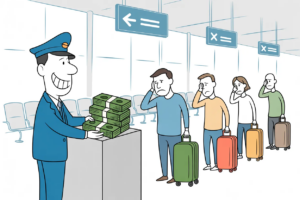
It’s also profitable. Of course it is. “Travel companies are trying to secure revenue,” says André Disselkamp, the cofounder of Insurancy, an insurance site. The simple fact is, if you have a nonrefundable ticket, room or car, it may seem like a good deal for you, but it’s always a great deal for the company. Because when your plans change, the company gets to keep all of your money.
But there’s a way to avoid losing everything on a nonrefundable purchase.
How to get around the refund rules this summer
The easiest way to avoid getting stuck with a worthless ticket, room or car is to avoid anything nonrefundable. The cost savings for hotels and car rentals are negligible, anyway. For example, when car rental companies offer a “prepay” rate, you’re only looking at a 10 percent savings, at best — but a lot more risk.
“With car rental it rarely benefits customers to prepay,” says Mark Mannell, CEO of CarRentalSavers.com. He says that’s particularly true during the summer, when many locations run out of cars. Often, rental companies are hesitant to refund the prepaid rate, even when they can’t give you a car.
Talk about a “lose-lose” proposition.
With airlines, it’s a little harder. But the good news is the price difference between a refundable ticket and a nonrefundable one has been shrinking lately, so it might be more affordable than you think. Just avoid the cheapest fares — the “basic economy” class tickets, which are the most restrictive.
You can also ask for an exception to the strict refund policy.
“Negotiate for a travel credit,” advises Laura Barlow, a travel advisor with Explore the Magic Travel. “Depending on the supplier, most would work with the client or travel advisor to issue a credit for a future trip. In these times, my policy is that it never hurts to ask.”
She’s right. Even though travel companies love to put their terms in ironclad contracts, the truth is, there’s usually a manager on the other end who can make a deal — if you ask nicely.
What about travel insurance?
There’s one more way around the problem of nonrefundability: travel insurance.
“Many travel insurance policies will provide a refund of these expenses in many instances,” says Andrew Jernigan, CEO of Insured Nomads, “Especially when you can get a ‘cancel for any reason’ benefit included in your policy.”
For example, Berkshire Hathaway Travel Protection’s (BHTP) “cancel for any reason” option will allow you to recover up to 50 percent of your nonrefundable trip payments if you need to cancel for reasons that fall outside of typical covered events.
“It’s a way to protect yourself if your plans change unexpectedly and you need to cancel for reasons not covered in the standard policy,” says Carol Mueller, BHTP’s head of marketing.
But you also may be covered under a regular travel insurance policy. For instance, TravelSafe’s Classic policy provides $2,500 for common carrier delays that result in an arrival more than three hours after the scheduled arrival if they cause a loss of prepaid land arrangements.
Travel insurance will also add to the cost of your vacation — about 8 to 10 percent of your prepaid nonrefundable expenses, and you’ll pay extra for a “cancel for any reason” option (as much as 12 percent of your trip cost).
It is the best way around the nonrefundability problem, though, and it would have definitely rescued Anderson’s vacation in Iceland.
Priceline contacted the hotel on Anderson’s behalf to ask about a refund, but it refused. The online agency offered her a 10 percent discount on a future booking, which she also refused.
We’re traveling in a nonrefundable world
We had better get used to the idea that everything in travel will apparently be nonrefundable sooner or later. This summer has proven that the travel industry’s ultimate goal is: no refunds.
That’s the wrong approach. Life can be unpredictable and plans can change. One hotel owner confided that he knows 10 percent of the guests who book his nonrefundable rooms will have to cancel. And when that happens, he gets to keep their money and resell the room. Cha-ching!
The best way to fight this may be to push back. Buy the refundable ticket or the refundable room — and send a message that nonrefundable travel is not a consumer-friendly option, no matter the discount.
The nonrefundable gamble
Is the small discount worth the big risk? Here’s how to decide.
Play it safe: Book refundable
- If your plans are uncertain or the trip is far in the future.
- If the discount is minimal (less than 15%).
- If you don’t have “Cancel For Any Reason” insurance.
Take the gamble: Book nonrefundable
- Only if your plans are absolutely set in stone.
- Only if the savings are substantial and worth the risk.
- Only if you are protected by a CFAR policy.



Have a question about this story? Tell us what happened — we read every comment.
Join the conversation