
in this commentary
- Travel sites are asking readers to write to Congress opposing a bill that would lower credit card swipe fees.
- The petitions run alongside campaigns funded by the banks and the airlines, warning that your rewards are at risk.
- Supporters say the bill breaks a duopoly and lowers prices. Opponents say it will gut the points you have earned.
Travel websites are asking you to do something strange this summer. They want you to write to Congress and beg lawmakers not to lower your credit card fees.
That’s right, sites that claim to work for consumers are running petition drives against a bill that could make prices more affordable.
The bill is the Credit Card Competition Act (CCCA), and it would require the biggest banks to let more than one network process your credit card. The proposed law has bipartisan support, including an unexpected endorsement from the president.
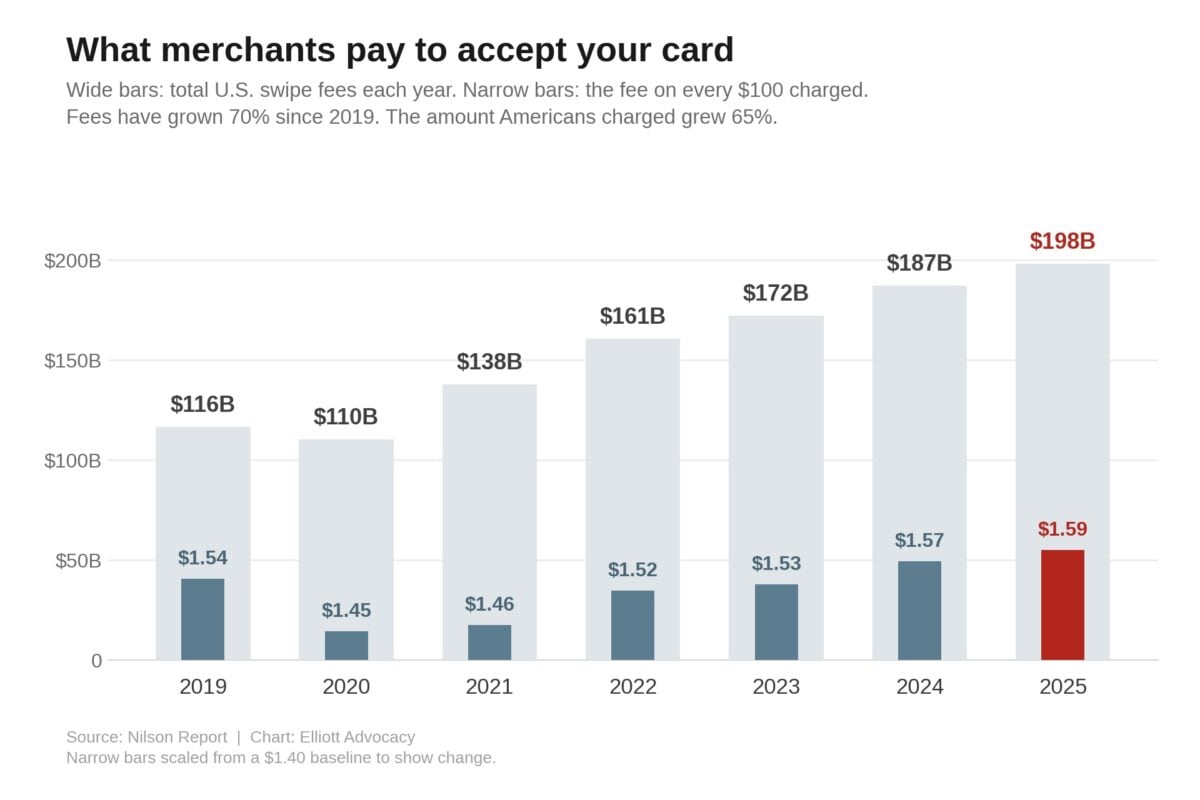
The CCCA would lower the swipe fee merchants pay every time you buy something. Fees run about 2 to 3 percent of the purchase, and sometimes more. Merchants build the cost into their prices, and you pay them whether you know it or not.
Last week, the advocacy group Demand Progress reported that the credit card industry had already spent $200 million since 2023 to defeat the legislation. That’s because the CCCA has a real shot at becoming law. Sponsors tried attaching it onto a cryptocurrency bill in January, and they’ve said they’ll keep looking for a bigger package to tie it to.
Which brings me back to those strange petitions.
Credit card swipe-fee misdirection
The pitch this summer is always some version of “protect your rewards,” warning that the bill will eviscerate your points balance unless you tell Congress to stop it. There’s even a handy form: You fill in your name and ZIP code, and it fires off a pre-written letter to your representatives.
These drives run in partnership with the credit card industry’s lobbyists. The banks have their own campaign called “Hands Off My Rewards,” run by their trade group, the Electronic Payments Coalition, whose members include JPMorgan Chase, Capital One and Visa. The airlines have one called “Protect Our Points,” funded by Airlines for America. The travel websites just mobilize the readers.
It’s a classic misdirection. A bank lobbying campaign gets dressed up as consumer activism, and the audience provides the outrage for free. The industry couldn’t buy that kind of authenticity.
It didn’t have to. The sites handed it over to the travel “experts.” One site openly admits that it’s teamed up with the Electronic Payments Coalition to amplify the message. Its readers have mailed thousands of letters to Congress, all defending the banks.
I live in WA state and it is legal here for merchants to tack on their credit card fees to the price you pay. The result? More people pay with cash in far NE WA. They give you a choice at checkout and then if you pay with a credit card they can tack on the processing fees. I like that system.
Read more insightful reader feedback. See all comments.
Your travel ‘expert’ works for the bank
You might wonder why a travel site would carry water for the banks.
Maybe it’s because these sites aren’t news organizations at all, but affiliate marketers wearing a press badge. They earn hundreds of dollars in commissions every time a reader signs up for a credit card through their links. The content—the reviews, the rankings, the breathless “best cards of 2026” lists—is nothing more than a storefront to sell more credit cards.
The same banks that pay these sites to push cards also fund the lobby fighting this bill. Lower swipe fees mean reduced bank margins, which means less cash flowing back to the sites that sell the cards.
They aren’t protecting your points, they’re protecting their own paycheck—and your points are the bait.
Even the scary numbers they cite are manufactured. The campaigns warn the bill would wipe out $80 billion in rewards a year, but that figure traces to a study the banks’ own coalition paid for.
Then a newsletter passes it along as if a trusted travel expert came up with it. And that’s how a lobby’s talking point gets laundered into fact.
The dirty secret about your credit card
The American credit card is a clunky, expensive way to move money. Every swipe crawls through a chain of middlemen, the issuing bank, the acquiring bank, the network, the processor, each one taking a cut. That’s why America’s fees are among the highest on earth.
It doesn’t have to work this way. Brazil built an instant payment system called Pix, run by its central bank. It charges merchants about 0.33 percent per transaction, according to International Monetary Fund figures, compared with 2.34 percent for a credit card. A street vendor selling coconuts on a beach in Recife pays less to accept a digital payment than a Walmart in Ohio pays Visa.
Pix now handles more transactions in Brazil than Visa and Mastercard combined.
In the United States, we’re stuck with the expensive version because the companies profiting from it spend $200 million to keep it that way. Then they kick back a small percentage to you as a reward to keep you compliant.
The CCCA won’t build us a Pix. But it’s a first and necessary crack in the Visa-Mastercard duopoly.
Nobody’s promising you a refund
The merchants pushing this bill have their own numbers, and they’re worth a look. They claim swipe fees have jumped 80 percent since the pandemic and have driven prices up by more than $1,200 a year for the average family.
In fairness, it’s not entirely clear if lowering swipe fees would bring down costs. The Congressional Research Service studied a 2010 law that capped debit swipe fees and found it “indeterminate” whether prices dropped for shoppers.
But one thing is certain: This summer’s rewards panic collapses under its own numbers. Americans earned $47 billion worth of credit card rewards in 2024, according to the Consumer Financial Protection Bureau. That same year, merchants paid $187 billion in swipe fees on credit cards. Your “free” flight is a partial rebate on a tax the banks set, collect and keep raising. They take three dollars and hand you back one. Then a website tells you to guard that dollar with your life and ignore the other two.
Read this before you sign the petition
So before you fill out one of those forms, understand what you’re doing. You’re protecting a fee you can’t see, sold to you by a marketer you mistook for a journalist, on behalf of the banks that will never stop charging you. Your “free” flight to Cancun was never at risk.
The banks spent $200 million on this fight, and now they’re asking you to work for free to promote a cause that could hurt you. Don’t be fooled.
Cheaper prices or richer rewards. This one splits travelers, and we want to hear where you land.
Your voice matters
Swipe fees, rewards, and the bill behind the petitions
A fight over credit card fees has landed in travel newsletters. Here is what readers ask most.
It is a bipartisan bill, reintroduced in January 2026 by Senators Dick Durbin and Roger Marshall with a companion House measure, that would require the largest card-issuing banks to make at least two unaffiliated networks available for processing each credit card transaction, including one outside Visa and Mastercard. The president endorsed it publicly the same day. It is currently before committee. A swipe fee, or interchange fee, is what a merchant pays each time you use a card, generally around 2 to 3 percent of the purchase. You do not see it on your receipt, but merchants typically build the cost into their prices, which means cash and debit customers help cover it too. Nobody knows, and both sides overstate their certainty. Opponents point to a real precedent: after a 2010 law capped debit card swipe fees, banks largely ended debit rewards. Supporters counter that credit cards are a different market and that competition on routing does not directly touch rewards programs. Treat confident predictions from either camp with caution. The banks’ trade group, the Electronic Payments Coalition, runs one campaign, and Airlines for America funds another. Several travel websites have amplified those messages to their readers with prewritten letters to Congress. One site has said openly that it partnered with the coalition on the effort. Many card-review sites are affiliate marketers that earn a commission whenever a reader is approved for a card through their links. That revenue is funded, indirectly, by the same interchange fees the bill targets. Whether that shapes their editorial position is a fair question to ask, and a reason to check whether a site discloses how it makes money. That is genuinely unsettled. Congressional researchers who examined the 2010 debit fee cap found it unclear whether savings reached shoppers. Merchant groups argue prices would ease, while critics say businesses would simply keep the difference. Honest advocates on both sides acknowledge the pass-through is uncertain. The Consumer Financial Protection Bureau reported that cardholders earned about $47.5 billion in credit card rewards in 2024. Estimates of what merchants paid in swipe fees that year run far higher, though published figures vary widely depending on what is counted. For more consumer coverage, see Elliott Advocacy.What is the Credit Card Competition Act?
What is a swipe fee, and do I pay it?
Would the bill really eliminate my rewards?
Who is running the campaigns against it?
Why would a travel site take the banks’ side?
Would lower swipe fees actually lower prices?
How do the rewards and fee numbers compare?

Have a question about this story? Tell us what happened — we read every comment.
Join the conversation