
How much of an airline ticket’s price do you deserve to see when you shop for a flight? The United States and Europe answered that question recently, and they’ve come to opposite conclusions.
In the United States, partial disclosure (for now)
On July 2, the Department of Transportation (DOT) finalized a rule that returns airline fee disclosure standards to where they stood in 2011.
Under that standard, airlines and ticket agents don’t have to show you the price of a checked bag or a ticket change when fares first appear in your search results. They only have to note that baggage fees may apply and point you toward the fine print. A ticket agent can send you to the airline’s website to find the numbers yourself.
It isn’t quite a rollback, as some consumer advocates have suggested. In 2024, the DOT issued a rule requiring airlines and booking sites to display baggage and change fees the first time a fare appeared in your search.
But passengers never saw those protections. A federal appeals court stayed the rule in July 2024, before any airline had to comply. Then in February, the full Fifth Circuit vacated the rule, finding the DOT violated federal procedure by not letting the public comment on a study it used to justify the regulation. The court didn’t say fee transparency is illegal, just that the government had skipped a step.
The July 2 rule is the paperwork that makes the defeat official. Rather than redo the rule correctly, the current administration abandoned it. The upfront fee disclosures Americans were promised two years ago never arrived, and it won’t arrive under the current administration.
In the past, I’ve gone through many steps to purchase a ticket and finally found the ‘real’ price on the very last step. Even then, after all that, you’re given a hint that you need to purchase your seat. I see processes becoming more murky and strange. This reminds me of my time living in Peru when I bought a rice cooker. The store clerk would take it apart and put it back together, then plug it in, all to show it worked. Once bought, you are not allowed to take it back. Are we going in this direction with airlines?
Read more insightful reader feedback. See all comments.
Meanwhile, in Europe …
Europe has taken a different path. On July 13, the European Parliament approved the first overhaul of EU air passenger rights in 22 years.
The centerpiece for anyone comparing this to the American approach: airlines, ticket agents and comparison sites must display fares that include the cost of standard carry-on bags from the outset, so travelers can see the true cost of competing tickets. It’s the principle the DOT, and the current administration, just scrapped.
The EU reform goes further. Airlines are now required by law to respond to claims within 30 days. Carriers can no longer charge parents to sit next to their own children, cancel your return flight because you skipped the outbound leg, or bill you for correcting a typo in your name.
The rules take effect roughly a year from now, and they’ll cover flights departing EU airports, which means American travelers will enjoy them too. Americans flying home from Paris will have more pricing disclosure and passenger rights than they have flying from Denver to Dallas.
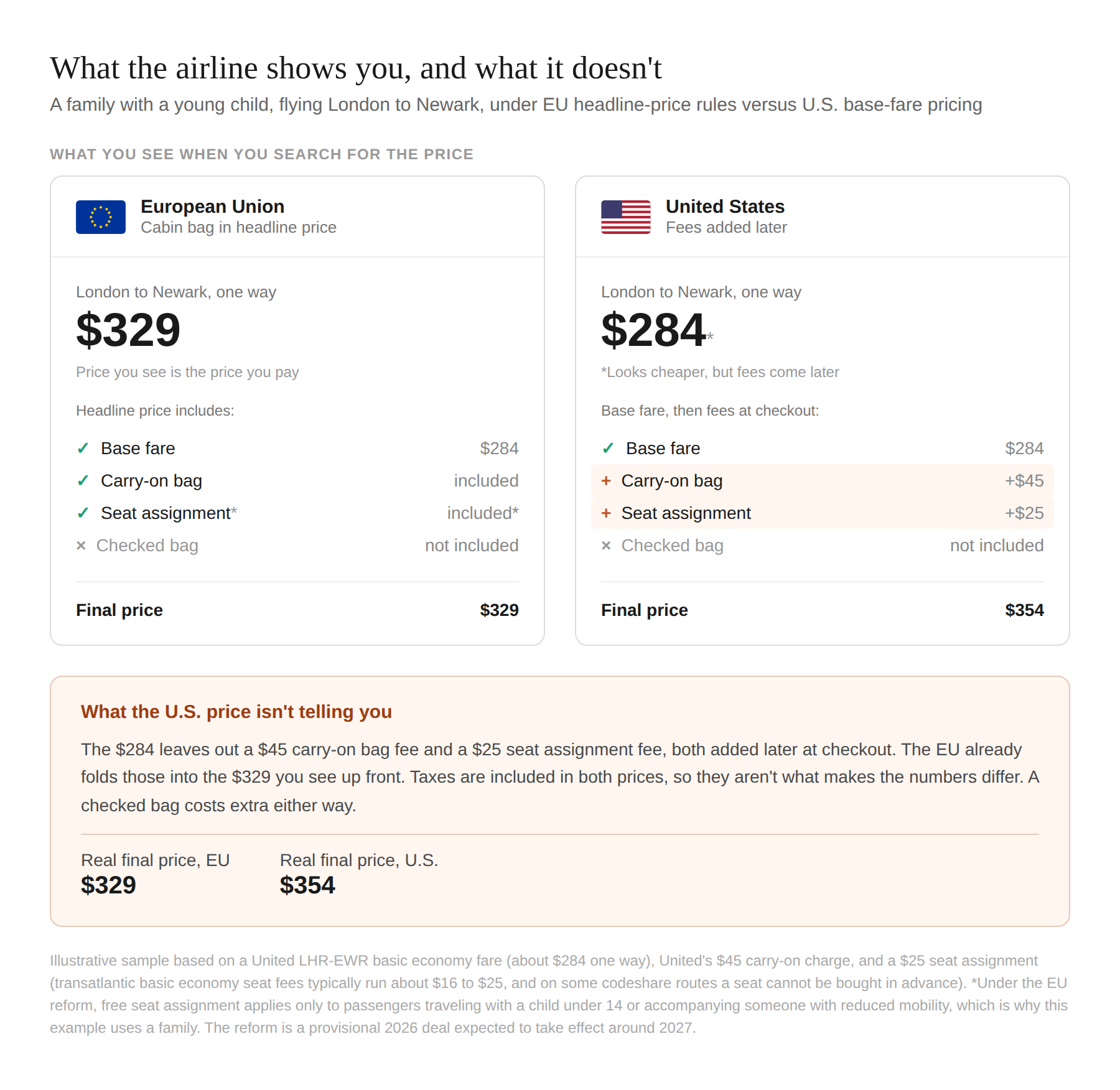
Are governments overstepping their authority?
Airlines for America, joined by American, Delta, United, JetBlue and Alaska, brought a lawsuit that killed the proposed 2024 rule, arguing the government overstepped its authority and imposed heavy redesign costs on booking systems. Carriers note that you still see every mandatory fee before you complete a purchase, and they argue unbundled pricing lets travelers who skip the extras pay less.
Some in the industry go further and frame mandated price displays as a violation of their right to free speech. Spirit Airlines made a version of that First Amendment argument against the government’s full-fare advertising rule in 2011. The U.S. Court of Appeals for the D.C. Circuit rejected it in 2012, ruling the requirement to show the total price prominently didn’t stop airlines from saying anything—only from burying the full fare.
What passengers say about airfare displays
Passengers didn’t lobby for piecemeal fare displays that strip a ticket down to an amount almost no one pays. That was the airline’s idea, and it works because a fare that hides the bag fee, the seat charge and the taxes looks cheaper than an all-inclusive fare.
When you ask travelers what they want, the answer is pretty consistent: They want to see the real price, all of it, the first time it appears. The more inclusive fare isn’t a burden on the customer. It’s what passengers wanted all along.
If you answered Europe:
- Should U.S. regulators restart the fee disclosure rule and fix the procedural defect the court identified?
- Would you book differently if every fare included a carry-on from the first screen?
If you answered United States:
- Does unbundled pricing actually save you money on the routes you fly?
- Where should fees appear: first search result, checkout or somewhere in between?
My take
Failing to disclose the full cost of a ticket up front—and yes, that includes taxes—only serves the airline by making the ticket appear to be cheaper than it is. Some airlines unbundled their tickets ad absurdum, removing even the ability to bring a carry-on onboard. And that’s fine, but you shouldn’t need a calculator to find and compare airline ticket prices. The price games must end, and in Europe, they are about to.
Your turn
There’s more coming from Washington. The DOT has proposed loosening its air fare price advertising rules even more and is weighing a repeal of the full fare advertising requirement entirely. I’ll have coverage of that rulemaking soon.
In the meantime, tell me: Which direction is more consumer-friendly? Is this a free speech issue? Should an airline be allowed to reveal only a partial fare to you? Our comments are open.

Have a question about this story? Tell us what happened — we read every comment.
Join the conversation