
It started with Stewie, a 3 1/2 -foot humanoid robot.
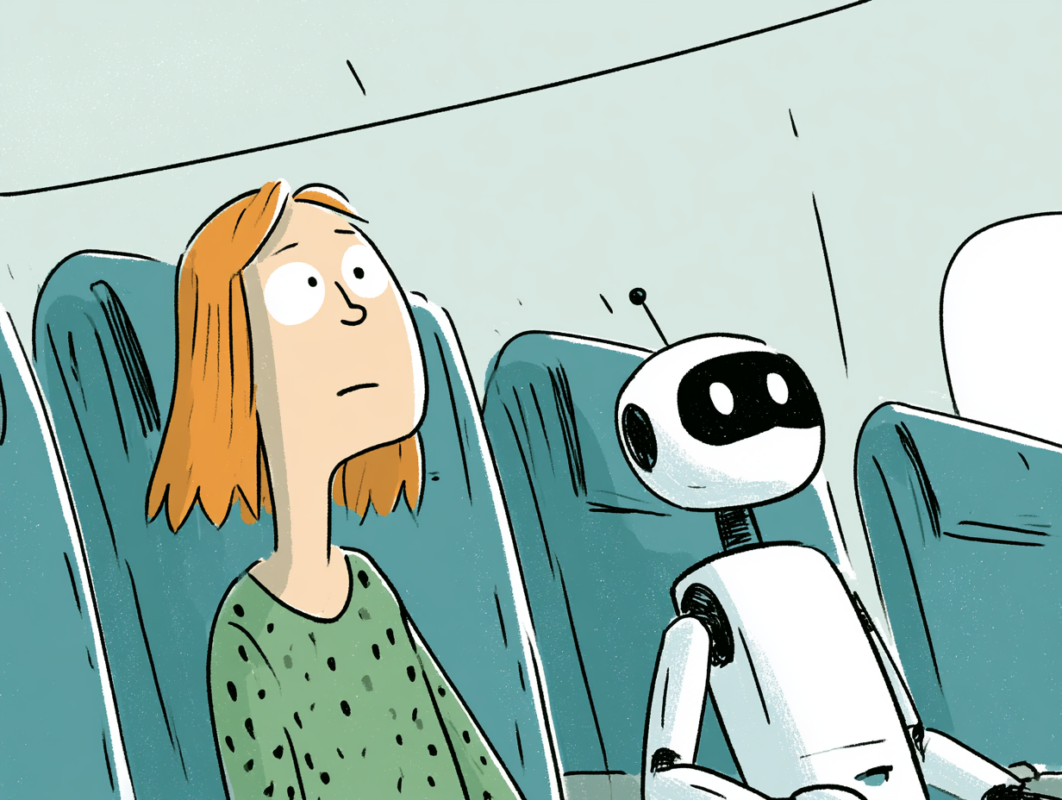
Stewie’s owner bought a ticket for him to Dallas on Southwest Airlines recently. When the robot walked through the terminal, passengers took pictures.
Within days, Southwest rewrote its policy to keep human-like and animal-like robots off its aircraft “regardless of size or purpose.”
Other airlines have followed recently. Delta’s ban happened June 18. United’s took effect July 23. American Airlines still has no published position, but I expect one any day now.
So we have three bans and one open question: Should airlines be doing this at all?
I would sit next to a robot any day. It probably won’t invade my personal space, talk too much, put the seat back or be an unruly drunk lol. Just keep the fire extinguisher nearby just in case.
Read more insightful reader feedback. See all comments.
What are the rules on robots?
Each ban covers the cabin and checked bags, and some carve out toys.
- Southwest allows other robots, toys included, if they fit inside a carry-on bag and meet battery limits.
- Delta’s restricted items page calls its ban temporary, and says it covers any robot built to imitate a human or animal in appearance, size, movement or behavior.
- United says its policy applies to humanoid and animal-like robots and wasn’t prompted by a specific incident.
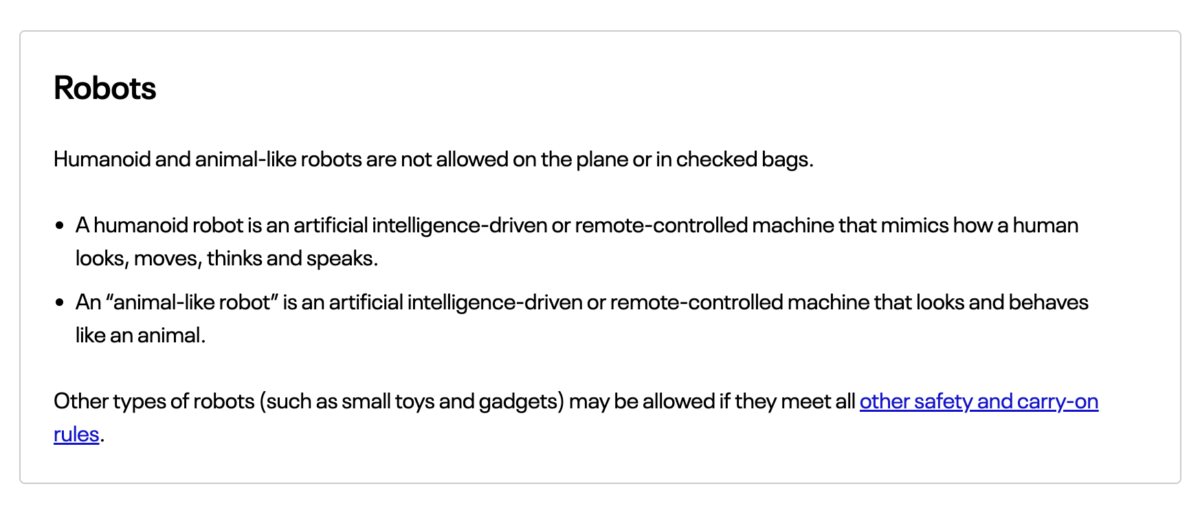
From United Airlines’ banned items page. Robots are “dangerous and excluded” items.
Will they confiscate your kid’s robot dog?
Here’s where some of the breathless media coverage has gone a little sideways. Southwest and Delta both publish toy exemptions. Southwest allows toys inside a carry-on bag that comply with the battery rules. Delta’s policy allows for human-like and animal-like toy robots, provided they meet standard carry-on limits, stow in an FAA-approved location and comply with battery restrictions. United’s guidance reportedly does the same for smaller robotic toys.
The problem here is that nobody has formally defined a toy. That leaves it up to gate agents to decide in real time while the boarding line waits behind them. A robot dog from a big-box store and a therapy seal costing thousands both have fur, and both make animal noises.
The case for the ban
True, there’s a fire risk to consider. Under current FAA guidance, batteries up to 100 watt-hours can fly without permission, 101 to 160 watt-hours need the carrier’s approval (except certain mobility aids), and anything above 160 watt-hours is forbidden on a passenger plane. A full-size humanoid carries far more power than a laptop.
There’s another reason. A gate agent has to decide whether a machine with limbs is baggage, cargo or a ticketed passenger. One of the two Southwest incidents that led to the ban held an Oakland departure for close to an hour while a crew worked that out. Ultimately, the airline decided it was self-loading cargo, just like the other passengers. (I’m kidding, we are definitely not self-loading cargo.)
What about the robot uprising?
In 1920 the Czech playwright Karel Capek wrote the play “R.U.R,” gave us the word “robot,” and built the plot around a machine rebellion that wipes out humanity. HAL 9000 and the Terminator kept the story going for a century.
Are these bans nothing more than a knee-jerk reaction, fueled by Hollywood blockbusters?
None of the three carriers has pointed to fears of a robot mutiny as the reason behind their ban. The stated concern is batteries and handling. Not one reported incident on Southwest or any other airline involves a robot doing anything a suitcase couldn’t do. Stewie sat in a seat without a fuss. A robot named Bebop had a battery that exceeded the cabin limit, and the crew removed the battery without drama.
The definitions have crept past batteries, though. United’s internal guidance, as reported, reaches machines that mimic how a person thinks and speaks. Cognition has nothing to do with watt-hours. When a safety rule starts describing what a device is rather than what it might do, the rule has stopped being about safety.
How much of this is AI hysteria?
Pew Research Center surveyed 5,119 U.S. adults recently and found that 63 percent think AI is advancing too quickly. (Only 2 percent say too slowly.) Roughly 40 percent expect AI to harm society over the next 20 years, against 16 percent who expect benefit.
Airlines read those polls, and it’s safe to say nobody at Delta got fired for banning a robot.
Public unease isn’t a safety finding, though. It’s more of a market condition. Neither the FAA nor the DOT has restricted robots. Three private carriers moved on their own, ahead of any regulator and ahead of any in-flight failure.
What about the robots that help?
Delta’s policy says these machines are “not considered assistive devices” and don’t meet the trained service animal definition.
But hang on—do airlines get to make that call by writing it down? Under federal law, an assistive device is “any piece of equipment that assists a passenger with a disability” to hear, see, communicate, maneuver or manage other functions of daily life.
Paro, the seal-shaped robot used in dementia and palliative care, is sold as a medical device. Under Delta’s language, it’s an animal-like robot. And a machine that guides a blind traveler or helps a nonverbal passenger communicate will satisfy the federal definition whether or not it has a face.
Aviation has done this before, and taken it back
The record on emergency device bans is uneven, and the reversals are instructive.
Homeland Security banned laptops and large electronics from the cabins of flights to the U.S. from 10 Middle Eastern and North African airports in March 2017. All of it was lifted by that July, four months later, once those airports installed better screening.
Congress banned lighters after the shoe bomber incident in 2005. TSA suspended enforcement on Aug. 4, 2007, telling Congress that common lighters “no longer pose a significant threat” and that confiscating 22,000 a day pulled screeners off looking for explosives. The reversal is in the Federal Register.
Passengers spent decades switching off electronics below 10,000 feet. The FAA convened its own rulemaking committee, found the interference risk didn’t justify the rule, and cleared gate-to-gate use in October 2013.
Shoes came off at checkpoints for almost 20 years. Homeland Security ended that on July 8, 2025, citing better scanners.
Not every ban gets reversed, of course. The Samsung Galaxy Note 7 remains forbidden under a 2016 DOT emergency order. Hoverboards are still on Delta’s prohibited list. Loose lithium cells can’t ride as cargo on a passenger jet.
Question is, should this ban remain?
If you voted yes:
- Should the ban still apply to a robot that meets every FAA battery limit?
- Who decides at the gate whether a device is a toy or a prohibited robot?
- Should the FAA write one national rule instead of individual carriers writing their own?
If you voted no:
- Should a robot travel as cargo, as a carry-on or in its own purchased seat?
- Who pays when a crew removes a robot at the gate?
- Would you sit next to a robot for six hours?
My take
Look, air safety comes first, and nobody wants a rogue lithium fire in row 12. Almost no one is going to argue with the battery case for banning robots. Watt-hour limits already exist, they’re federal, and any airline is free to enforce them hard. If a humanoid packs 400 watt-hours, it doesn’t fly.
But what the carriers added on top was a test based on what a machine looks like, plus a preemptive declaration that nothing in the category could ever be an assistive device. Aviation has a habit of banning first and asking questions later. Laptops, lighters, e-readers and shoes all came back once cooler heads prevailed. Delta calls its ban temporary. Maybe airlines should use the time to test the hazard, then write a rule about the battery instead of what it’s powering.
Your turn
Would you fly with a robot, or would you rather the seat beside you stayed human? Our comments are open.

Have a question about this story? Tell us what happened — we read every comment.
Join the conversation