
Just when you thought you’ve seen it all, along comes the latest viral video incident: A woman on a Carnival cruise scraping dry skin off the bottom of her bare foot at a dining table.
It’s all on Instagram if you care to see it (details in a moment). But it raises a bigger question: Should cruise lines ban passengers for doing something gross, and potentially unsanitary?
What happened?
The incident, which took place on a Carnival cruise earlier this month and documented by another passenger on Instagram, shows a passenger sitting in the ship’s dining area barefoot. She’s feverishly scratching her foot, which appears to be ravaged by tinea pedis, a contagious fungal infection that causes itching, peeling, and cracked skin. Then she uses the same hand to resume eating.
I am unable to type up an appropriate response as I am currently hanging my head over my toilet, heaving uncontrollably…..
….Phew. Okay, I think I’ll survive.
Readers, I warn you: unless you want to find yourself praying to the porcelain God, do NOT watch those videos. I can never unsee this.
I can’t even answer the question about whether or not she should be banned and if banning her would set a bad precedence because FOR FECK’S SAKE THAT WOMAN NEEDS TO BE BANNED!
Read more insightful reader feedback. See all comments.
Yuck.
In a follow-up video, the same passenger is shown using a fork to relieve the itching. The video created an instant firestorm of comments from readers, many of whom wondered if the fork would be properly cleaned—and what would happen to the passenger.
Carnival partially answered those questions earlier this week:
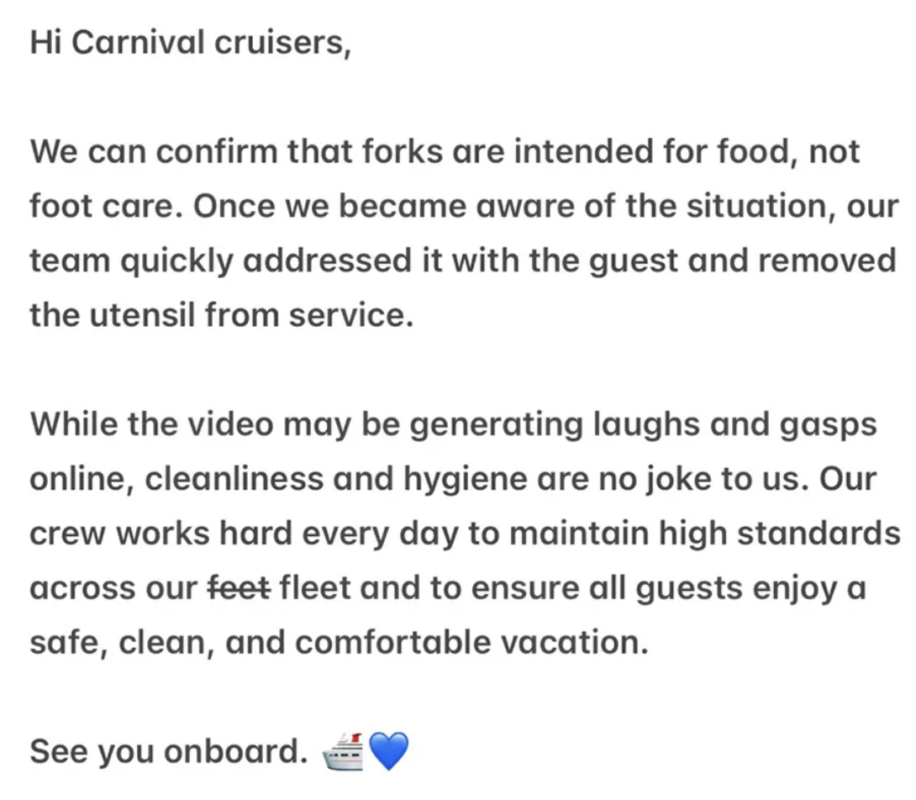
I asked Carnival if Fork Lady would be welcome on a future cruise. It has not responded.
But that got me thinking about who actually ends up on the banned-guest list, and whether the criteria make sense.
A brief history of cruise ship bannings
So why do people normally get banned?
The routine reasons are the ones written into every conduct code: physical violence or threats, illegal drugs, ignoring crew and safety instructions, vandalism, harassment and sexual misconduct, smoking where you shouldn’t, and fraud like chargeback scams and theft.
Those are the bright-line offenses, and the lines enforce them without much hesitation. We’ve also had numerous Do Not Sail list cases. A few that stuck with me:
- CBD mints. As Stephen and Susan Shub boarded the Carnival Conquest in Miami to spread a family member’s ashes, a drug-sniffing dog flagged Stephen’s backpack. Inside was a half-finished tin of mints, a few of them CBD. Carnival pulled his boarding pass, kept his roughly $500 fare and banned them both for life. Five months later, after I asked about the case, the cruise line reversed itself and mailed a $500 check to the Shubs.
- A broken picture frame. Norwegian Cruise Line put Christopher Yanchak on its Do Not Sail list over an incident on a New York to Bermuda sailing, saying video showed him breaking a picture frame in a hallway. Yanchak had no memory of it and asked to see the footage. Norwegian refused, citing the privacy of other passengers in the recording. He was banned on the strength of evidence he wasn’t allowed to view. After my team looked into the case, NCL took his name off the Do Not Cruise list.
- Vague “security concerns.” Broadway superfan Susan Kemen paid $4,996 for a themed cruise on the Norwegian Gem, then got a call the next day canceling her booking. The organizer, Sixthman, cited “security concerns” and wouldn’t say more. Kemen had a clean record, a parking ticket a decade back her only brush with the law. She got her refund but never got an explanation.
What lands you on the Do Not Sail list
The current lists cover unacceptable conduct toward others, and usually it’s enforced in an even-handed way.
For example, when a brawl broke out at the PortMiami terminal, 16 Carnival guests were banned. After a fight near the pizzeria on Carnival Sunrise, security confined at least one passenger to his cabin with a guard posted outside around the clock until the ship reached port, and Carnival confirmed those involved would never sail with it again.
Notice what every category has in common (other than that it happened on Carnival)? Malice, criminality, intent to harm.
But the fork passenger fits none of it. Fork Lady threatened no one, damaged nothing, broke no law. She created a public-health problem in a shared dining room, and that’s a category the lists barely address.
Section 2(f) of Carnival’s ticket contract—the legal agreement between you and the cruise line—requires guests to “comply with all pre-embarkation, onboard and shore excursion rules and policies including, but not limited to, all environmental and public health policies and procedures.” A lawyer could build a sanitation argument on that clause, but probably not enough to get someone put on the Do Not Sail List.
Still, cruise vessels are closed environments where norovirus and other illnesses move fast. A passenger who exposes hundreds of people in a buffet line to a fungal infection, or who ignores an isolation order during an outbreak, arguably endangers more people than a single guest throwing a punch in a lounge. Yet the puncher gets a lifetime ban and Fork Lady gets a laughing emoji.
What the cruise lines say
The cruise lines will tell you they don’t need a longer list, because they already have the authority to act. When you buy a ticket, you’ve already given the cruise line sole discretion to refuse service, which means conduct that isn’t specifically listed can still get you banned.
Carnival’s code says any guest whose conduct affects the comfort, enjoyment, safety or well-being of other guests or crew can be disembarked at their own expense and barred from future sailings. “Comfort” and “enjoyment” are probably broad enough to cover foot scratching. From the industry’s point of view, the system works as designed: Broad discretion lets a captain handle whatever a rulebook didn’t anticipate, without turning every voyage into a legal proceeding.
That’s the case for leaving things as they are. But is that the right call?
Is more power the answer?
The same broad authority that could bar a genuine health risk also bars people for reasons that never get explained. There’s no federal referee for this. The Federal Maritime Commission has narrow jurisdiction focused on safety, not customer-service disputes like arbitrary bans.
Once you’re flagged, you’re pretty much done. There isn’t much of an appeal process, and most cases go straight to the legal department. And the bans are usually brand-wide, across the parent company’s entire fleet.
So the debate isn’t only about which behaviors deserve a spot on the list. It’s about whether we trust cruise lines to expand a system that already runs with almost no transparency and almost no recourse. Adding “unsanitary” or “disgusting” to the criteria sounds reasonable until you ask who decides. A messy eater? A crying baby? A passenger with a visible skin condition?
If you answered yes: Should a health-based ban carry the same permanence as a ban for violence? Who should review the decision before it becomes final? What would you want the cruise line to prove before adding a passenger for a hygiene violation?
If you answered no: Where’s the line between a gross-but-harmless passenger and a genuine health risk? If the current conduct codes stay as they are, what should the crew do about a passenger exposing others to infection? Would you feel differently during a norovirus outbreak?
My take
I think this requires a common-sense approach. If you ban someone for doing something gross, first determine if there’s a genuine health risk. Follow up with a written explanation and offer a meaningful way to appeal in case the cruise line has it wrong.
Fork Lady is an easy target because the video is disgusting. But easy targets are exactly how bad policy gets written. Maybe a cruise line that can ban you for “comfort and enjoyment,” with no referee and no appeal, doesn’t need a broader mandate. Maybe it needs a check on the one it’s got.
Your turn
Should Fork Lady have been banned? And if the lines start banning passengers for bad hygiene, who do you trust to draw the line? Our comments are open.

Have a question about this story? Tell us what happened — we read every comment.
Join the conversation