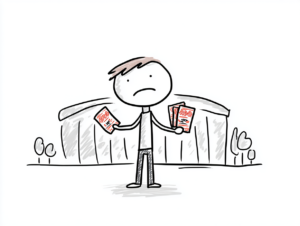
Robert Logan couldn’t wait to see Daryl Hall perform in Denver, but apparently Denver wasn’t on Hall’s list. After Logan paid $489 for a pair of tickets from StubHub, Hall canceled his performance.
And then Logan did what any sensible person would do: He asked for his money back.
He called. Then he called again. And again—six times in total. Each time, StubHub gave him the same corporate song and dance: “We will escalate the refund. Give us 4 to 5 days to resolve.”
But Stubhub, a ticket broker, was apparently out of touch with reality. The refund never materialized.
“I’m stuck,” says Logan. “StubHub will not and does not plan to refund my tickets.”
His case raises several important questions about ticket refunds:
- Does the Fair Credit Billing Act really have a 60-day expiration date for refunds?
- How does the FanProtect Guarantee actually work when a show is cancelled?
- Can a bank chargeback actually hurt your chances of getting a voluntary refund?
“I just want a full refund for my tickets”
A Daryl Hall concert is an “iffy” proposition. The half of the 80s group Hall & Oates had canceled previous shows because he tested positive for COVID and has struggled with Lyme disease.
But nostalgia is a funny thing. If you grew up in the 1980s, you probably remember the Hall & Oates hits like “Private Eyes” and “Maneater,” and if you like that kind of music, you’d take a chance. I know I would.
Logan’s concert wasn’t meant to be. Hall canceled the concert and didn’t reschedule it. The rules were clear: Logan was entitled to a full refund.
“I just want a full refund for my tickets,” he says.
After his calls failed, Logan tried his bank. But he ran into a wall there, too. Because he’d bought the tickets in June and the cancellation happened in October, his bank claimed federal laws prevented a refund since more than 60 days had passed since the purchase.
Logan didn’t go for that, so he contacted my advocacy team for help.
Is the 60-day dispute window a hard limit?
Logan’s bank said that because 60 days had passed from the date of purchase, “federal and governmental laws do not allow them to give me my money back.” This is a common point of confusion involving the Fair Credit Billing Act (FCBA). Under the FCBA, you generally have 60 days from the date you receive the first bill containing the error to dispute it in writing.
However, the “error” in Logan’s case wasn’t the original purchase in June; it was the failure to provide the service (the concert) in October. Many banks interpret the 60-day rule strictly from the transaction date, but the law is meant to protect you when services are not delivered as agreed.
In other words, Logan’s bank was wrong.
In Logan’s situation, the service was only officially “not delivered” once the cancellation was announced. While the FCBA provides a legal floor for protections, many credit card issuers have internal policies that allow for disputes much later than 60 days, especially for future-dated events like concerts or cruises.
Logan’s bank was being particularly rigid, perhaps hoping he’d just go away. But when a company takes your money for a show that doesn’t happen, it’s not just a billing error—it’s a breach of contract.
But that wasn’t Logan’s only protection.
What is the FanProtect Guarantee?
StubHub makes a lot of noise about its FanProtect Guarantee. It promises that if an event is canceled and not rescheduled, you’ll receive a full refund or a 120 percent credit. Looks great on paper, but as Logan discovered, the execution leaves something to be desired.
StubHub told me that its ability to process these refunds depends on receiving formal confirmation of the cancellation from the organizer or venue. Until that happens, the event might be stuck in a “postponed” limbo, which limits your options. Once the event is officially dead, StubHub sends an email with instructions on how to get the cash.
The problem for Logan was the escalation loop. He’d requested the refund, but the company’s internal gears weren’t turning fast enough. This is where the gap between a marketing promise and actual customer service becomes a chasm. A guarantee is only as good as the execution, and if the agent says “4 to 5 days” but the system can’t support it, what’s the point?
That’s how the trouble started.
The credit card chargeback trap
Here’s where things got messy. Logan, frustrated by StubHub’s delays, filed a chargeback with his credit card. StubHub later pointed to this as the reason for the delay, noting that it has a policy against issuing duplicate refunds when a chargeback is active.
When you dispute a charge under the Fair Credit Billing Act, the merchant often stops all internal refund processing because the money is now tied up in a legal tug-of-war between the financial institutions. StubHub’s representative told me the open chargeback was delaying the resolution.
That’s a classic Catch-22. You dispute the charge because the company won’t pay, and then the company says it can’t pay because you disputed the charge.
While it’s tempting to hit the nuclear option of a chargeback, it can sometimes move you to the back of the line while the lawyers and bankers sort it out. In Logan’s case, the bank initially told him it couldn’t help, but behind the scenes, the process was still churning.
A resolution—at last
After I contacted StubHub, it eventually confirmed that the bank had actually resolved the case in Logan’s favor. StubHub’s records showed the refund had been processed through that channel, which is why their internal system hadn’t issued a separate check.
Logan confirmed he received the full $489 he paid for the tickets.
If you find yourself in a similar situation, my advice is to skip the phone calls. Start a paper trail immediately and, if the company stalls, reach out to an executive. And maybe listen to a little Daryl Hall while you wait—he had it right when he said “watch out, boy.”

Have a question about this story? Tell us what happened — we read every comment.
Join the conversation