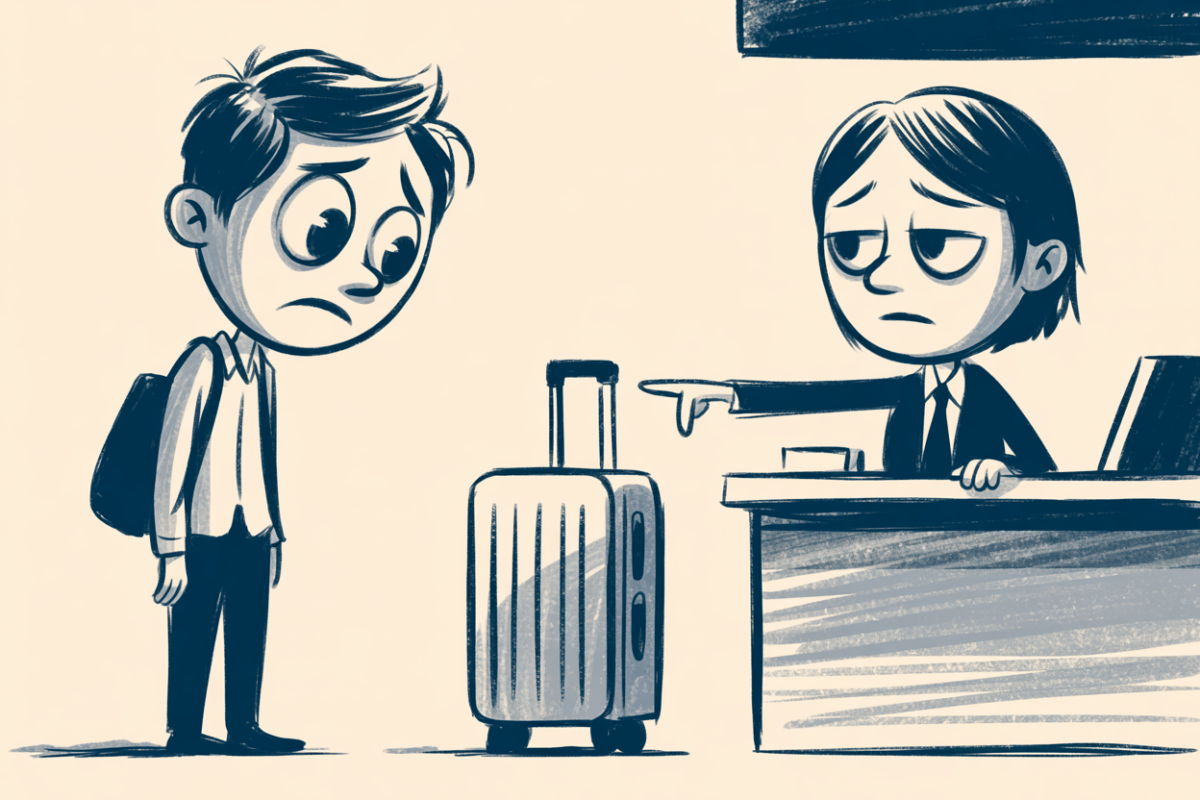
Benjamin Khoury knows how to follow instructions. So when he prepared for his Frontier Airlines flight from Dallas to Phoenix, he made sure his carry-on luggage was regulation size. He even measured it before his trip.
But at the gate, things took a strange turn. Despite Khoury’s bag fitting into the official measuring tool, the agent insisted it was an oversized personal item.
The price for this alleged transgression? A cool $99—practically a Benjamin for Benjamin.
Khoury paid under duress. He took a photo and documented the bag sitting snugly in the sizer, proving that the laws of physics were, in fact, on his side. Yet, when he reached out to Frontier’s customer care, he was met with a wall of boilerplate “nos.”
His case raises several important questions:
- Why do airlines ignore photographic evidence of a bag fitting in the sizer?
- Do gate agents have a financial incentive to charge passengers for bags?
- What are your rights when an airline’s “assessment” contradicts its own published rules?
I don’t want to have an “adversarial relationship” with companies I patronize, which is why I avoid Frontier if at all possible. That includes companies that do not respond to customer inquiries. I am not sure whether Frontier has included that in their business model.
Why do airlines ignore photographic evidence?
Khoury, a science teacher who is also enrolled in a graduate engineering program, cares about details. So before his Frontier flight—knowing how strict it was about luggage allowances—he made sure that his luggage was the correct size and weight.
It didn’t matter. A gate agent pulled him aside and gave him the bad news: He needed to pay $99 or his bag wouldn’t fly.
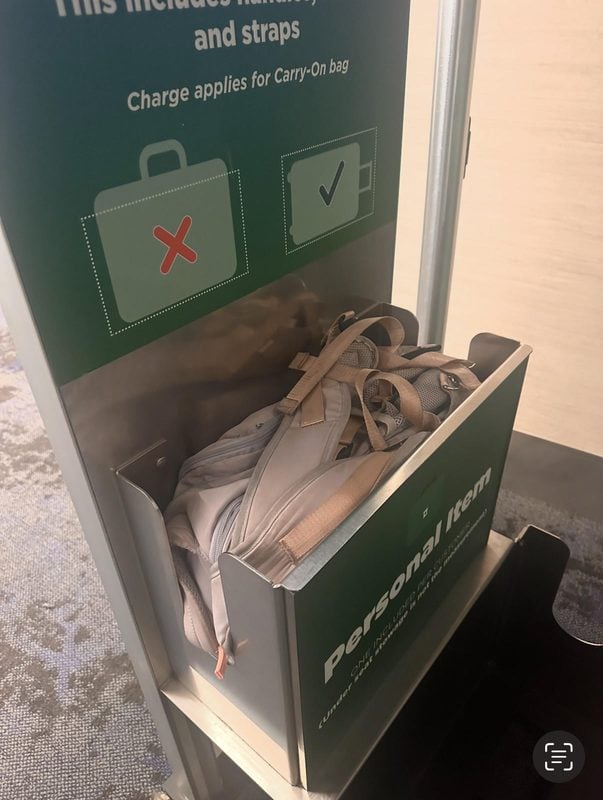
Khoury’s regulation-size backpack in the Frontier luggage sizer.
“They weighed it at the time and there was no problem,” he says. “The charge was solely based on the size.”
Even after Khoury showed the Frontier employees a photo of his regulation-size bag, they didn’t care.
“After reviewing your case, we confirmed that the charge was applied because the item was assessed as oversized or overweight at the airport,” a representative wrote. “Per Frontier Airlines’ policy, these fees are non-refundable.”
When a passenger like Khoury presents a photo of his bag sitting perfectly inside the sizer, you’d think the case would be closed in his favor. In any other industry, that’s called proof. In the airline industry, not so much.
Airlines like Frontier rely on the agent’s assessment at the time of boarding. This creates a “he-said, she-said” dynamic where the carrier almost always sides with its employee. From the airline’s perspective, a photo taken by a passenger might not show the full context. Maybe Khoury forced the bag in, or maybe it was protruding in a way the camera didn’t catch.
But let’s be real: Khoury isn’t out here trying to pull a fast one on the aviation industry over a $99 backpack charge. He followed the rules, used the sizer, and documented his compliance.
By ignoring this evidence, airlines like Frontier are sending a clear message: Our “assessment” is the only one that matters, regardless of what your lying eyes (or iPhone) tell you.
One other problem: The assessment happens in the heat of a boarding process where speed is prioritized over accuracy. Once you pay the fee, it’s entered into the system as a legitimate charge for an oversized item. Reversing it requires a human in a distant call center to override the “facts” reported by the gate agent—something they are loath to do because it undermines their own staff.
Wait, do gate agents have a financial incentive to charge you?
Here’s where things get interesting: For years, rumors have swirled that budget airline gate agents receive commissions for every bag they catch. But in Frontier’s case, these aren’t just rumors. The airline has previously admitted to paying bonuses to employees for collecting carry-on bag fees.
Think about that for a second. The person standing between you and your flight has a direct financial stake in finding something—anything—wrong with your luggage. It’s like a traffic cop getting a cut of every speeding ticket he writes. It changes the nature of the interaction from customer service to revenue collection.
Frontier’s bounty system creates an adversarial environment for passengers like Khoury. If agents see a bag that’s a tight fit, are they going to give the passenger the benefit of the doubt, or are they going to see an extra $10 in their next paycheck? When you combine this with the high-stress environment of a boarding gate, of course there will be conflicting reports.
What are your rights against an airline’s incorrect luggage assessment?
Technically, when you buy a ticket, you agree to the airline’s terms and conditions. Frontier’s policy says that baggage dimensions are verified at boarding and that their determination is final. This gives the airline a massive amount of wiggle room to charge you whatever they want, as long as an employee says the bag was too big.
But does that make it right? Under Department of Transportation (DOT) guidelines, airlines must be transparent about their fees and apply them fairly. If an airline is systematically using sizers that are smaller than advertised—a claim passengers have made in the past—they could be in hot water for deceptive trade practices.
Khoury did the only thing a consumer can do: He created a paper trail. He contacted the company, got a written refusal, and then reached out to an advocate (that would be me). By the way, I publish Frontier’s executive contacts on this site, just in case something like this ever happens to you.
Frontier doesn’t want to talk about this
I contacted Frontier on Khoury’s behalf.
The response? Silence.
My team contacted Frontier again and again over three months, but heard nothing. Finally, I decided to try one last time before writing this story, and Frontier responded.
A Frontier representative said there were “conflicting reports” about Khoury’s bag. Specifically, an agent said it was too big and Khoury said it wasn’t. But there was that photo, too. Kind of hard to ignore.
“As a gesture of goodwill, we are issuing a refund for the oversized bag fee,” a Frontier representative told me.
Khoury finally got his $99 back. It shouldn’t have taken a syndicated columnist and several weeks of back-and-forth to honor the evidence of a simple photograph. But in the world of “budget” airlines, goodwill is often the only way to overcome a bad assessment.
My advice: Keep your tape measure handy, keep your camera ready, and if the sizer says yes but the agent says no, don’t just get mad—get evidence.

Have a question about this story? Tell us what happened — we read every comment.
Join the conversation