To get an idea of how hard it is to kill nuisance surcharges at restaurants, consider what happened in San Francisco.
More than a decade ago, the city required employers to spend money on their workers’ health care. Many restaurants responded by adding a few percent to every check, labeled as a “health care surcharge.” Then the city attorney’s office found that some restaurants weren’t spending the money on health care. Dozens of restaurants were fined.
You’d think that would have ended it. It didn’t.
San Francisco’s city attorney is back. This time he’s a co-plaintiff with the Federal Trade Commission and seven states in a new lawsuit against Toast, the restaurant software company. The government alleges Toast added a 99-cent fee to diners’ online orders over $10 for almost two years, first in test markets and then at every Toast restaurant. The money went to Toast, not the restaurant. According to the complaint, neither the restaurants nor their customers agreed to it.
Toast says it strongly disagrees with the allegations in the lawsuit, adding that it remained committed to “providing innovative solutions to restaurants in a competitive market.”
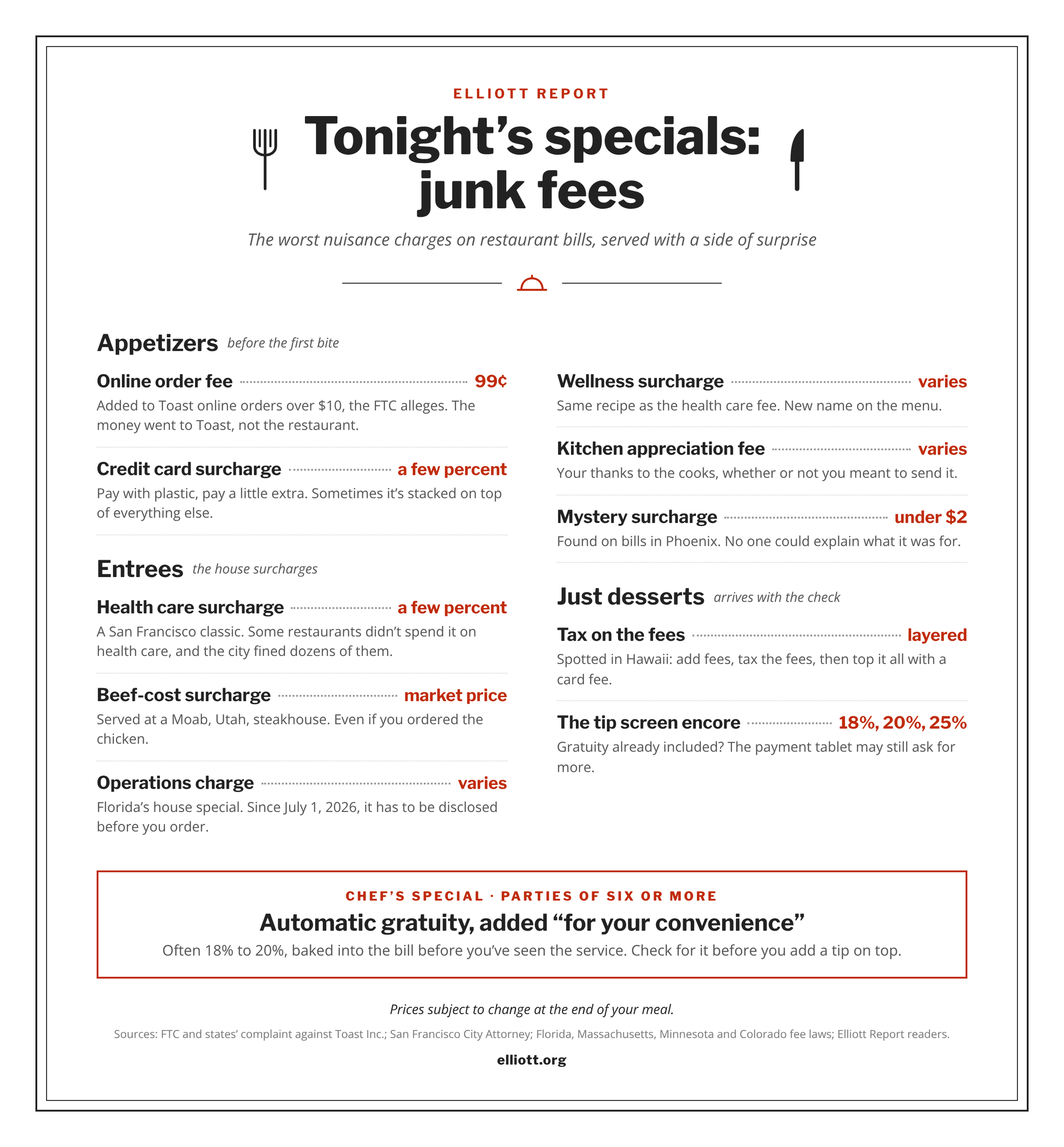
Restaurant surcharges are the cockroaches of junk fees. A regulator flips on the lights, they scatter, and then they come back under a new name — a health mandate fee, a wellness surcharge or a kitchen appreciation fee. Don’t even get me started on tipping, which feels very mandatory in the United States. That’s the receipt ambush: a fee you don’t see until you’re signing the check.
The states are chipping away at it, one disclosure rule at a time, but it’s not working. The solution needs to be bigger.
My readers have had enough
I hear about these fees all the time. Alan Levine, a retired magazine editor from New York, had dinner at a steakhouse in Moab, Utah, and found a “beef-cost surcharge” on his bill.
“My server claimed the beef-cost surcharge was standard,” he says. “But I had ordered chicken.”
In Hawaii, he says, one restaurant added fees, charged tax on the fees and then added a credit card fee on top of the whole thing.
Alan Craig, a retired executive from Phoenix, found surcharges of under $2 at two restaurants in his hometown. No one could tell him what they were for. “I paid it, but I let them know these fees are bad for business,” he says.
He’s right. A menu price is an implicit promise. When a restaurant breaks it at the end of the meal, it’s counting on you to pay rather than argue over a couple of dollars. Most people do, not wanting to cause a scene. Those couple of dollars, multiplied across millions of checks, are why the receipt ambush won’t go away by itself.
Some states are trying to fix this
Several states have adopted new rules in the last two years:
- Massachusetts. The attorney general’s junk fee regulations, effective Sept. 2, 2025, require businesses to include mandatory fees in the first price you see.
- Minnesota. A state law that took effect Jan. 1, 2025, requires advertised prices to include mandatory fees. It applies to all restaurants.
- Colorado. Under a deceptive pricing law that took effect Jan. 1, 2026, restaurants can still charge a service fee. But they have to disclose the amount and who gets the money up front.
- Florida. A law effective July 1, 2026, requires restaurants to disclose an “operations charge” before you order and list it on your receipt.
Notice a pattern? Only Massachusetts and Minnesota require the price on the menu to be the price you pay. The rest just ask restaurants to warn you about the ambush.
California blinked
California was supposed to settle this. Its Honest Pricing Law banned mandatory fees not included in the advertised price, starting July 1, 2024. Restaurant surcharges, including the ones in San Francisco, looked doomed.
Two days before the law took effect, Gov. Gavin Newsom signed a carve-out for restaurants. Under that law, restaurants can keep their surcharges as long as they post them. The state with the toughest junk fee law in the country lost its nerve on the one industry that needed the law most.
Washington needs to finish the job
Federal regulators haven’t done much better. The FTC’s rule on unfair or deceptive fees took effect in May 2025. It covers live-event tickets and short-term lodging. Restaurants aren’t included.
The Toast case shows that the FTC can still go after bad actors one at a time. But it’s slow. The 99-cent fee ended in 2023, and the lawsuit came three years later.
Look, this doesn’t have to be complicated. Congress should pass an all-in pricing law that covers restaurants. If a charge is mandatory, it goes in the menu price. Tips stay optional. If a restaurant needs more money to pay its staff, it can raise its prices like every other business. Diners can handle a $24 entree. What bothers them is a $22 entree that ends up costing $24.
Until then, here’s how to protect yourself
In the meantime, you’ll have to protect yourself. Read the menu carefully, including the fine print at the bottom. If you see a surcharge or service fee, ask your server what it is, whether it’s mandatory and who gets the money. Ask before you order, not after.
If a fee shows up on your bill that no one told you about, politely ask to have it removed. That’s what Levine did in Moab.
“I told them that my standard way of dealing with thieves is to walk away,” he says. The restaurant took the charge off his bill.
San Francisco has been fighting this fight for more than a decade. You shouldn’t have to.

Have a question about this story? Tell us what happened — we read every comment.
Join the conversation