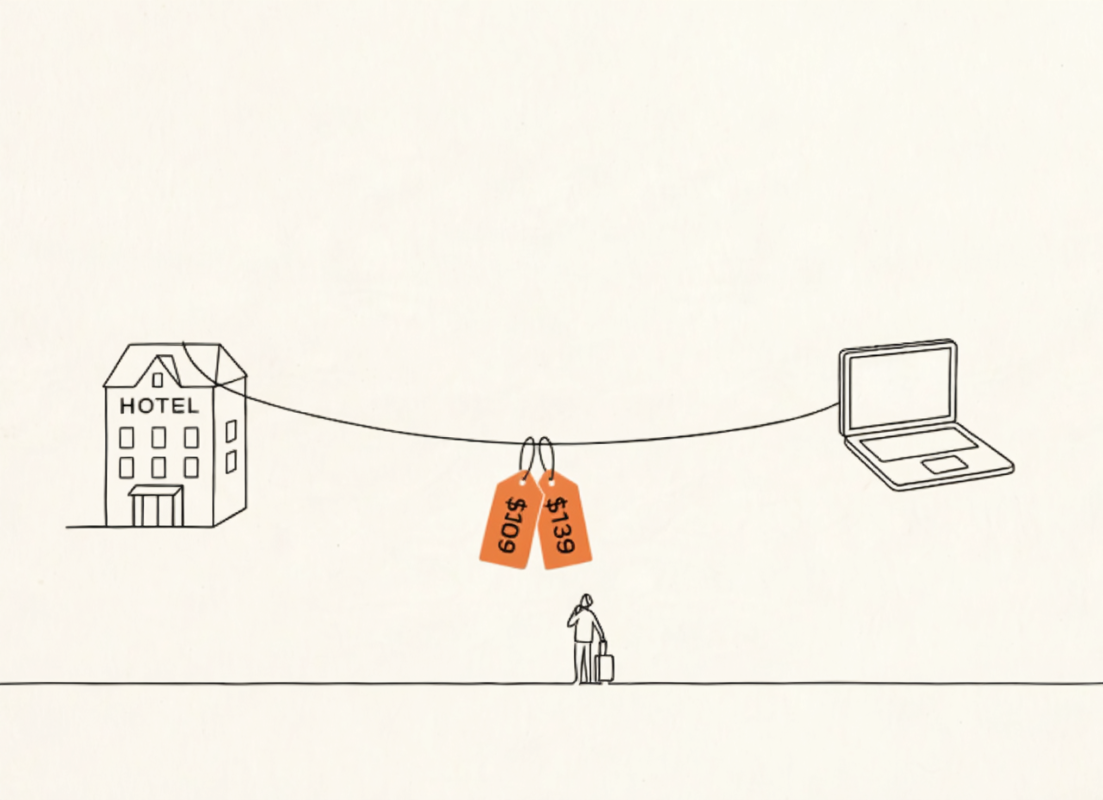
When Hilary Azzaretti found a deal on a Croatian hotel’s website, she did what any smart traveler would do. She double-checked the price on Expedia.
The rate was pretty much the same. The only difference was the fine print. The hotel’s deal was nonrefundable, but Expedia let her cancel up to two days before arrival.
So she booked with Expedia. The hotel lost her direct booking to a middleman, which Azzaretti says was “definitely not worth it for the hotel.”
That’s no coincidence. Many hotels that list on booking sites agree never to sell a room for less on their own websites. It’s a contract term called a rate parity clause. Most travelers have never heard of it, but a new lawsuit says it’s raising hotel prices for nearly everyone, including people who never visit an online travel site.
Maybe it’s time for the United States to put an end to rate parity clauses, the way much of Europe already has.
The promise you never signed
Expedia’s lodging agreement says a hotel’s rates “will be equal to or better than” those on the hotel’s own online channels, according to the lawsuit, Andrews v. Expedia Group, filed October 2 in federal court in Seattle.
Notice which way that runs. The booking site can be cheaper than the hotel. The hotel can’t be cheaper than the booking site. That’s probably why Azzaretti found the same rate in both places.
Why should you care if you book directly? Booking sites charge hotels a commission. The lawsuit puts it at about 15%, climbing to 25% or 30% for hotels that pay for better placement. A hotel can’t discount its own website to pass those savings to you. So it builds the commission into every rate, everywhere.
Call it the invisible commission. You pay it even when you never touch the middleman.
A system that polices itself
The complaint alleges that Expedia pushes hotels down its search results when they sell for less on rival sites. It also describes an automatic rate-match tool that lowers a hotel’s Expedia price whenever a cheaper rate shows up elsewhere. According to the plaintiffs, Expedia handles nearly 80% of U.S. hotel bookings made through online travel agencies.
Expedia has called the allegations “meritless.” The company says it has offered travelers transparency and value for more than 30 years.
Europe already said no
None of this is news to Europeans. Germany’s competition regulator banned Booking.com’s parity clause in 2015. The country’s top civil court upheld that decision in 2021. France outlawed the clauses the same year as the German ban. Austria and Italy followed. Switzerland’s Lex Booking law took effect in 2022. It bars booking sites from controlling what a hotel charges or offers on any other channel, including the hotel’s own website.
Then the European Union went further. Its Digital Markets Act bars Booking.com from imposing parity at all. In 2024, the EU’s highest court ruled that parity clauses aren’t necessary for a booking platform to do business.
My favorite detail is in Expedia’s own contract. The parity language in its contract starts with the words, “Unless you are located in Australia.” That’s because Expedia dropped the clause there in 2019 after a probe by Australia’s competition regulator, according to the lawsuit. So Australians get a deal Americans don’t.
Don’t expect a price miracle
Would a ban lower room rates? Probably, but not by 30%. After Germany’s ban, researchers found that chain hotels offered the lowest price on their own websites far more often, increasing from 6% of the time to about 10%. Other studies found modest changes in overall prices.
But there’s a catch: Booking sites rank hotels partly on price, so a hotel that undercuts the site can still slide down the results. Some European hoteliers say that’s happening now. A ban that ignores the ranking penalty won’t accomplish much.
Rate parity undermines the principle of a free market. In a competitive market, sellers fight for your business on price. A hotel that saves 15% or more by selling a room directly should be free to share some of those savings with you.
A booking site that wants your reservation should have to earn it with a better price or better service. Parity clauses take both choices off the table. They let the dominant middleman put a floor under everyone’s rates, including the hotel’s own. The result is a private price control, written by the company that profits most from it.
What Washington should do
The American record here is sketchy. A federal judge in Texas threw out a major online hotel booking case in 2014. The Federal Trade Commission’s case against Amazon, which makes similar price-parity claims, won’t go to trial until March 2027.
Look, this doesn’t have to be complicated. Congress can ban parity clauses for hotels, and it should. The rule should also cover the tools that do the same job, including search penalties and automatic rate matching.
Hotels should be free to show guests how much commission they pay on a booking. States don’t have to wait for Washington, either. Switzerland did it with a short amendment to its unfair competition law. Any state can copy it.
For years, I’ve told my readers to book directly with the hotel. I was half right. The hotel’s website is where you ought to find the lowest rate. Thanks to a clause almost nobody has read, it’s usually where you find the same rate as everywhere else.
Until the law changes, try something contrarian. Call the hotel and ask for its best rate. As the lawsuit describes it, Expedia’s clause covers only online channels. The person at the front desk may have more latitude to offer a lower price than the website does.
Resolve it yourself
Stuck with a complaint? Build your path to a fix.
Answer two quick questions and get a step-by-step plan tailored to your situation.
Your plan

Have a question about this story? Tell us what happened — we read every comment.
Join the conversation