If you’re booking a holiday trip, you’ve probably already seen the warnings. “Only 3 seats left at this fare.” “Booked 17 times in the last 24 hours.” “12 people are looking at this hotel.”
Sometimes a clock ticks down next to the price.
Do any of those numbers mean anything? Joshua Clouette found the answer by accident.
Clouette, who lives in Marlborough, Mass., tried to change his business class ticket on an Asian carrier recently. During the call, he asked a supervisor how many business class seats were left on his flight. The supervisor said that information couldn’t be shared.
Then Clouette asked about the airline’s website, which declared “only 3 seats left.” Was that true?
“Not necessarily,” the supervisor told him, adding that the site might “not reflect actual availability.”
“To me, this suggests they’re deliberately creating false urgency on their website,” he told me.
Clouette’s case raises a question few travelers think to ask during the holiday booking rush. When a website says a deal is about to vanish, how do we know it’s true? In the United States, almost nobody checks. Maybe that should change. If a hotel claims there are only three rooms left at this price, it should be ready to prove it. If it can’t, it shouldn’t say it.
When I see “only 2 left” on a website, I go to another site that also sells that item (airfare, hotel room, etc.) and they’ve usually got plenty at the same price or lower.
It’s either false scarcity or the site itself has been allocated a certain number of rooms, seats, etc. by the original vendor, but they can get more if need be.
An old trick with a new urgency
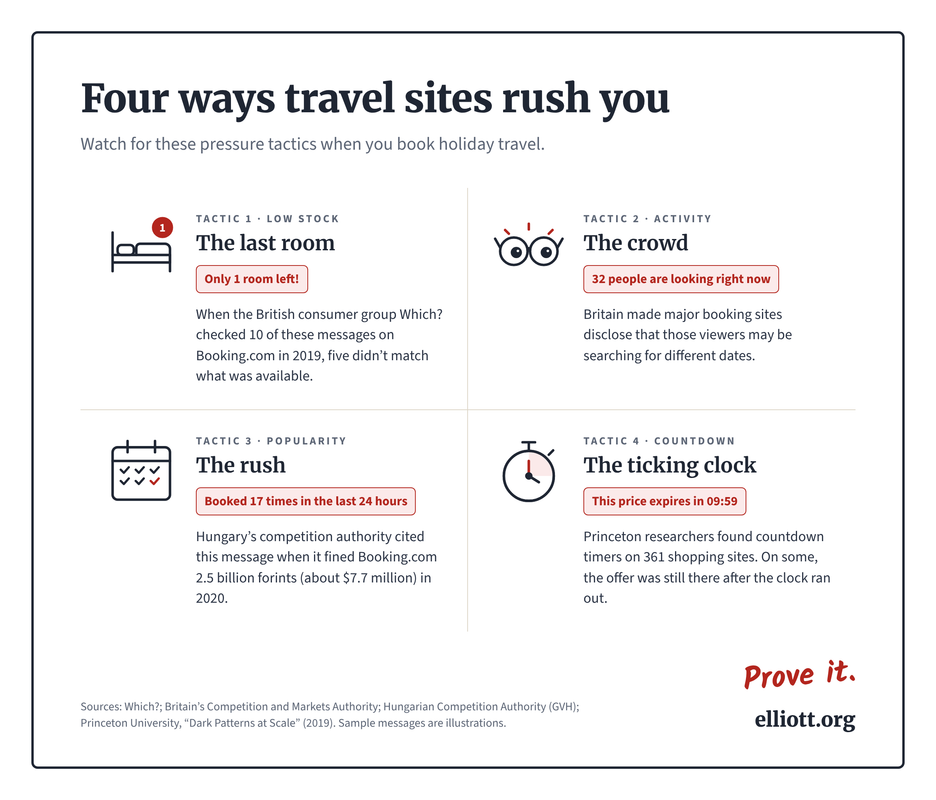
None of this is new. A few years ago, Princeton researchers crawled about 11,000 shopping sites and found low-stock messages on 581 of them. On some online stores, the same warning appeared on every product, regardless of inventory. Countdown timers showed up on 361 sites. On some, the “expiring” offer was still available after the clock ran out.
Travel shoppers face extra pressure this holiday season. Fares and room rates are high and holiday dates are filling up. Nobody wants to pay more by waiting. A scarcity message plays on all of that.
Readers who contact my advocacy team describe the panic. David Stuebner, a railroad manager from Sturgeon Bay, Wis., says his airfare jumped from $1,791 to $2,325 while he typed in his wife’s passenger information. He changed no flights, no dates and no fare class. His airline told him it couldn’t adjust the price.
After an experience like that, the next “only 2 seats left” message looks like a threat you can’t afford to ignore. The travel industry is counting on it.
Other countries already cracked down
Regulators abroad saw this and did something about it years ago.
In 2019, Britain’s Competition and Markets Authority got Expedia, Booking.com, Agoda, Hotels.com, ebookers and Trivago to agree to stop giving a false impression of a hotel’s availability or popularity. The sites also promised to stop rushing customers. When they say other people are viewing a hotel, they now have to disclose that those people may be searching for different dates.
Did it work? Not immediately. Months later, the British consumer group Which? checked 10 “only 1 room left” messages on Booking.com and found that five didn’t match what was available. One Liverpool bed-and-breakfast showed “1 room left” for a budget double. Which? clicked through and found four identical rooms at 49 pounds (about $65) each. Booking.com said it had worked to meet its commitments.
Hungary went further. In 2020, its competition authority fined Booking.com 2.5 billion forints (about $7.7 million) over pressure-selling tactics. Among the messages it cited: “32 more people are also watching” and “Highly sought after! Booked 17 times in the last 24 hours.” Sound familiar?
Booking.com and Expedia also made commitments to European Union consumer authorities in 2019 and 2020 to change how they present offers and prices.
And in the U.S.?
In 2022, Federal Trade Commission staff published a report called Bringing Dark Patterns to Light. It named fake countdown timers and false scarcity claims as tactics designed to plant false beliefs. A report isn’t a rule, though. I couldn’t find a single U.S. enforcement action against a travel company over a scarcity claim.
Airlines are a special case. The Department of Transportation, not the FTC, polices unfair and deceptive practices by airlines and ticket agents. A seat count that doesn’t match the seats for sale should fall within its authority. Lately, though, DOT has been forgiving airline penalties, not imposing them.
What to do about false scarcity claims
A scarcity or demand claim must be true at the moment it’s shown, and the company has to keep records that prove it. Three seats left means three seats in that cabin on that flight and date. A “people are viewing” counter has to say what it’s counting. A countdown timer means the price changes when it hits zero.
DOT can enforce that for airlines today. The FTC and state attorneys general can enforce it for hotels and booking sites under existing deceptive-practices laws. They don’t need a new statute, just the will to ask for the data and to take action.
Until regulators do their job, travelers must approach every urgency claim with deep skepticism. Don’t let high-pressure tactics or arbitrary countdowns force a hasty decision. Instead, demand transparency and hold booking platforms accountable when their claims don’t add up.

Have a question about this story? Tell us what happened — we read every comment.
Join the conversation