You don’t have to be a frequent traveler to know that the rules of flying now favor the airline.
You can feel it at the gate when your flight is delayed for the third time and nobody offers you anything, not even an explanation. You see it when an airline advertises a fare that bears little resemblance to what you actually pay for your ticket.
Your suspicions are correct. In the United States, passenger rights are shrinking.
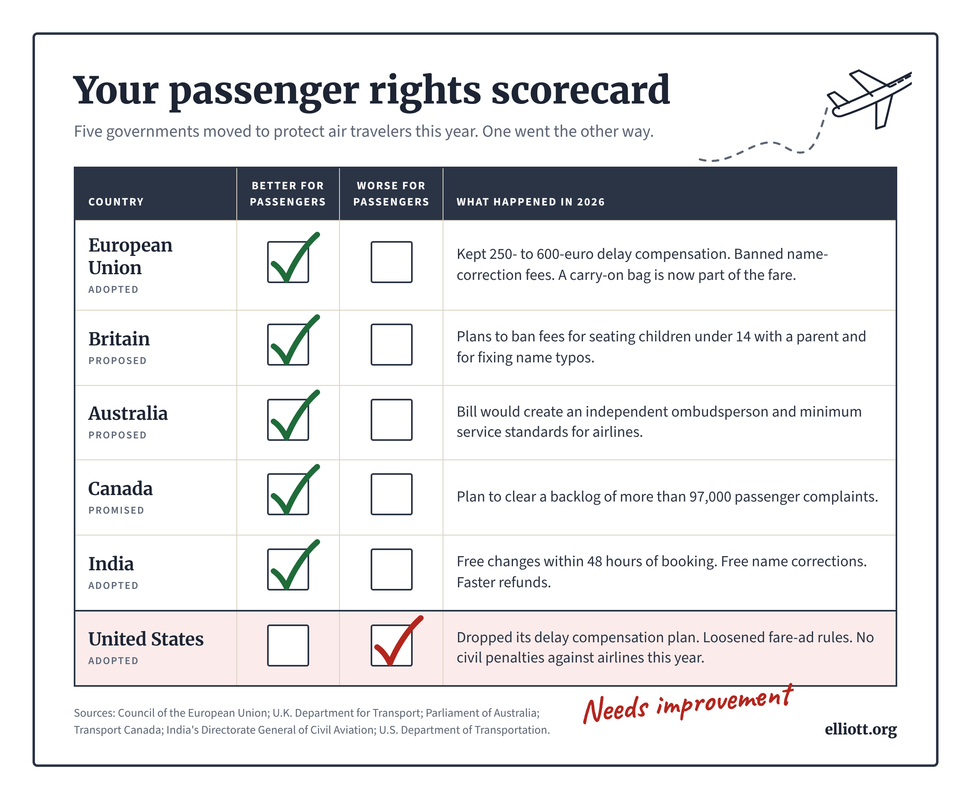
Elsewhere, they’re growing. Europe, Britain, Australia, Canada and India have all moved to protect air travelers this year. But here in the U.S., the Department of Transportation (DOT) has spent the better part of the last two years dismantling the few rules that existed.
What the U.S. is doing for airline passengers
The government dropped a plan to require cash compensation for long delays within an airline’s control. It also abandoned a proposal that would have required airlines to cover meals and hotels during major disruptions.
This summer, the DOT formally removed a 2024 fee-disclosure rules. It also proposed an elimination of the full-fare advertising rule, reopening the door to the old “$49 fare (plus taxes and fees)” ad.
The government also extended its pause on refund enforcement for “renumbered” flights through next summer. That creates a loophole allowing airlines to simply renumber a delayed or canceled flight and avoid paying any kind of compensation or refunds to passengers.
No more airline fines?
Enforcement has collapsed along with the rules. I reported in August that the government hadn’t assessed a single civil penalty against an airline for violating consumer protection rules this year.
Instead, it has forgiven nearly $28 million in fines since December. Southwest got the last $11 million of its penalty waived for the December 2022 holiday meltdown. American had nearly $17 million of its wheelchair-handling penalty released. Under a policy DOT adopted in January, an airline that breaks the rules now generally gets a warning letter first. Fines are reserved for conduct the department considers “widespread, systemic, egregious or intentional.”
The department’s position is that it will enforce every protection Congress requires, including refunds for canceled flights. It argues that some Biden-era rules went further than the law demands.
To be fair, DOT did finalize a rule in April requiring every airline to post a one-page summary of passenger rights. The trouble is that the list of rights it summarizes keeps getting shorter.
What everyone else is doing
Let’s start with Europe. On July 7, the European Parliament approved a long-delayed overhaul of its air passenger rules by a vote of 646 to 12. Airlines had lobbied for years to push back the point at which delay compensation begins. They lost.
Passengers receive compensation ranging from 250 to 600 euros (about $280 to $672) for delays of three hours or more. Fixing a misspelled name will be free of charge. Fares on booking sites must include a carry-on bag from the first search screen, although airlines may still offer a discount to passengers who travel without one. The rules take effect in 2027.
Britain is next. On October 1, the U.K. Department for Transport announced plans to ban charges for seating children under 14 next to an accompanying adult. It would also end fees for correcting spelling errors on a ticket, as the EU’s new rules will.
The department’s own numbers show what’s at stake: up to 104 British pounds (about $138) per round trip for family seating, and up to 40 pounds (about $53) to fix a typo. The changes depend on the Civil Aviation (Consumer Protection and Regulatory Reform) Bill, which is still working its way through Parliament.
Australia introduced its Aviation Consumer Protection Bill on April 1. It would replace the industry-funded Airline Customer Advocate, which the minister described as widely considered ineffectual, with an independent ombudsperson. A charter would set minimum standards for airlines and airports. Carriers would have to report the reasons for delays and cancellations. A new authority inside the Department of Infrastructure would enforce it all. The bill doesn’t include European-style cash compensation for delays.
Canada has plenty of rules on the books. Its problem is enforcement. In May, the government said more than 97,000 passenger complaints were stuck at the Canadian Transportation Agency. It promised to bring in an outside dispute-resolution group to clear them and to stop requiring passengers to keep the process confidential. It also noted that fines for systemic violations can reach 1 million Canadian dollars (about $700,000).
India also moved to protect air travelers this year. As of March 26, passengers who book directly with an airline can cancel or change a ticket within 48 hours at no charge, provided the flight date is far enough out. Name corrections reported within 24 hours are free. Refunds are due within 14 working days.
None of these systems is perfect. Each one, though, is moving toward the passenger.
What happened to the watchdogs?
How could this unfold in the last two years without anyone noticing? Well, it didn’t all happen at once, so unless you’re a beat reporter for a major news organization, you probably wouldn’t have noticed this gradual erosion of consumer rights.
But even if you were, you might have your reasons for overlooking it. After all, you wouldn’t want to incur the wrath of this highly litigious administration. But a certain newspaper of record finally caught up with this story earlier this month. It called two consumer advocates at the top of its Google search results for a comment and then called it a day. Nice work.
This story has been unfolding for months, and readers of this column have watched the rollbacks pile up one at a time. But you don’t need to ask a consumer advocate if things are bad. Just pay attention to the Federal Register. Or just book an airline ticket.
What you can do about it
American travelers can’t vote in the European Parliament. You can take advantage of its rules, though. EU protections cover any flight departing from an EU airport and any EU airline flying into or out of an EU airport. If you have a choice of carrier, that coverage has value.
Ask for compensation for long delays and flight cancellations. Pay with a credit card so you can dispute a charge for a flight you didn’t take. File complaints with DOT even if enforcement is slow, because those numbers show up in the monthly Air Travel Consumer Report and go on an airline’s permanent record.
When DOT opens a rule for public comment, file one. Airlines always do.
Most importantly, vote. Find candidates who believe in stronger consumer protections and support them in this midterm election.

Have a question about this story? Tell us what happened — we read every comment.
Join the conversation