Americans have spent this summer cutting down license plate cameras. They’ve packed city council meetings with printouts of search logs, and a few towns have canceled their surveillance contracts.
The target is Flock Safety, whose automated license plate readers are installed on poles in thousands of American communities, and the anger got loud enough that the company backed down last week.
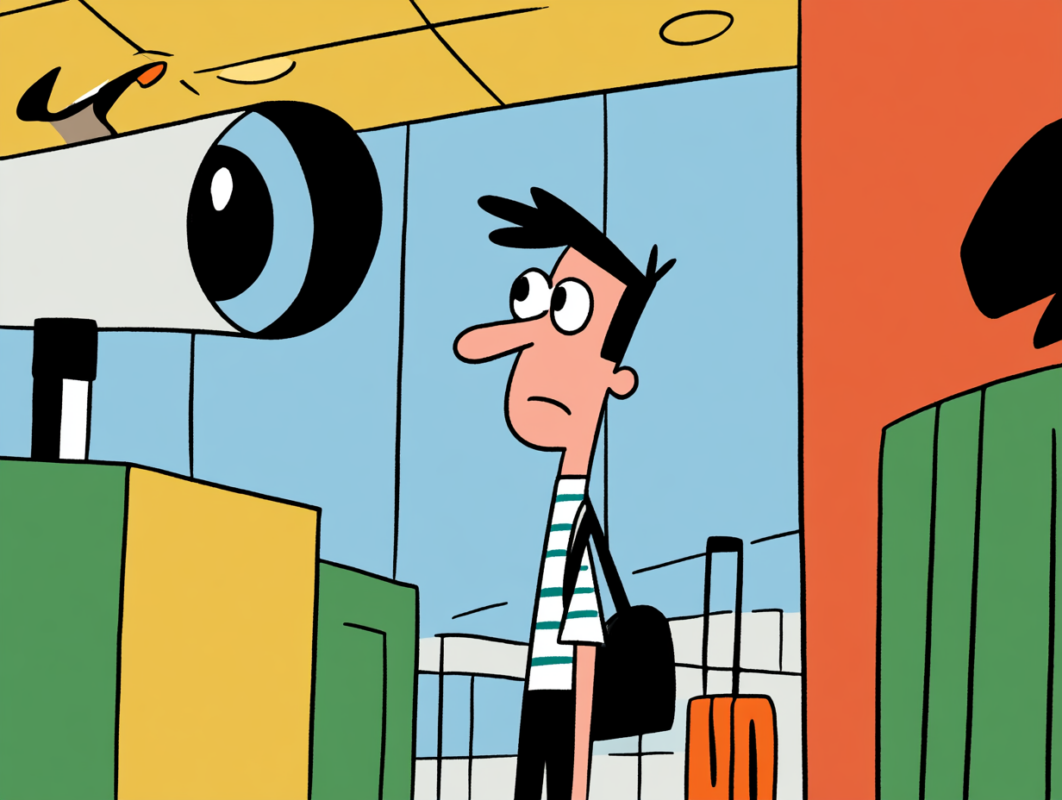
Then a lot of those same people drove to the airport, walked up to a checkpoint, and let a machine photograph their face without a complaint.
What Flock changed, and why
Flock announced a set of privacy changes after losing contracts and absorbing months of criticism. (You may recall Darth Vader in San Diego and the Ohio man who felled a Flock pole but then wasn’t indicted despite photographic evidence of the crime.)
Among the changes: Cities can now limit what other agencies may search their cameras for, blocking immigration enforcement searches while still allowing violent crime lookups.By the end of 2026 every search will require a case code, and default retention will drop from 30 days to seven.
The pressure came from what the logs showed. A Utah investigation found that 10 cameras in a single county had been searched 5.1 million times by agencies in 45 states, which prompted Gov. Spencer Cox to send the state Privacy Commission after the rules. Officials in Mountain View, Calif., have alleged that federal and state agencies accessed their camera data without consent.
The ACLU called Flock’s changes “a thinly veiled PR attempt.”
But there’s more to this story.
Are we all naïve enough to think that our faces aren’t already in global databases? I obtained entry ETAs for New Zealand and Australia last year and had to provide a picture. I just received my UK ETA, which did a scan of my face and also a picture. I received my confirmation for all three immediately. If this isn’t facial recognition, what is?
What’s happening at the checkpoint?
Airport facial recognition is moving in the opposite direction, but hardly anyone is paying attention. TSA PreCheck Touchless ID ran in 15 airports at the start of the year, with the agency promising 65 by the end of the first quarter. Facial comparison cameras at standard checkpoints have been rolling out for years and are headed toward hundreds of airports.
The legal protections haven’t kept pace. S. 1691, the Traveler Privacy Protection Act, would let you opt out, bar the TSA from making face scans mandatory, and prohibit any penalty for declining.
It’s about as bipartisan as a bill gets: three Republicans and three Democrats, from Kennedy of Louisiana to Markey of Massachusetts. When Sen. John Kennedy introduced it in May 2025, he said the TSA “subjects countless law-abiding Americans to excessive facial recognition screenings as they travel, invading passengers’ privacy without even making it clear that they can opt out.”
The bill got pulled from its Senate markup after airline industry pushback and hasn’t moved since. A second bill, S. 3779, the ICE Out of Our Faces Act, would ban ICE and CBP from using facial recognition at all. It’s also frozen.
The agency has its own plans. In a Federal Register notice reported in January, the TSA floated centralizing traveler account management and letting biometric data move between programs, connecting PreCheck records with CBP’s Global Entry database. Almost nobody outside the privacy groups bothered to comment.
There’s been some pushback. Last week, Rep. Shontel Brown and Sen. Ron Wyden asked the Government Accountability Office to investigate the DOT’s failure to protect airline passenger data.The lawmakers cited four decades of inaction from the DOT, noting it hasn’t executed any privacy enforcement measures, leaving millions of travelers vulnerable to corporate data mining and warrantless government surveillance.
Why facial screening works
The TSA’s argument is that the technology verifies you’re the person on the ID, catching fraudulent documents better than a tired officer at 5 a.m. In short, it speeds up the screening process. Touchless ID promises verification in under 10 seconds.
The agency says the photos aren’t retained in normal operations, and that declining a scan carries no penalty. Airlines like it because it moves people. Airports like it because it moves people. Congress has shown no appetite to slow it down.
But should it? Is the travel industry about to have its own Flock moment?
If you answered yes:
- Have you ever actually said “I opt out” at a checkpoint? What happened?
- Did the officer honor it without comment, or did you get pushback?
- Would you still opt out if it added 10 minutes to your wait?
If you answered no:
- Is it the convenience, or do you not object to the scan itself?
- Would you change your mind if the photo were kept and shared across agencies?
- Do you know the opt-out exists?
My take
The Flock backlash was so effective because people could see the cameras. They’re bolted to poles at eye level on streets where people live. When the search logs came out, it was hard to argue with them.
A camera on your street reads as an intrusion. A camera at the airport doesn’t, though the airport version collects more than a license plate. It records your face, connects it to your name, your itinerary, and now possibly your Global Entry file.The public is conditioned to believe that airport scans are necessary for security, which may be why we don’t question them.
The opt-out exists as agency policy, which means the agency can revise it whenever it likes. The bill that would make it law has gone nowhere for over a year, and the officers running the scanners aren’t always told that declining is your right. Every traveler who says “I opt out” makes the policy harder to retire.
In other countries, facial recognition is firmly embedded in the screening process, and there’s no way out. Try saying you opt out when you’re flying into Singapore, and you’ll see what I mean.
Your turn
Have you tried to opt out of a face scan at a U.S. airport? Tell me which checkpoint, what you said, and how the officer responded. If you were turned down or pressured, I want the details.

Have a question about this story? Tell us what happened — we read every comment.
Join the conversation