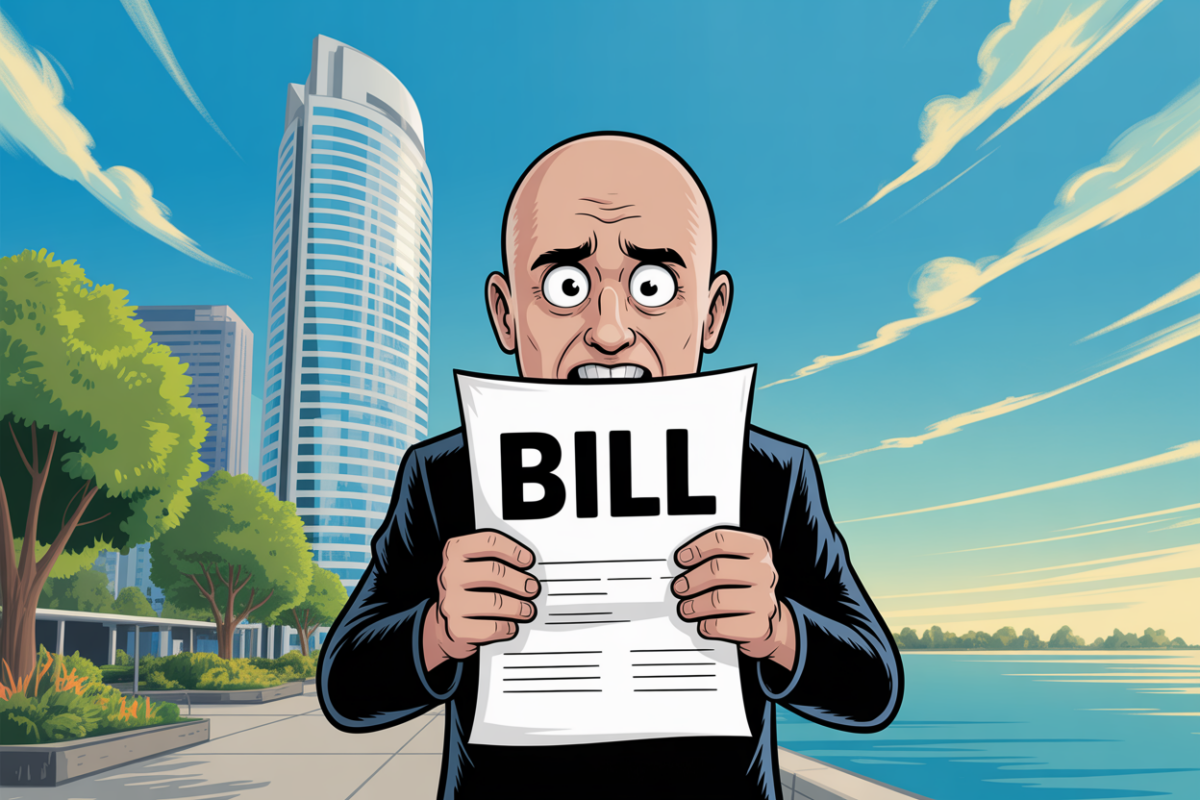
in this case
- Mitch Gershenfeld faced a medical emergency in Qatar that forced him to pay nearly $18,000 out of pocket.
- He submitted his medical records to GeoBlue five separate times, yet the insurer denied his claim citing missing documentation.
- Stuck in a loop of bureaucratic requests and rejections, he turns to the advocacy team for help.
Mitch Gershenfeld expected an adventure when he retired to travel the world — not a medical misadventure that would pit him against his health insurance company. But that’s exactly what he got after landing in a hospital in Doha and then filing a claim with GeoBlue.
“I provided all of my hospital records and bills to GeoBlue four times,” he says. “Now they have rejected my claim, saying I did not provide medical records.”
His story isn’t just about hospital bills and delayed claims. It’s a cautionary tale about how insurers can bury customers under paperwork, hope they give up — and what happens when someone fights back.
Gershenfeld’s case raises several critical questions for any traveler trusting an insurance policy:
- What should you do when your insurer repeatedly claims your medical records are missing?
- How can you protect yourself from international medical claim runarounds?
- What is the golden rule about medical insurance claims abroad?
The stone that started an avalanche
Gershenfeld and his wife, Sam, are roving expats who visited Doha, Qatar, last year. That’s when Gershenfeld experienced a fever and a sharp, excruciating pain in his abdomen, which a doctor quickly diagnosed as kidney stones.
“When I arrived at the emergency room, I gave them my insurance card,” he says. “They told me that they don’t accept GeoBlue and that I would have to pay up front. At that point, it was only the emergency room fee. I was in so much pain that I didn’t think to call GeoBlue, especially since I was told the hospital didn’t accept it.”
So, aided by pain meds, he says he happily gave them his credit card.
Three surgeries and eight days later at The View Hospital, he emerged with a $17,746 bill. He paid the full amount when he was discharged.
Gershenfeld quickly turned to his international medical insurer, GeoBlue, and filed a claim. He believed his comprehensive insurance would cover his bill.
He meticulously gathered everything the insurance company required: discharge summaries, operation records, detailed patient bills, pharmacy invoices, doctor contacts – the full dossier. He submitted it all through GeoBlue’s online portal.
Then the requests started.
“Please provide all supporting medical records”
A few days later, an email arrived from a GeoBlue representative.
“We understand that recently you were admitted to the hospital for the treatment of kidney stones,” it said. “In your direct reply to this email, please provide all supporting medical records which illustrate medical necessity.”
It asked for more details, including medical records, hospital contacts, diagnosis and the names of the physicians who had treated him.
Gershenfeld was puzzled, because he had already sent the information to GeoBlue.
He replied the same day, attaching the documents again and meticulously listing the hospital and urologist details. “The attached documents should contain all of the information you need,” he wrote.
Two days later, another near-identical request from GeoBlue landed. Gershenfeld, now frustrated, reiterated: “I sent this information in response to your last email. It seems that you are looking for the same information. PLEASE see the attached documents.”
Then, four days later, a new email arrived – not acknowledging receipt of the documents he’d sent multiple times, but instructing him to fill out a claim form and send everything again, this time to a different email address.
Exasperated, Gershenfeld complied a fourth time, sending the claim form and the now-familiar stack of medical records to the new address.
Ten days later, instead of a check, he received an Explanation of Benefits (EOB). It was a rejection. Reason?
“D43 – We are unable to determine if the service(s) are eligible under your benefit plan without medical records. Please resubmit your claim with medical records within 90 days,” it said.
The denial was the final straw.
“I am in receipt of your rejection of my claim,” he wrote in an email. “You said it was D43, no medical records. I sent you the medical records on four occasions. I am attaching them again here. Please tell me specifically what is missing.”
GeoBlue’s response? Silence.
And that’s when he contacted our advocacy team.
What should you do when your insurer repeatedly claims your medical records are missing?
Gershenfeld’s experience with GeoBlue’s “D43” code – the endless loop of “we need records” despite repeated submissions – is infuriatingly common.
But is it deliberate? Perhaps. Many businesses — not just insurance companies–send their customers. It’s a game customers shouldn’t have to play.
Here’s how to avoid it:
Document absolutely everything. Gershenfeld did this right. He kept copies of every email he sent, every attachment, every date stamp. He referenced previous submission threads. This creates an irrefutable paper trail proving the insurance company’s failure, not yours. When you send something, state clearly: “Attached please find [list documents], submitted per your request dated [Date of their email]. This is the [Second/Third/etc.] time this complete documentation has been provided.”
Demand specificity. Don’t just resend the entire packet when they generically ask for “medical records.” Respond exactly as Gershenfeld did: “You state medical records are missing. Please identify exactly which specific document or piece of information from the records I provided on [dates] is absent.” Insurers bank on vague requests. Pin them down. If they can’t name the missing item, their request is invalid.
Escalate without mercy. Customer service reps often lack the power or visibility to see if documents are truly lost in the system or if a previous department received them. After the second request for the same docs:
- Call. Use the numbers on your card or website. Ask to speak to supervisor and note his/her name and the date/time of your call. Cite your claim number and the dates and times you submitted documents. Ask for their direct email so you can follow up.
- Email the executives. Find executive contacts. For insurers like GeoBlue, target titles like “VP of Customer Service,” “Head of Claims,” “Chief Operating Officer.” A brief, factual email outlining the runaround, referencing your claim number and submission dates, CC’d to multiple executives, often triggers internal alarms. You can use a subject line like, “URGENT: Repeated Document Requests Despite Submission – Claim #[Your Number] – Member #[Your Number].” Here are GeoBlue’s executive contacts.
- Follow up with paper. Send a physical packet of the documents and a cover letter detailing your submission history via certified mail, return receipt requested, to their corporate headquarters. This creates a legal paper trail and signals that you mean business.
Know the regulations. In the United States, health insurers (including travel medical insurers like GeoBlue) operate under state insurance departments. File a formal complaint immediately with your state’s Department of Insurance (DOI). Find yours via the National Association of Insurance Commissioners (NAIC) website. Detail the “D43” denials and repeated document requests despite submissions. DOI complaints carry significant weight and force insurers to respond formally and quickly. Gershenfeld, unfortunately stuck mid-process internationally, hadn’t reached this stage before he reached out to me — but it’s a crucial weapon.
Gershenfeld’s persistence in sending the documents five times and meticulously tracking each submission was his strongest asset, even before outside help arrived. It provided the concrete evidence needed to prove GeoBlue’s error.
Never assume sending it once is enough. Treat every communication as evidence for the appeal or complaint you might need to file.
How can you protect yourself from international medical claim runarounds?
Gershenfeld’s ordeal in Doha highlights the unique vulnerabilities of seeking medical care abroad. The stress of illness is compounded by navigating foreign systems and an insurer potentially an ocean away. Proactive steps before and during a medical event are your best defense.
Before you go: Review your policy — carefully
Understand direct billing versus reimbursement. If you are admitted to the hospital, call your insurance company right away. It can arrange a preauthorization with the hospital, which lets the facility directly bill the insurance company. If Gershenfeld had called when he was admitted to the hospital, he might have avoided all of this. (But not always — I contacted my insurance company when I was admitted to the hospital in Switzerland a few years ago, and the hospital screwed up the paperwork and then billed me.)
Know your documentation requirements
Before your discharge, ask your insurer: “What specific documents will you require for an inpatient hospital claim abroad?” Get it in writing. GeoBlue’s initial request list (medical records, facility/doctor contacts, diagnosis, dates, procedures, itemized costs) is a good template. You’ll definitely need the itemized bill showing a payment.
Carry physical and digital proof of insurance
Have your insurance ID card and a digital copy (PDF/photo) accessible offline. Include the policy summary highlighting coverage limits and the emergency contact number.
The golden rule about medical insurance claims abroad
Assume you’ll have to prove everything twice. Collect far more documentation than you think you need. Get English translations of key documents. Organize it all chronologically the moment you get home. Gershenfeld’s comprehensive packet – discharge summary, patient bill, medical report, operation record, pharmacy bill – was exactly right. GeoBlue should have logged it properly the first time.
I have discovered, through bitter experience, that insurance companies (including well known and supposed reputable, national brands) use service companies to process claims, especially those related to non-primary business lines. These service providers are paid to make sure that the insurer pays as little as possible. I do not believe that the insurer’s service company made a mistake, I think (as Christopher stated) that they are trying to wear the customer down. Following up with a state insurance commissioner is absolutely essential.
Read more insightful reader feedback. See all comments.
“It looks like we mistakenly asked twice for the same records”
I reached out to GeoBlue on Gershenfeld’s behalf. I received a response within a day.
“We have all the documents needed from the member,” a representative told me. “I have reviewed the attached medical records and claim forms. We have processed the claim, and the member will be paid via paper check in the amount of $17,746.”
What about Gershenfeld’s paperwork purgatory?
“It looks like we mistakenly asked twice for the same records,” the representative said.
(Actually, Gershenfeld sent the documents five times.)
“Irrespective of the duplicate request for the records, the member’s claim would have been paid this week,” the GeoBlue rep added. “Your intervention sped that process up by a few days. We tell members that claims should be paid in 30 days from the date that they are received, and we are still within that 30-day window.”
GeoBlue’s repeated requests for documents, followed by its silence, led Gershenfeld to believe he would never get his $17,746 paid.
“I’m certain that GeoBlue was not going to pay my claim after the D43 notice,” he says. “It was your intervention that got it done. They were just going to keep denying that I had provided the medical records.”
I asked GeoBlue how this could have been avoided.
“If you are admitted to the hospital, call us,” the representative added. “If we are called at the start of an admission, we can arrange direct billing. This would completely avoid the need to submit a claim.”
That’s great advice and perhaps the most important takeaway from this case. After you call the ambulance, call your insurance company. Don’t wait.
How to stop the medical claim runaround
What to do when your insurer says “We need records” (again)
The trap: The “D43” loop
The defense: How to fight back
The golden rules
Executive contacts
If standard GeoBlue customer service has not addressed your issue, you may consider escalating your complaint to the executives below.

What you’re saying
Readers were not surprised by the “missing records” excuse. Industry insiders confirmed that stalling is often a deliberate tactic to avoid paying high-dollar claims, while others shared strategies for forcing insurers to pay up.
-
The “deny first” strategy
Pamela Phillips Link, a retired medical biller, revealed that insurers often automatically deny high-dollar claims just to see if the patient gives up. BKMatthew agreed, noting that third-party processors are incentivized to pay as little as possible.
-
Why stall on a legitimate claim?
Joe questioned the logic of using delay tactics on an $18,000 bill, arguing that almost no one would walk away from that amount of money. M.C. Storm and JenniferFinger countered that the system is designed to wear you down regardless of the amount.
-
Fighting back works
George Schulman shared his success story of taking an insurer to small claims court after they refused to pay fully. Steeler in TX, an industry veteran, validated the article’s advice, confirming that escalating the issue is often the only way to move the needle.




Have a question about this story? Tell us what happened — we read every comment.
Join the conversation