
in this commentary
- Credit card fraud cases are doubling, with $32 billion in global losses. Eric Finkel’s Vietnam hotel “canceled” a $1,500 overcharge in front of him, then resubmitted it months later. Only his paper receipts proved the scam.
- ATM skimming in Prague, Hawaii, and Berlin used small test charges to verify stolen data. Merchant fraud exploits trust through “accidental” double billing. Public Wi-Fi has 78% higher breach rates than phone hotspots, and summer mobile theft spikes 20% when phones contain banking apps.
- Use the three-card rule: one for bookings, one for daily use, one backup. Real-time SMS alerts catch fraud within minutes. Only use ATMs inside bank branches or airports. Keep paper receipts because “canceled” charges can reappear months later.
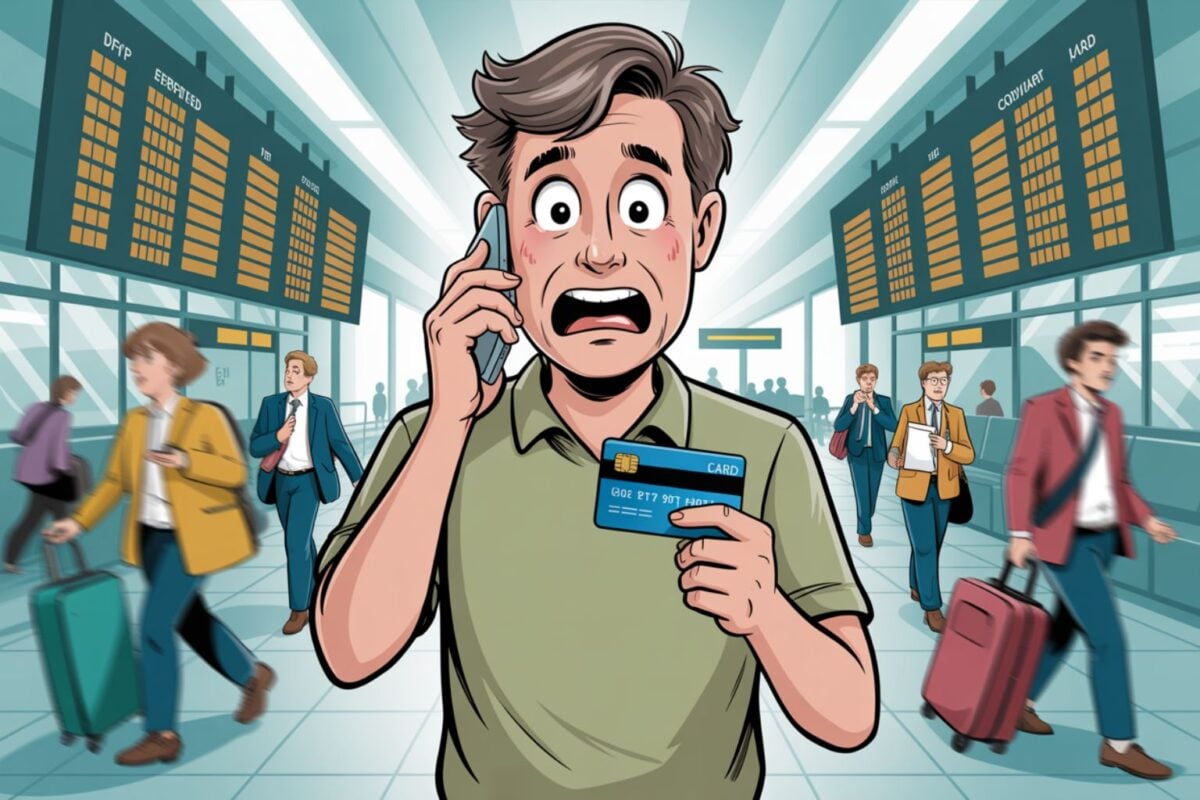
Eric Finkel thought he’d dodged a bullet on a recent visit to Vietnam. His hotel “accidentally” charged his credit card $1,500 instead of the correct amount of $66. The staff immediately cancelled the erroneous charge right in front of him.
Problem solved, right? Wrong.
Months later, Finkel discovered the hotel had quietly resubmitted the fraudulent $1,500 charge without the cancellation slip. What followed was a lengthy ordeal with his credit card company that was only resolved because Finkel had kept his paper receipts. Without that documentation, his credit card company told him he’d be stuck paying for the scam.
“I can’t imagine how many travelers have been defrauded using this technique,” says Finkel, an executive based in Vancouver, Canada.
I can. I handle credit card fraud cases almost daily as a consumer advocate. And I can tell you, travelers are constantly in the crosshairs. Credit card fraud cases were on track to double last year, according to the Federal Trade Commission. Global losses hit $32 billion the previous year.
Credit cards have become the default safety net for travelers — convenient, widely accepted, with fraud protection that feels foolproof. But those protections aren’t perfect. From sophisticated skimming operations to “accidental” overcharges, your plastic can be compromised in ways you might not expect. The question isn’t whether you’ll encounter credit card problems while traveling. It’s whether you’re prepared to prevent them or fix them when they happen.
The old credit card fraud tricks still work
Some types of fraud never go out of style. The bad guys just find new venues. ATMs remain one of the most persistent threats for credit cards, especially for those going abroad.
Vlad Polyanskiy, chief marketing officer at FlightRefunder, saw it himself when a client’s card was skimmed at an ATM in Prague. “Four transactions for small amounts appeared on his account,” Polyanskiy says. “He found out thanks to SMS notifications.”
The client immediately blocked the card and contacted his bank. His bank returned the money two weeks later, but those were two weeks of uncertainty during what should have been a relaxing vacation.
Look, the credit card companies HAVE THE TECHNOLOGY to detect ‘bill, cancel, rebill months later’.
Read more insightful reader feedback. See all comments.
Robert Hareland, a former U.S. consular officer, had his own ATM nightmare recently. His card was skimmed at a gas station on his way to catch a flight to Hawaii. “I only discovered what happened when my card stopped working in Hawaii,” he says.
The sophistication of skimming operations has evolved dramatically. Modern skimmers can be nearly invisible, often placed over legitimate card readers at ATMs, gas stations, and even restaurant payment terminals. Some use Bluetooth technology to wirelessly transmit stolen data to criminals lurking nearby.
Peter Murphy experienced this during a recent visit to Europe. His business credit card was declined at a hotel in Berlin. When he checked his app, he found a series of $1 to $3 test charges in Brazil.
“All of the charges were indications of skimming,” says Murphy, the CEO of a sports equipment business and a frequent traveler. The fraud team at his bank stopped more than 20 attempted transactions in less than two hours.
These small test charges are a telltale sign of card skimming. Criminals use them to verify that stolen card data works before attempting larger purchases. By the time you notice a $2 charge from halfway around the world, your card details might already be for sale on the dark web.
Steve Payerle, president of Next Level Technologies, a cybersecurity firm, has tracked fraud patterns for over a decade.
“Credit card fraud spikes 40 percent during peak travel seasons,” he says. “The biggest mistake travelers make is using the same card for everything — creating a single point of failure.”
When businesses make “mistakes”
Not all credit card problems come from criminals. Sometimes, the businesses you’re trying to support are the problem.
Finkel’s Vietnam hotel incident illustrates a particularly insidious form of fraud that exploits the trust between travelers and legitimate businesses. The hotel had made an innocent-looking exchange rate error, confusing dollars for Vietnamese dong. The staff then created a paper trail that looked legitimate — they even performed the “cancellation” in front of witnesses. But months later, when memories fade and receipts get lost, they resubmit the original charge without the corresponding cancellation.
“The situation was only resolved because I dug through a pile of papers from the trip and discovered the paper receipts,” Finkel says. “Without that documentation, the credit card company told us that we would have been stuck paying for the scam.”
The burden of proof in credit card disputes often falls heavily on cardholders, especially for international transactions. Credit card companies have limited ability to investigate claims in foreign countries, and they often rely on merchant statements and documentation to resolve disputes.
Idil Kuyucu, a payment systems consultant and former Visa Europe contractor, experienced merchant fraud firsthand in Taormina, Sicily. During dinner at a restaurant, her card was mischarged twice — unauthorized transactions of €150 and €400 at the same point-of-sale terminal.
“I noticed it within minutes thanks to real-time SMS and app alerts,” Kuyucu says. She immediately locked the card in her banking app, called the issuer’s international number, and switched to her backup card. At the restaurant, she showed the SMS alerts and demanded cancellation receipts for both fraudulent transactions.
The charges were reversed within 10 business days, but Kuyucu’s quick action and documentation were important. “Without the real-time SMS and app alerts, the charges could easily have gone unnoticed and become much harder to unwind,” she says.
Airlines and hotels aren’t immune to “accidental” double billing either. System glitches, processing errors, and sometimes outright fraud can result in duplicate charges that might not show up for weeks. When you’re already home and back to your routine, disputing a $300 hotel charge from three weeks ago becomes a time-consuming headache.
Digital traps are everywhere
The rise of online travel booking has created new vulnerabilities that didn’t exist in the era of travel agents and paper tickets. Every website, app, and digital platform that stores your card information becomes a potential entry point for criminals.
The problem isn’t just with the big, well-known booking sites. Fraudsters have become increasingly sophisticated at creating fake travel websites that look legitimate but exist solely to steal credit card information. These sites often pop up around major events or travel seasons, offering deals that seem too good to be true.
Public Wi-Fi networks at airports, hotels, and cafés present another significant threat. Rafay Baloch, CEO of cybersecurity firm REDSECLABS, warns that these networks are “essentially open highways for cybercriminals.”
“The most overlooked vulnerability is using public Wi-Fi for travel bookings,” says Payerle, who has seen countless clients fall victim to this scenario. His firm has tracked a 78 percent reduction in travel-related breaches when clients use their phone’s hotspot instead of public Wi-Fi for financial transactions.
The rise of mobile banking has made travelers more vulnerable in some ways. While apps offer convenience and real-time monitoring, they also mean people are more likely to check their accounts and make transactions while connected to unsecured networks.
Of course, credit card scams based on your physical card aren’t the only challenge travelers face. Dave Lewis, the chief information security officer at 1Password, notes that mobile theft claims spike up to 20 percent during the summer months as people take phones on vacation and become targets for theft. When your phone contains your banking apps, losing the device can mean losing control of your financial accounts.
Strategies to protect your credit card when you travel
The experts I spoke with don’t always agree on the perfect solution — banks vary wildly in their fraud response, and technology that protects you in one scenario can create vulnerabilities in another. But certain strategies consistently prove effective.
The most important advice is also the simplest: carry backup cards from different networks, and keep them separated.
“Always have an emergency card and a replacement card just in case,” advises Sandra Zo Awodele, a frequent traveler.
Payerle, the cybersecurity expert, recommends the “three-card rule” to his cybersecurity clients: “One for hotels and flights booked in advance, one for daily expenses, and a backup that never leaves your wallet.” When one client’s primary card was skimmed at a Rome ATM, they still had clean cards to continue their trip while the bank resolved the issue.
Real-time transaction alerts were invaluable for nearly every fraud victim I spoke with. Murphy, whose card was skimmed in Prague, says establishing real-time transaction notifications “has saved me thousands.” Polyanskiy’s client caught four fraudulent transactions immediately thanks to SMS alerts.
“Enable text or app notifications for every charge so you can spot suspicious activity immediately,” recommends Raymond Yorke, a spokesman for Redpoint Travel Protection, a travel insurance company.
Daniel Karon, author of “Your Lovable Lawyer’s Guide to Legal Wellness,” emphasizes the importance of proactive notification: “Notify your card issuer about your travel plans. This prevents your issuer from flagging legitimate purchases as suspicious activity and blocking your card.”
When it comes to ATMs, location matters more than you might think. Tapos Kumar, a U.S. finance professional, follows strict ATM rules with his clients.
“Only withdraw from machines physically located inside bank branches or airports — never from freestanding kiosks,” he warns. “Street ATMs are the number one hotspot for skimming.”
Credit cards consistently offer better protection than debit cards for travel purchases. “Generally, credit cards offer stronger fraud protection than debit cards, which are directly linked to your bank account,” Karon notes.
Kelly Hall, the director of global initiatives at Cedar Crest College, who works with student travelers, has a practical tip that many travelers overlook: “Always make copies of the front and back of cards before you leave home. Leave one copy with a friend or relative, and pack one copy separately from your credit card.”
Virtual credit card numbers, offered by many banks, can provide an additional layer of security for online bookings. James Wilson, a data privacy expert from Spokane, Wash., recommends services like Privacy.com that let you create multiple virtual cards, with the option to set spending limits.
The technology double-edged sword
Contactless payments and mobile wallets like Apple Pay and Google Pay offer enhanced security through tokenization — your actual card number is never transmitted during the transaction. But they also create new vulnerabilities.
“Tokenized payments expose fewer card details than swiping a plastic card,” says Kuyucu.
But the same technology that protects your card number can be exploited in other ways. RFID skimming — where criminals use handheld scanners to read contactless cards through wallets or purses — has become more common in crowded tourist areas. There are RFID-blocking wallets that can help protect your technology, but clever criminals are always finding new ways to get around the safeguards. (Related: Travel warning: Credit card cloning is back, but here’s how to stop it.)
The biggest technological vulnerability might be the most basic: human behavior. Fineas Tatar, co-CEO of Viva Executive Assistants, trains high-level executives on travel security. He emphasizes daily expense tracking using tools like Google Sheets or Notion databases.
“Early detection gives travelers a stronger case with providers or banks when disputing charges,” he says.
The reality check
Even following all the expert advice won’t guarantee a fraud-free trip. Banks vary dramatically in their response to travel-related fraud claims. Some resolve disputes within days, others drag the process out for months. Some automatically side with merchants in international disputes, others give customers the benefit of the doubt.
Darius Kingsley, Head of the consumer banking practices for JPMorgan Chase, recommends travelers verify booking sites carefully to avoid trouble.
“Take extra caution when booking accommodations for your trip,” he says. “Scammers try to mimic or impersonate popular travel websites by re-recreating familiar branding, logos, or company verbiage.”
Don’t rely on your insurance policy to cover fraudulent charges. Joe Cronin, president of International Citizens Insurance, points out an important limitation: “Insurance doesn’t cover fraudulent charges. This is something you have to talk to your credit card provider about.”
Susan Sherren, founder of Couture Trips, takes a different approach with her high-end clients: “One of the most convenient ways to protect your credit card is to first prepay for as many travel components as possible, such as hotels, tours, and transfers.” By prepaying through a secure platform, travelers reduce the number of transactions and potential exposure points during the trip.
If you travel, it could happen to you
It’s probably not a question of if, but when, you’ll be a victim of credit card fraud while you’re traveling. The criminals are getting more sophisticated, the technology is evolving faster than security measures, and the sheer volume of transactions while traveling creates multiple vulnerability points.
Like Eric Finkel, you might think you’ve dodged a bullet when a merchant immediately “fixes” an error in front of you. But months later, when that fraudulent charge reappears on your statement and you’re fighting your credit card company from thousands of miles away, you’ll wish you’d been more prepared.
I was. I recently stayed at a hotel in Boise, Idaho, that decided to charge me an extra $400 for a second room — four months after I checked out. My credit card accepted the late charge without question. I contacted the hotel and pointed out the error, and it only reversed the charge after I threatened to file a dispute under the Fair Credit Billing Act.
The goal isn’t to avoid all credit card problems. That’s impossible in today’s interconnected world. It’s to make yourself a harder target and to be prepared when something goes wrong. Carry backup cards. Set up real-time alerts. Keep your receipts. Monitor your accounts obsessively.
And remember Finkel’s hard-learned lesson: Even when you think a problem has been resolved, keep those receipts anyway. You never know when a “canceled” charge might mysteriously reappear.
Your voice matters
Credit card fraud doubled last year, hitting $32 billion globally. A Vietnam hotel canceled a $1,500 overcharge in front of Eric Finkel, then resubmitted it months later. Only his paper receipts proved the scam and forced reversal.
- Should merchants be prohibited from resubmitting charges that were canceled in front of customers without explicit written authorization?
- Should credit card companies be required to reverse international merchant charges when customers provide paper receipts showing cancellation?
- Have you been hit with fraudulent travel charges that appeared months after your trip ended?
What you’re saying
Readers argued credit card companies have the technology to detect rebilling scams, debated banning merchant resubmissions, and shared RFID blocking and VPN tactics.
-
Credit card companies could stop this
deemery pointed out credit card companies have the technology to detect ‘bill, cancel, rebill months later’ patterns. George Schulman voted no on banning resubmissions because sometimes merchants need to cancel transactions for errors but submit genuine ones later.
-
RFID blocking and VPN protection
Tim uses RFID-blocking sleeves for cards and passport, which create a Faraday cage blocking radio waves. He connects to VPN before signing into anything public and names his phone hotspot uniquely to avoid nefarious networks with similar names. He noted fraud prevention can work against you when banks block legitimate large transfers despite warnings.
-
Digital wallets prevent skimming
OnePersonOrAnother prefers Google Pay on his phone over physical cards to avoid skimming. SusanV asked if he runs into places where it doesn’t work even though it’s supposedly accepted, citing her Apple Pay issues.

Have a question about this story? Tell us what happened — we read every comment.
Join the conversation