
in this commentary
- The U.S. Secret Service issued a request for information for a tool to monitor travel in near real-time by tapping into commercial airline databases, exploiting the Third-Party Doctrine that strips privacy protections once you voluntarily share data with companies like airlines or banks.
- The system would reveal not just destinations but hotels, credit cards, payment amounts, and travel companions through fuzzy matching algorithms, potentially flagging lifestyle patterns as suspicious and directing TSA searches or no-fly list additions without warrants, making every traveler a suspect until data prove otherwise.
- By laundering surveillance through private sector data-sharing agreements (after last year’s Airlines Reporting Corporation program was shuttered), the government bypasses Fourth Amendment protections, normalizing constant observation where the state knows where you’re going before you buy the ticket and can start asking why, a question that should never be theirs to ask in a free society.
Marilyn Kaufman didn’t realize she was inviting an observer into her living room when she signed up for a lower car insurance rate. To secure a discount, her insurance company required her to keep a driving-tracker app active on her phone all the time. It monitored her braking and acceleration, but it also followed her while she walked her dog or sat at her kitchen table.
To her, this was a persistent monitoring of her life that never clocked out.
“I consider this an invasion of my privacy,” says Kaufman, a retired marketer from Boca Raton, Fla.
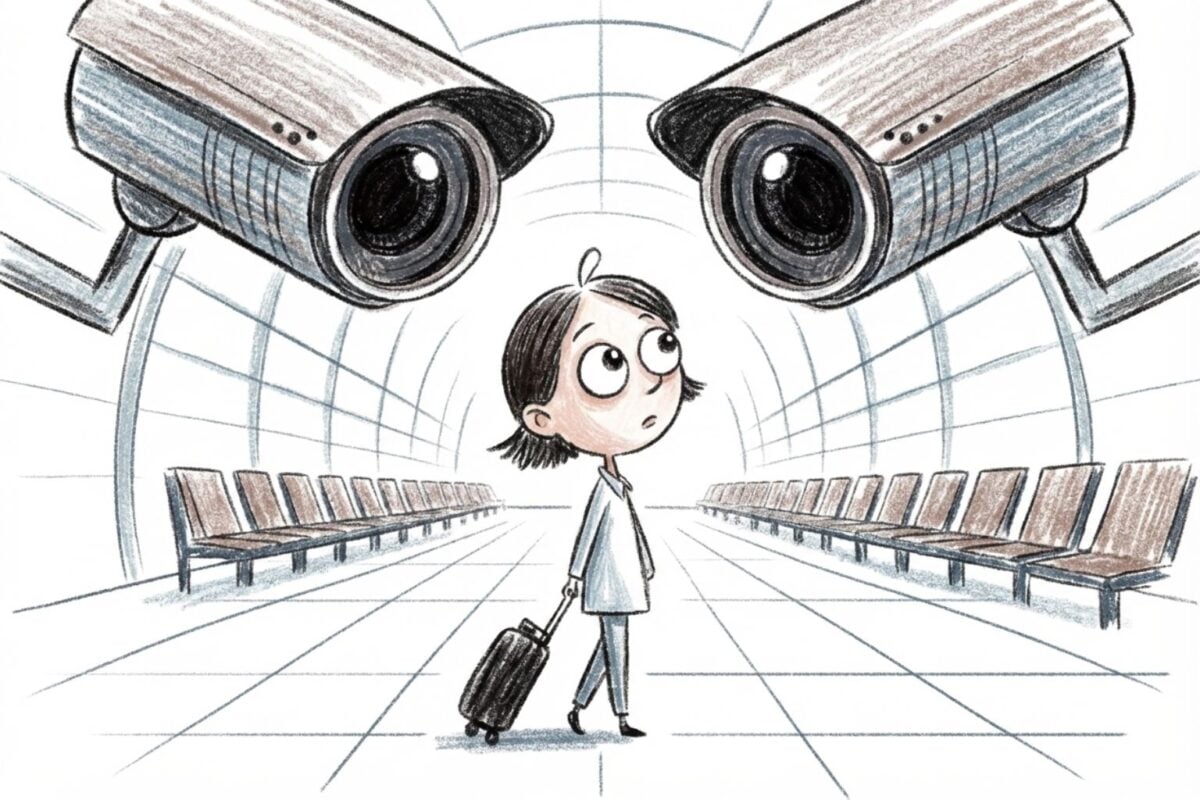
If Kaufman finds the gaze of a private insurance company intrusive, she won’t like the government’s plans. The U.S. Secret Service recently issued a request for information for an online tool that would monitor your travel in “near” real-time. It could at some point even include your driving data.
The request, used to gather information from the public and potential vendors before a formal bid, reveals a troubling ambition: The government wants to monitor your travel patterns by tapping into an existing commercial database that already has an established data-sharing agreement with domestic and international airlines. And it suggests a much broader goal to track American travelers wherever they are.
Exploiting a legal loophole
Something feels wrong about this proposed digital dragnet. While the Supreme Court has long recognized a right to travel protected by the Fifth and 14th Amendments, this system primarily threatens your Fourth Amendment protection against unreasonable searches.
The government relies on a legal concept known as the Third-Party Doctrine, which dictates that once you voluntarily give your data to a commercial entity, like an airline or a bank, you lose your expectation of privacy. (Related: The cruise ship virus is back. Why did we fire the health inspectors, again?)
By looking for a vendor who already has these data-sharing agreements in place, the government is effectively laundering its surveillance through the private sector, turning a fundamental right to move freely into a government-monitored privilege.
This initiative represents a calculated pivot toward algorithmic surveillance, effectively laundering government oversight through private-sector data-sharing agreements. By weaponizing the Third-Party Doctrine, the state creates a digital panopticon that bypasses Fourth Amendment protections without the friction of a warrant.
The integration of fuzzy matching to map social and lifestyle patterns transforms the fundamental right of movement into a transparent data stream for a cold bureaucracy.
Read more insightful reader feedback. See all comments.
It’s not the first attempt. Last year, the Airlines Reporting Corporation, a data broker owned by the major US airlines, sold flight data to U.S. immigration officials as part of its Travel Intelligence Program. The program was shuttered in November amid criticism from privacy advocates.
When the government seeks direct access to travel data without additional facilitation, it’s removing the last guardrails of due process.
What if this goes through?
If this system is built, the government won’t just know you went to Cabo for spring break. It will know where you stayed, what credit card you used, and how much you paid. It will use a technique called fuzzy matching to connect you with other members of your party—and maybe other people you don’t even know.
There’s a lot of potential for mischief. By connecting too many dots, an algorithm could flag your lifestyle patterns as suspicious, directing TSA agents to give you a more thorough search or even adding you to the no-fly list. Real-time access through a commercial database makes the process invisible and instantaneous.
The database could also be used for pre-emptive investigation. By monitoring forms of payment and ticketing dates, the government could flag anyone who buys a one-way ticket with cash or a last-minute flight to a protest-heavy city. And suddenly, your right to travel is contingent on whether your itinerary fits the state’s definition of a “normal” vacation. It turns every traveler into a suspect until the data prove otherwise—a complete reversal of the presumption of innocence.
Fear is increasing
It would be too easy to dismiss these technical filings as dry bureaucracy, but the request for information is a blueprint for a digital panopticon. It mirrors the anxiety felt by travelers who are returning to the United States.
“Many folks have a fear that under this new administration, there is a risk that they could be detained or delayed at borders,” says Alma Lopez, a travel agency owner from Los Angeles.
When the state demands to know where you are going before you even buy the ticket, the anxiety is bound to increase.
In this framework, your travel history is no longer a private transaction between you and a carrier. It is a transparent stream of data available to law enforcement 24 hours a day. No warrant required.
Ultimately, the goal of such a system is the normalization of observation. Like Marilyn Kaufman’s insurance app, the government wants to become a permanent, silent passenger in your life. Once they know where you go, they can start asking why—and in a free society, that question should never be theirs to ask.
Your voice matters
The U.S. Secret Service wants to monitor your travel in real-time by tapping into commercial airline databases, exploiting a legal loophole that strips your privacy protections once you share data with companies. The system would track destinations, hotels, payments, and companions without warrants, turning every traveler into a suspect.
- Should the government be legally prohibited from accessing commercial travel databases without a warrant, even when airlines voluntarily share the data?
- Should the Third-Party Doctrine be reformed so that sharing data with private companies does not automatically eliminate your Fourth Amendment protections against government surveillance?
- Does knowing the government could monitor your travel in real-time change how you feel about booking flights or planning trips?
What you’re saying
Readers reacted with alarm to the government’s push for unfettered access to airline passenger data, debating the fine line between national security and an Orwellian surveillance state.
-
The death of the Fourth Amendment
Tina and Chriscfrn warned that handing commercial travel data to the government destroys the presumption of innocence, turning everyday flight itineraries into suspicious activity. Pattipeg Harjo compared the dragnet to the surveillance state in 1984, arguing that law-abiding citizens deserve basic privacy without warrantless tracking.
-
The danger of “fuzzy matching”
Several readers zeroed in on the technical flaws of the proposed system. SusanV and lostinlodos pointed out that algorithmic “fuzzy matching” creates massive risks for false positives, potentially entangling innocent travelers in criminal investigations simply because they booked a flight near a person of interest.
-
The regulation trap
KennyG argued that consumers inadvertently created this problem by demanding heavy government regulation of airlines, which built the very data pipeline authorities now want to exploit. Dave strongly disagreed, pointing to the European Union as proof that a government can strictly regulate corporate business practices while still fiercely protecting individual data privacy.

Have a question about this story? Tell us what happened — we read every comment.
Join the conversation