
in this commentary
- The Star Princess saw 104 passengers and 49 crew struck by norovirus. HHS Secretary Kennedy gutted the CDC’s Vessel Sanitation Program, firing all civilian employees and leaving just 12 officers to police the entire cruise industry.
- The fee-funded program cost taxpayers nothing. Eliminating positions removed independent oversight while the lead epidemiologist was fired, leaving one trainee to investigate outbreaks. Remaining inspectors are buried in paperwork.
- Norovirus survives on surfaces two weeks, withstands heat to 145°F, and needs under 100 particles to infect. Hand sanitizer doesn’t work. Only handwashing and bleach help. With no verification of self-reporting, every passenger is gambling.
When passengers boarded the Star Princess earlier this month in Fort Lauderdale, Fla., they expected a two-week Caribbean adventure.
The voyage reportedly turned into a miserable misadventure: 104 passengers and 49 crew members were struck by a relentless assault of violent projectile vomiting and watery diarrhea. Norovirus, the causative agent, left travelers incapacitated in their cabins as the ship’s staff scrambled to contain the chaos.
I should know. Norovirus brought me to my knees on a river cruise years ago, and I’ll never forget the agony of clutching my stomach in pain—and the rest, which is too graphic to describe in polite company.
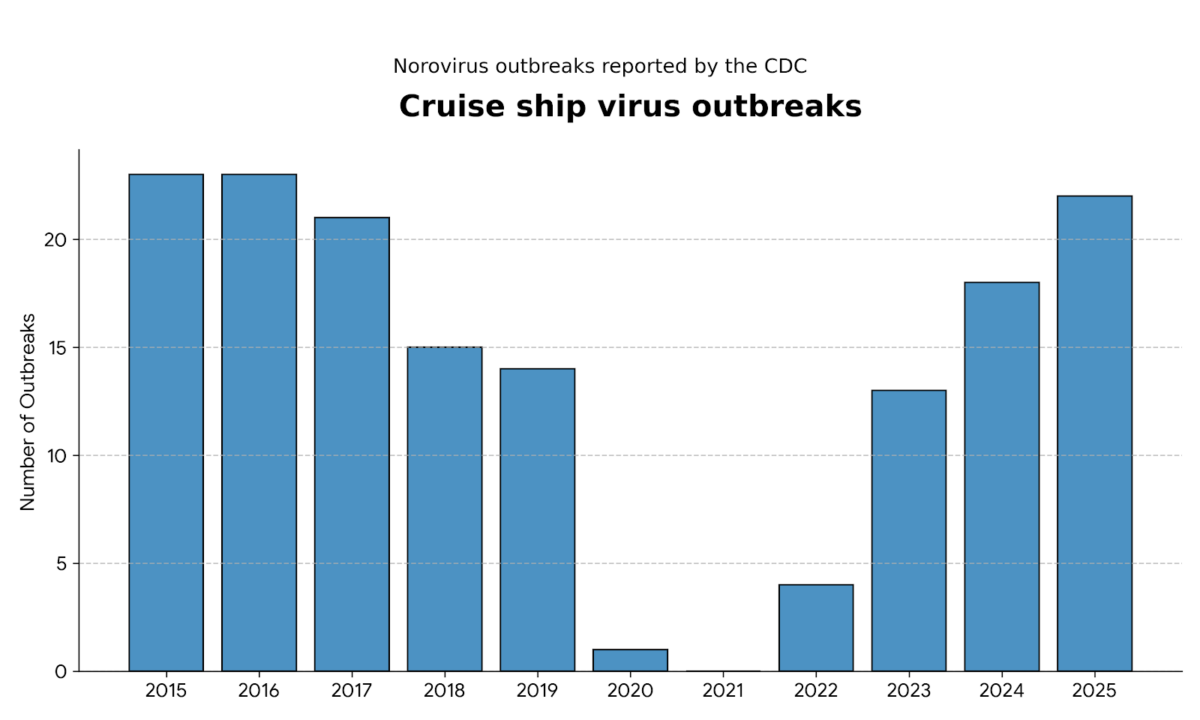
Last year saw the highest number of norovirus cases since 2017, fueled by an aggressive new strain of the virus. The “cruise virus,” as it’s sometimes called, is trending toward a crisis again. But at the very moment we most need government oversight and reporting, the inspectors have been sent home.
Who’s watching the ships, anyway?
As cases climb again, a disturbing question looms over every gangway: Can we actually trust the sanitation reports provided by the CDC’s Vessel Sanitation Program?
Maybe not. In a move that has baffled public health experts, HHS Secretary Robert F. Kennedy Jr. last year gutted the inspection program, laying off all full-time civilian employees. This leaves a skeleton crew of just 12 U.S. Public Health Service officers to police a massive multibillion dollar industry.
Government inspectors are key to identifying where the virus likely began and how it was transmitted. Identifying that quickly can lower cases, but more importantly, help to prevent further outbreaks. Viruses can easily mutate and someone needs to be on surveillance for that. New vectors or modes of transmission might be found. Had there not been a robust government program in place, norovirus would likely have become even worse and perhaps decimated the industry.
Read more insightful reader feedback. See all comments.
The logic behind these cuts is problematic. The Vessel Sanitation Program isn’t a drain on the American taxpayer. The program is entirely funded by fees paid by the cruise lines themselves. By eliminating these positions, the administration hasn’t saved the public a dime—it has only removed the only independent health inspectors many of these ships ever see.
The consequences are already visible. The epidemiologist who led the agency’s outbreak response was among those fired, leaving the program with just one trainee epidemiologist to investigate industry wide norovirus outbreaks last year. The few remaining inspectors are now so buried in administrative paperwork that actual inspections—checking water systems, food safety, and medical centers—are being sidelined.
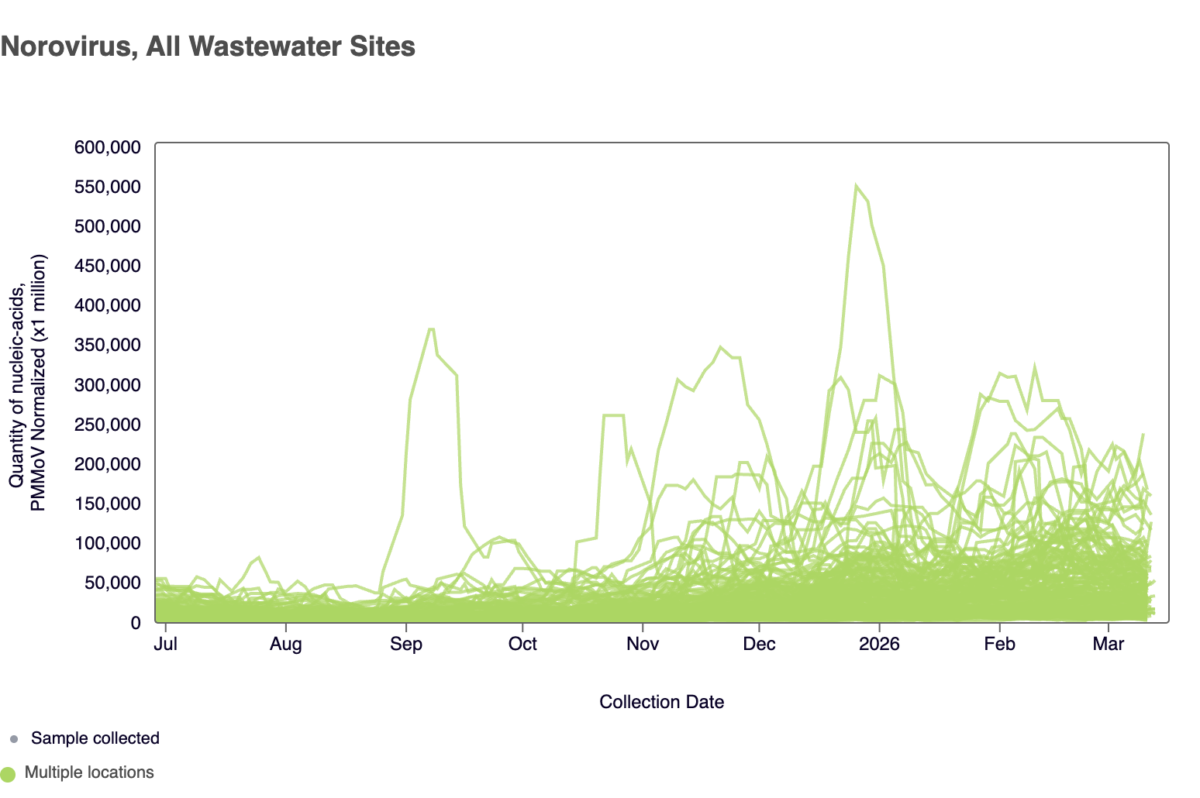
Noroviruses are surging nationwide, as they do every spring. The virus is also common on land. Here are measurements taken from wastewater. (Source: Wastewaterscan.org)
The ultimate breeding ground
It’s a common misconception that cruise ships are inherently unclean. They’re not. Cruise lines like Princess go out of their way to keep the ships, well, shipshape. There are warning signs throughout the vessel, urging passengers to wash their hands and practice good hygiene. And there are hand sanitizer stations around every corner.
So what’s wrong? Cruise ships are simply the ultimate biological pressure cookers. When you pack thousands of people into close quarters where they share food sources and touch the same handrails and elevator buttons, you create an incubator for gastrointestinal illnesses. (Related: This isn’t the summer for a cruise.)
Norovirus has a protein armor that makes it shockingly resilient. It can live on objects for up to two weeks. It survives freezing and heat up to 145°F, meaning standard food prep often isn’t enough to kill it.
Most disturbingly, that bottle of hand sanitizer in your pocket is useless. Alcohol-based rubs do not kill norovirus. Only vigorous handwashing and industrial-strength bleach can stop the spread.
And take it from me, infection is utter misery. I spent three days flat on my back on board the river cruise, barely able to eat or drink. I was lucky. In vulnerable passengers such as the elderly or those with weakened immune systems, norovirus can cause fatal dehydration from intense vomiting and diarrhea.
How to restore confidence in cruising
The current situation is a recipe for a public health disaster. We have a highly contagious and resilient virus spreading across the cruise industry at the exact moment the only agency capable of regulating ship sanitation has been dismantled.
We can’t even be sure we’re getting the full picture about the condition of cruise ships. A norovirus outbreak on a ship must be reported to the CDC when gastrointestinal illness cases exceed 3 percent of passengers or crew, but no one is looking over the cruise industry’s shoulder anymore.
To restore confidence in the cruise industry, we can’t let the cruise industry grade its own homework. Self-reporting and streamlined oversight are no substitute for the rigorous, unannounced inspections that civilian experts used to provide.
If we want the debilitating and sometimes deadly cruise ship virus to stay off the high seas, the government must reinstate the full-time staff of the Vessel Sanitation Program. Until then, every passenger boarding a ship is taking a gamble that the next headline-making outbreak will be theirs.
Your voice matters
HHS Secretary Kennedy gutted the CDC’s fee-funded Vessel Sanitation Program, firing all civilian employees and leaving just 12 officers to police the entire cruise industry. The lead epidemiologist was fired, leaving one trainee to investigate norovirus outbreaks while inspectors are buried in paperwork.
- Should the government be required to reinstate full-time civilian inspectors for the Vessel Sanitation Program to prevent norovirus outbreaks on cruise ships?
- Should cruise lines be prohibited from self-reporting their own sanitation compliance without independent verification from government inspectors?
- Would you still book a cruise knowing that government health inspectors have been eliminated and ships are essentially grading their own homework?
What you’re saying
Readers debated whether inspectors are necessary, questioned how 12 people can oversee hundreds of ships, and compared cruise outbreaks to schools closing for norovirus sanitization.
-
Market forces versus government oversight
Joe argued cruise lines have incentive to keep infection rates low or people will stop cruising. michael anthony countered that inspectors identify virus origins, track mutations, and find new transmission vectors. Tim suggested cruise lines create independent inspection like Good Housekeeping Seal since they pay the fees anyway.
-
Twelve inspectors can’t oversee hundreds of ships
Miles Will Save Us All said 12 people can’t provide meaningful oversight for hundreds of vessels. 737MAXPilot found it hard to believe a fee-funded program costing taxpayers nothing would be cut.
-
Just wash your hands and live your life
Brillohead noted schools close for norovirus but no one suggests stopping school. Wash hands and live your life. Larry Lundberg called Chris “Chicken Little” and said people must accept responsibility for their own safety. AJPeabody warned cruises trap hundreds in enclosed spaces, unlike land where only household members are exposed.

Have a question about this story? Tell us what happened — we read every comment.
Join the conversation