in this commentary
- The cruise industry claims it’s the safest vacation on Earth, but a closer look at crime statistics reveals reporting loopholes that hide the true danger.
- Current laws allow cruise lines to police themselves, reporting only closed FBI cases and ignoring serious assaults that don’t result in “bodily injury.”
- New legislation promises to strip oversight from the cruise lines and end forced arbitration, finally giving passengers a clear view of safety at sea.
The cruise industry wants you to think it’s the safest vacation in the world. But recent crime reports have cast an unwanted beacon on flawed regulations and fine-print arbitration clauses that may be hiding the reality of safety at sea.
Carnival Cruise Line appealed a more than $12 million award in a false imprisonment and negligence lawsuit in which a passenger had claimed she was raped by a former crew member. And there was the tragic death of Anna Kepner, an 18-year-old passenger on the Carnival Horizon, in November. Her stepbrother is a suspect in her murder.
The timing couldn’t be worse. This is “wave” season, the time of year when most cruises are sold—and crime is bad for business.
We wonder: Is cruising safe? And unfortunately, there’s no way to know—yet.
The cruise industry claims it’s safe
The cruise industry dismisses crimes like these as rare. “Cruise ships are one of the safest vacation options in the world,” the cruise industry trade group CLIA says on its site.
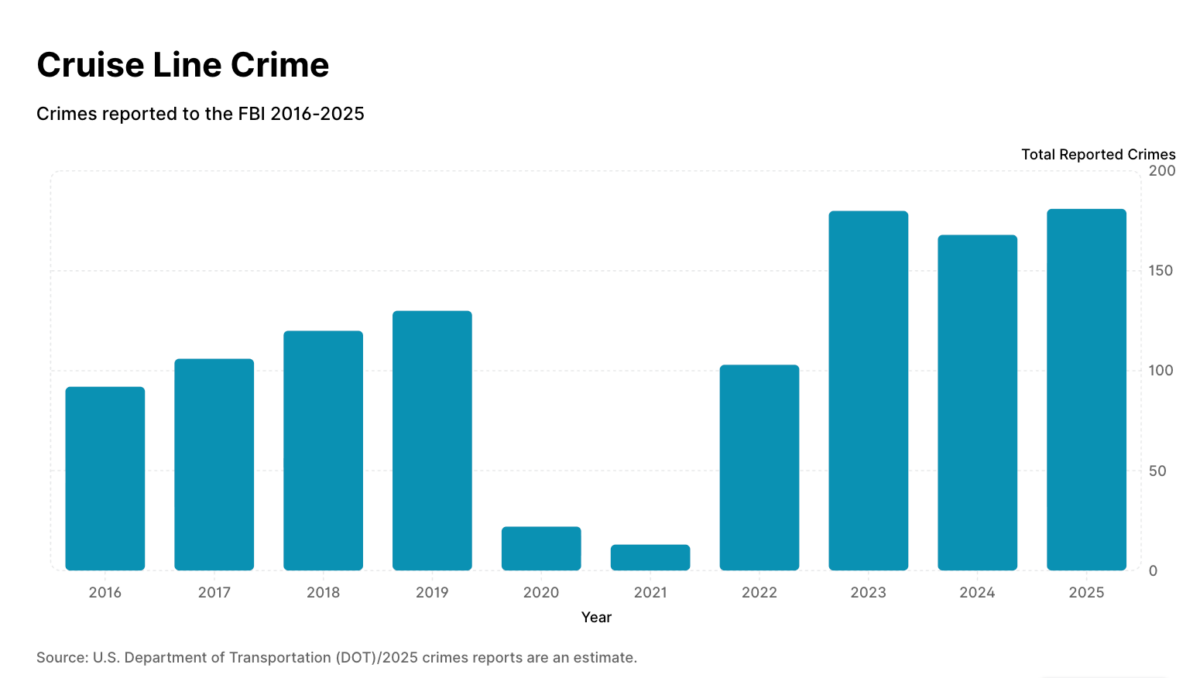
The numbers seem to back it up. The Department of Transportation reported a total of 181 crimes on all cruise lines in 2025. Adjusted for population, that is roughly 250 times lower than the crime rate in Miami, the city from which many cruises originate. On paper, you’re safer on deck than on a sidewalk in Wynwood.
But that’s just on paper. In practice, the cruise lines’ claims about safety aren’t quite as compelling.
Passengers aren’t getting the full picture
The 2010 Cruise Vessel Security and Safety Act was sold as a safety net, but it had a gaping hole below the waterline. The law made it difficult for the public to see a true reflection of safety on cruise ships because it only required the publication of statistics for cases that the FBI had investigated and officially closed. That made cruise ships basically look crime-free.
Legislators tightened the law a few years later, requiring the government to publish statistics for all alleged crimes reported to the FBI, regardless of whether the case was eventually solved or prosecuted. They also reinforced a requirement for cruise lines to maintain a logbook of all complaints of serious crimes, including homicide, kidnapping, and sexual assault, and to report these to the nearest FBI field office as soon as possible.
To improve the accuracy of reports and investigations, the law mandated better video surveillance and the maintenance of those records to assist law enforcement in verifying claims—a significant improvement.
We don’t know how safe cruising truly is because of reporting gaps
It’s not enough. A look at the latest report shows why. The report offers no details on these crimes and alleged crimes. On land, police would keep records on up to 52 different types of crimes. DOT only requires cruise lines to report a narrow list: homicide, suspicious death, missing U.S. nationals, kidnapping, assault with serious bodily injury, sexual assault, firing/tampering with a vessel, and high-value theft. City records include all physical assaults, but cruise lines only report assaults that result in “serious” bodily injury.
There’s a huge conflict of interest, too. Those responsible for the initial reporting on cruise ships are private employees of the cruise line. Critics say this creates a conflict where companies are incentivized to minimize crime statistics to protect their reputation.
Even if a crime is reported, the path to justice is often blocked by the fine print on your ticket—a legally binding agreement you automatically accept just by purchasing a fare or stepping on board. These contracts ensure that any hope for public accountability is scuttled before it reaches a courtroom. By forcing disputes into private arbitration, the industry effectively leaves legal challenges dead in the water, so the public can’t see the damage.
Perhaps the biggest loophole involves who is even counted on the manifest. By primarily reporting crimes involving U.S. nationals, the law ignores a vast number of international passengers and crew, essentially using jurisdictional currents to wash away the crime data.
You have the right to transparency
Travelers deserve to know the risks before they board. The persistent reporting gaps between cruise lines and land-based municipalities underscore a fundamental lack of parity in consumer safety. As long as reporting is filtered through the cruise industry’s own security teams, we’ll never know how safe—or dangerous—cruising really is.
In a perfect world, the cruise industry would voluntarily agree to report all crimes, just like on land, to allow an apples-to-apples comparison. Give us full police blotters where they record crimes, arrests, incidents, just like they do in every U.S. city.
The cruise lines are acting like the cities and other localities that do not send their crime data to the FBI: they want to hide how dangerous they are and make their reported crime rates artificially low.
Any public transport company (bus, train, airplanes, and ships) should report any crime that a city is supposed to — plus any that might be unique to their industry that their customers and passengers would be interested in knowing as mentioned in the article.
But if this is legislated, how would it be enforced? Would the DOT office have employees riding on the ships (and other modes of transport, hopefully) to catch and log the wrongdoing? How would that work with foreign-flagged ships? How would we know that a crime happened but the report of it was never made? And if the reporting is flawed, what is the penalty? A fine? Losing the ability to do business within the U.S. or its ports — and for how long?
Read more insightful reader feedback. See all comments.
But who are we kidding? The cruise industry wants you to think it’s safer than the suburbs, and the travel advisors and industry apologists are only too eager to support that. We need to overhaul the flawed regulations that led to this problem.
The Cruise Passenger Protection Act, introduced late last summer, may help. It would strip away the industry’s ability to police itself, shifting oversight to an independent office within the DOT. Objective authorities, not cruise line employees, would handle crime reports.
The proposed law would also broaden the definition of reportable crimes to match the standards of U.S. cities, requiring transparency for a wider range of incidents and granting passengers immediate access to critical surveillance footage.
Most importantly, the Cruise Passenger Protection Act would eliminate the fine-print arbitration clauses that currently bury legal claims in private proceedings, finally allowing the public to see a true and unvarnished record of cruise ship safety.
The cruise industry’s reporting gaps mean we have no way of knowing how safe cruising actually is. Travelers deserve the same level of transparency and safety on the high seas that they expect in any U.S. city.
The Cruise Passenger Protection Act promises to finally turn the tide on these flawed regulations. It offers the first real chance for passengers to find out the truth about safety when they go on a cruise.
The cruise industry says you are safer on a ship than on the street, but critics argue the data is rigged by loopholes and self-reporting.
Your voice matters
What you’re saying
Readers pushed back against the cruise industry’s “trust us” approach to crime reporting. While some avid cruisers defended their own safety records, most agreed that hiding crime statistics behind arbitration clauses and self-reporting loopholes is unacceptable.
-
The self-reporting flaw
Tim and M.C. Storm compared the cruise industry’s reporting to cities that refuse to send crime data to the FBI. They argued that self-reporting inherently creates skepticism because companies are incentivized to suppress bad news to protect their image.
-
Arbitration buries the truth
Miles Will Save Us All criticized forced arbitration as a tool for corporations to bury their mistakes. Public accountability, they argued, is the only way to ensure that companies prioritize actual safety over their bottom line.
-
The profit motive
Gerri Hether lamented that it takes government force to get corporations to release basic safety data. She noted that if savvy travelers saw the real stats, they might choose different cruise lines—or stop cruising altogether—which is exactly why the industry fights transparency.

Have a question about this story? Tell us what happened — we read every comment.
Join the conversation