

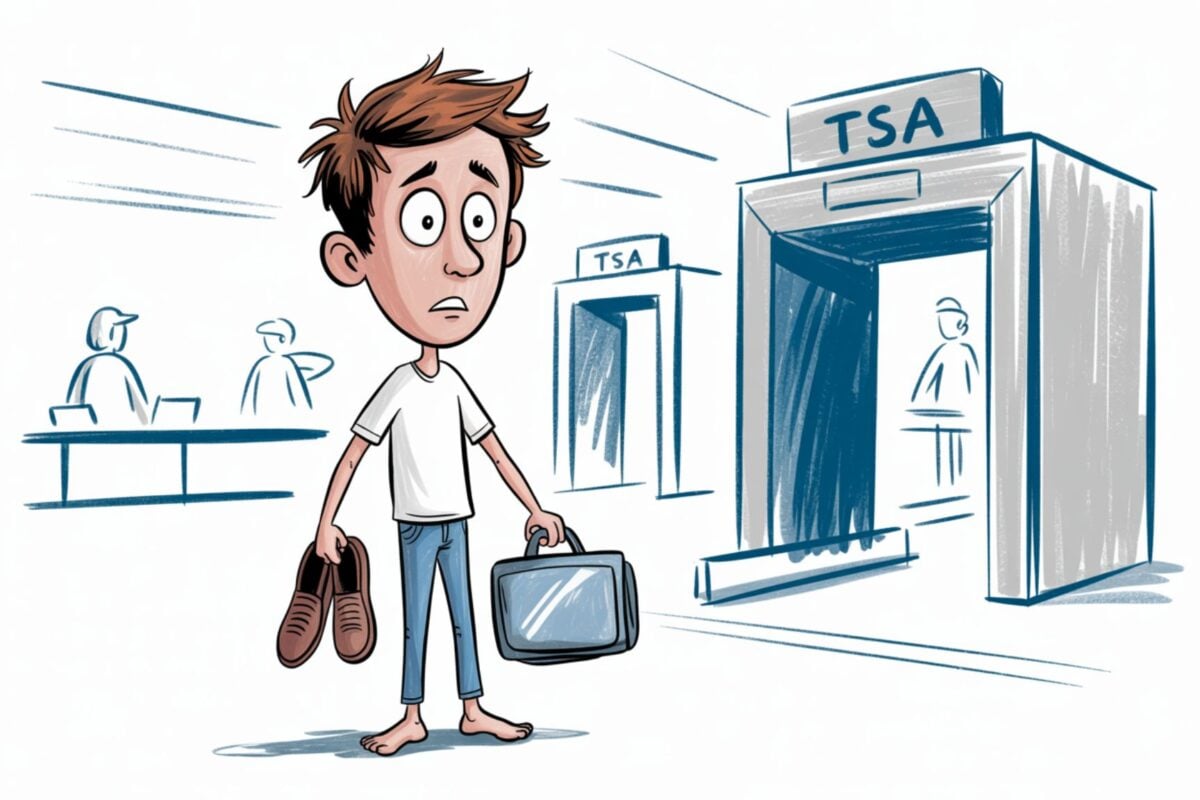
Does the TSA keep you safe? Or is it just a massive, taxpayer-funded security circus that’s in its final act?
The latest government shutdown means the agency could lose its funding as early as this weekend, leaving 61,000 federal screeners to work without a paycheck.
We’ve been here before. During previous shutdowns, unpaid TSA employees ended up sleeping in their cars or selling blood just to afford the gas to get to work. Morale craters, sick-outs spike, and your wait at the 7 a.m. rush becomes a protracted nightmare.
But maybe the real question isn’t how we pay for the TSA, but whether it needs to exist at all.
We never did need it. A massive boondoggle that has squandered billions that could have been more usefully spent and wasted unimaginable hours, taking out laptops, removing shoes and disposing of liquids.
The liquid ban was caused by a completely imaginary so-called plot in the UK that nobody went to jail for. Just think of the unnecessary havoc that caused.
25 years this ridiculous nonsense has been going on for now. Forcing you to show up three hours early and hang around in one of the most unpleasant and unfriendly environments on the planet.
Read more insightful reader feedback. See all comments.
How effective is the TSA?
The TSA was created in a post-9/11 panic to federalize what had been a private industry. Since then, its track record has been, shall we say, less than stellar.
A 95 percent failure rate. In 2015, undercover Homeland Security investigators successfully smuggled fake explosives and weapons past TSA checkpoints in 95 percent of tests. The figure improved to 70 to 80 percent two years later, and is currently unknown. (Related: Will an Iran war ground your travel plans?)
Meaningless layers of security. Experts argue that the real deterrents aren’t the blue uniforms, but reinforced cockpit doors, armed pilots, and a more vigilant flying public.
A high price for “safety.” Canada and many European countries use private security models that can be up to 40 percent cheaper per capita while meeting the same international standards.
What’s working? The U.S. already has the Screening Partnership Program, where 22 airports use private contractors. A 2011 study found private screeners were 65 percent more productive than their federal counterparts.
Is the TSA still necessary for your safety?
I’ve had a few run-ins with the TSA. In 2009, I reported on a confidential security directive on my site. The Department of Homeland Security sent a federal marshal to my home with a subpoena, demanding that I reveal my source (I didn’t). So you might say I’ve had a front row to the security circus.
I’m not impressed, and I’m hard-pressed to find a single incident where the TSA has stopped a post 9/11 terrorist incident. Still, it’s reassuring to see someone at the airport in uniform, checking for dangerous items.
And a few follow-up questions:
- If you said no, is it because of the cost? The inefficiency?
- If you said yes, what part of the process actually makes you feel safe? Could a private security firm do the job better for less money?
My take: I’ve been covering the TSA since the very beginning, and I think the agency might have been an overreaction. We’ve spent billions of your tax dollars to achieve a 95 percent failure rate in internal tests. Maybe it’s time to stop the cycle of shutdown drama and move toward a more efficient, private security model that focuses on actual threats rather than the size of your shampoo bottle.
Your turn
What do you think? Should we keep the TSA, or is it time to let private security take over the checkpoints? Our comments are open.

Have a question about this story? Tell us what happened — we read every comment.
Join the conversation

What you’re saying
Readers shared deeply personal stories of TSA overreach — from invasive pat-downs to stolen belongings — while debating whether the agency provides real security or just expensive theater. The conversation revealed a sharp divide between those who see TSA as essential and those who view it as a 25-year boondoggle.
Personal violations and power trips
Daniel F. Oppliger, a 71-year-old with TSA PreCheck, described a Dallas-Fort Worth pat-down where an agent made repeated contact with his genitals despite his objections, calling it a serious violation of dignity. Bill recounted how an “overzealous, wanna-be cop” forced him through an extended search purely as a power trip, nearly causing him to miss his flight. Chris Schiem, who travels frequently throughout Asia, reported having expensive items stolen from his luggage by TSA in Los Angeles and Atlanta — something that has never happened to him anywhere in Asia, even in communist China where inspections are done in front of passengers.
Inconsistency and detection failures
CT, a former airport employee, carried a large screwdriver through security for months without detection, only to be treated like a criminal when it was finally flagged. Cindi Sweeney was subjected to pat-downs for underwire bras, embroidery, and grosgrain ribbon on different flights, asking sarcastically if she should wear “a clear plastic raincoat with nothing underneath.” Paul Heymont and Mama Lo questioned whether the 2015 failure rate data is even relevant a decade later, arguing we have no statistical basis for judging TSA’s current effectiveness without updated testing.
Security theater vs. real threats
AJPeabody sarcastically noted that TSA has successfully kept rogue elephants and vampire bats off flights for 25 years, implying the real threats are imaginary. Skeptic pointed out that in Alaska, the biggest airport security threat is smuggled fentanyl — not terrorism — arguing TSA funds would save more lives if redirected to drug detection. michael anthony highlighted that lithium-ion battery fires pose a far greater danger than liquid explosives, noting that 4,000 guns were confiscated in 2024, meaning just as many likely made it through given TSA’s failure rate. deemery called most of TSA’s work “security theater” and suggested looking at El Al for actual effective security.