in this commentary
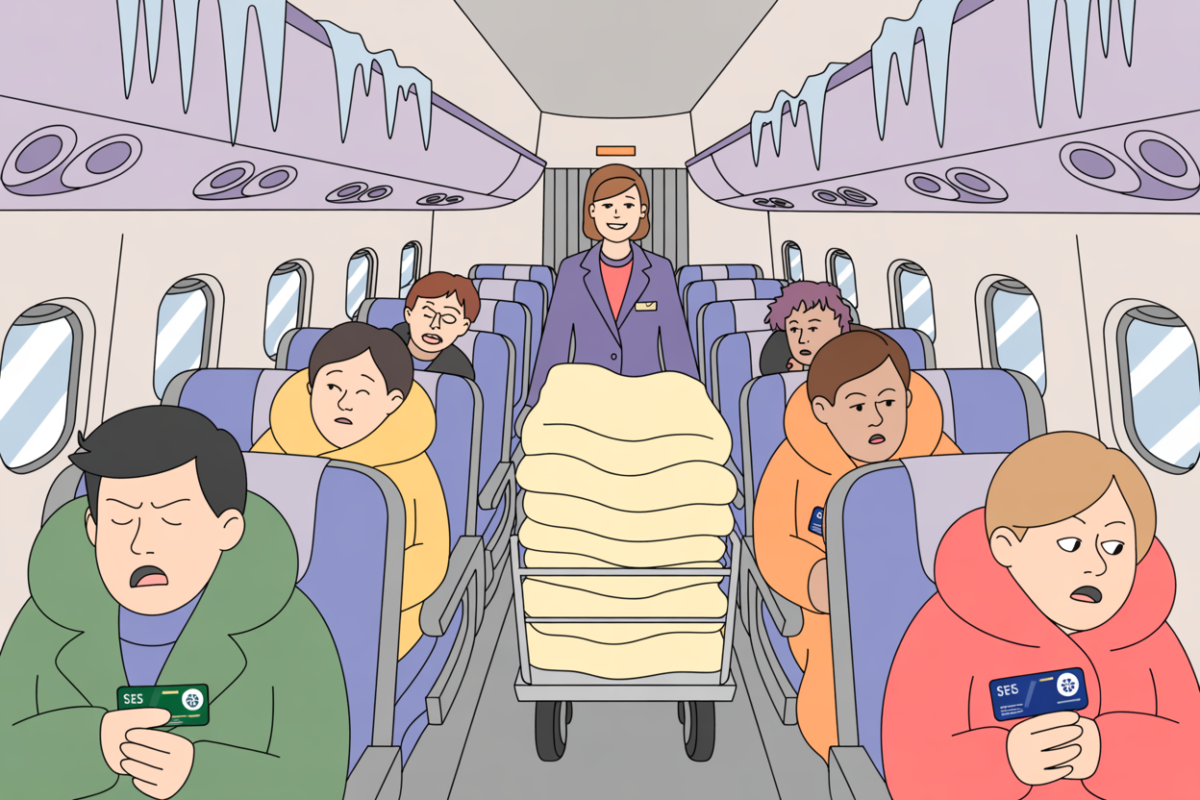
- That sudden chill in the airplane cabin isn’t a malfunction—it is a calculated move to trigger your survival instincts and sell you a $10 blanket.
- From “signature scents” that bypass logic to intentional Wi-Fi dead zones, the travel industry is weaponizing your physical environment to force you to spend more.
- Experts expose the invisible “dark patterns” companies use to exploit your fatigue and reveal the counter-tactics you need to keep your money safe.
If you’ve ever felt frozen on a plane, or caught a whiff of vanilla in a hotel lobby, or couldn’t quite make a Wi-Fi connection in your room, congratulations: You may be a victim of the travel industry’s latest manipulation tactics.
How’s that? On a recent flight from Doha, Qatar, to Delhi, Mohd Rizwan found out.
Before takeoff, a crew member lowered the cabin temperature to what felt like 65 degrees. Passengers under the open vents started shivering. Then, shortly after takeoff, flight attendants came through the main cabin, selling blankets for about $10 apiece.
“At one point, a crew member confided to me that this was a usual upsell path,” says Rizwan, a frequent traveler who runs a travel agency in India. “It was a tactical environment change that enhanced sales.”
Oh, and it worked. Passengers clamored for the covers like a Black Friday mob at Walmart.
Is this the golden age of travel manipulation?
Welcome to the golden age of travel manipulation. Pushing overpriced minibars or rental car insurance is so passé. Airlines, hotels, and rental companies are subtly adjusting your physical environment – the air you breathe, the temperature you feel on your skin – to nudge you toward spending more. Their ally: cold, hard data that suggests you’ll fall for it every time.
“Travel companies are using data to target customers when they’re more likely to decide with comfort or convenience at stake, like during boarding or booking,” says Mario Matulich, president of Customer Management Practice. “Some travelers notice the prompts, but they rarely see the underlying strategy.”
Until now.
So what are they doing? Glad you asked.
The temperature tango: from shivers to sales
The arctic airliner is a classic move. It goes like this: You settle into your economy seat for a red-eye flight. But soon you’re shivering uncontrollably because the AC is cranked up. And magically, the flight attendants appear, offering cozy (but pricey) blankets. You cave.
“Airlines definitely drop the cabin temperature, especially on red-eyes,” says frequent flier Jasmine Charbonier, who runs a marketing agency in Tampa.
Allen Chenault knows this game cold. As an HVAC contractor servicing Florida hotels and restaurants, he’s installed the systems that make the manipulation possible. (Related: The secret ways travel companies get you to pay more — and how to beat them.)
“It’s absolutely real and systematic,” Chenault says. “Hotels run lobbies two to three degrees warmer than guest surveys say people like. Why? To drive you toward the bar or restaurant where it’s cooler – and where you’ll spend.”
He remembers one theme park restaurant client who wanted the merchandise area kept at a bone-chilling 65 degrees.
“Make families so uncomfortable that they buy the overpriced hoodies right there,” Chenault explains. “It’s intentional manipulation.”
Restaurants often drop dining room temps a few degrees during peak hours. “They want you slightly uncomfortable. You eat faster, they turn tables quicker. One client boosted dinner capacity by 20 percent just by going from 72 degrees to 68 degrees.”
Scents and sensibility: Pumping perfume for profit
How about that signature scent when you check into your hotel? It’s probably intentional, too. Scent bypasses your logical brain, hitting emotions and memory directly.
Think back to your last resort visit. Remember that lavender scent that greeted you when you walked into the spa? Or the smell of freshly baked cookies when you checked in? A smell can drive you to buy food, upgrade your room, book a spa treatment or check out the gift shop. (Related: Should I take an EV on my next road trip? Here’s the uncomfortable truth.)
“Smell manipulation is particularly insidious,” explains Bambi Rattner, a therapist who studies environmental trauma. “It triggers emotional memories. Companies rewire your associations to drive purchases. You feel safe or ‘excited’ in a scented retail space, so you buy.”
Tourism expert Jaleel Mankarathodi, who regularly visits resort hotels, has seen what scents can do.
“I’ve personally seen a 15 to 20 percent increase in sales when these scent strategies are employed,” he told me.
This nonsense with scents has gone far beyond travel. Gunnar Blakeway-Walen, the marketing manager for an apartment rental company based in Chicago, says scents drive his sales higher, too.
“We pump vanilla and cedar scents through HVAC systems during property tours,” he told me. “Vanilla triggers comfort and associations with home. Cedar suggests luxury and permanence.”
The Wi-Fi dead zone example hit home. I stayed at a resort where the only reliable signal was near the bar. Guess where everyone ended up spending time and money.
Read more insightful reader feedback. See all comments.
The digital nudge: Fake urgency and phantom scarcity
Of course, the manipulation extends to the digital world.
Clayton Johnson, a hospitality industry marketer, recalls one client who strategically created Wi-Fi dead zones throughout the resort to force guests into the lobby and restaurant areas where connectivity was strong.
“Guests stuck in these connection zones spent 47 percent more on food and beverages compared to those with in-room internet access,” he recalls.
Online booking sites flash warnings: “Only two rooms left at this price!” or “Three people looking now!” But somehow, that “last” room is available tomorrow, raising suspicions about the accuracy of that warning.
Airlines excel at creating digital discomfort during booking. Lorena Basualdo, a luxury travel advisor, points to budget carriers. (Related: AI is making travel scams impossible to spot — unless you know these strategies.)
“They downplay the least expensive option – a middle seat, no bag – in grey or small font,” she explains. “And they visually amplify expensive bundles. It creates loss aversion. You pay more just to avoid feeling like the deprived passenger.”
Timing is an essential part of the manipulation. If you think the clock is running out, you’re likely to make a snap decision to pay more — exactly what the airline wants.
Waiting for you to be vulnerable and “spend impulsively”
But timing is important in other ways. Because the manipulation doesn’t work as well unless you’re vulnerable. And that happens when you’re completely exhausted — another thing at which the travel industry excels.
Ever wonder why airlines aggressively push co-branded credit cards while you’re wedged into the tiny economy class seats at the end of a grueling flight? The implied promise: If you collect enough miles, you can fly in premium economy next time, and maybe get an extra inch of legroom and a “free” bag of pretzels.
Rattner, the trauma therapist, says the tactics work because travelers are in a compromised mental state.
“Your prefrontal cortex – responsible for logical decisions – goes offline with fatigue,” she explains.”You become the perfect target. Companies hijack your nervous system’s autonomic stress responses. Discomfort makes you crave immediate relief, so you spend impulsively.”
You can fight back
These manipulation tactics are barely legal. But you’re not powerless. Awareness is your first shield.
“Spot manipulation by asking,” advises Matulich, the customer service expert. “Is this solving a real need, or creating one? Is the urgency genuine? Does it enhance my experience, or just inflate my bill?”
Here’s your counter-manipulation toolkit:
- Pack for cold weather — even if it’s warm outside. Always carry a light jacket or travel blanket on planes. Assume the cabin will be cold. It probably will be. And here come the blankets!
- The nose knows. Notice overwhelming scents while you’re traveling? Be conscious they might be designed to open your wallet. You can also raise a stink about it, especially if you feel a headache coming on.
- Go incognito. Always book flights and hotels using a VPN in incognito mode. This combats dynamic pricing based on your search history, which could lead to higher fares.
- Don’t believe everything you read. See “Only two rooms left!”? Take a breath. Check other sites or dates. Those countdown times are designed to push you into a quick sale.
Travel companies invest millions in understanding how to make you spend. They manipulate temperature, scent, light, sound, and digital interfaces because it works.
Don’t fall for it. Recognize when your environment is being engineered. Feel that artificial chill? Notice that sudden, perfect scent? See that flashing “last chance” warning? It’s probably a manipulation.
Your voice matters
From freezing cabins that sell blankets to “last room” warnings that trigger panic buying, the travel industry is mastering the art of manipulation.
- Have you ever bought something while traveling (like a hoodie or blanket) purely because the environment made you uncomfortable?
- Do you consider scent marketing and temperature control clever business tactics or deceptive manipulation?
- What is the most obvious “dark pattern” you have encountered while booking travel online?
What you’re saying
Readers recognized these “dark patterns” immediately. From calculated Wi-Fi outages to the freezing cabin phenomenon, the consensus is that companies are intentionally degrading the basic experience to sell back comfort.
-
The digital nudge works
Jennifer validated the Wi-Fi manipulation strategy, recalling a resort where the only signal was conveniently located near the bar—leading everyone to spend money just to get online.
-
The era of “enshittification”
deemery applied Cory Doctorow’s term “enshittification” to the trend, noting that companies are systematically making their products worse to squeeze out profit. George Schulman linked it back to the “Hidden Persuaders” of the 1950s—old tricks with new tech.
-
Defensive dressing
KanExplore and Gerri Hether refuse to play the temperature game. Their strategy is simple: assume the plane will be freezing and pack hoodies and wool socks so the airline can’t sell you warmth.

Have a question about this story? Tell us what happened — we read every comment.
Join the conversation