in this commentary
- A dream road trip in a Ford Mustang Mach-E turns into a desperate hunt for electricity as Nathan Heinrich discovers the stressful reality of public charging infrastructure.
- From “Reichweitenangst” (range anxiety) on the German autobahn to broken apps in the rain, the EV experience often fails to match the marketing hype.
- Experts reveal the essential apps and planning strategies you need to survive an electric road trip—and why you might want to stick to a gas car for now.
Nathan Heinrich wanted an adventure when he rented a Ford Mustang Mach-E SUV for a Northern California road trip. Instead, he got a misadventure.
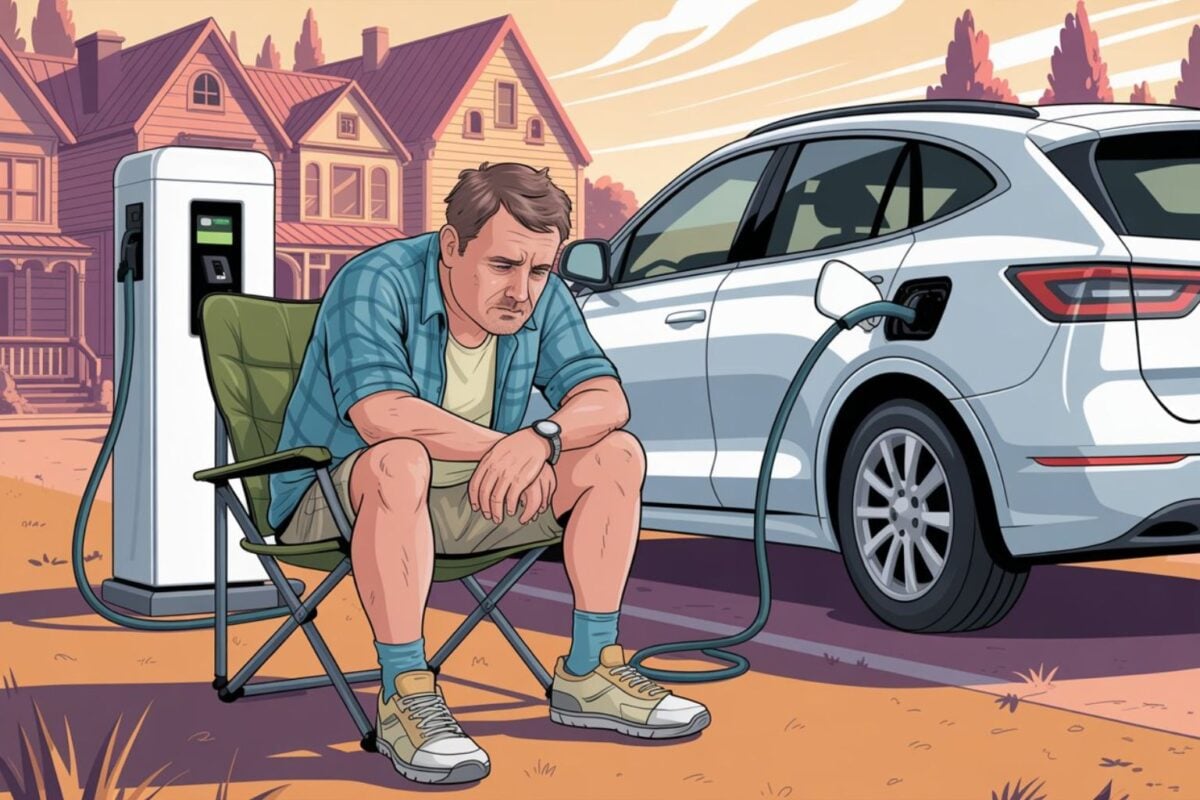
“The car operated beautifully,” remembers Heinrich, a horticulturalist and podcaster. But a day later he heard the “BLING BLING!” warning him his battery level had dipped below 20 percent. He pulled into a Walgreens for a quick charge.
“When I came back an hour later, there was only a 30 percent charge,” he says. For the next week, he frantically hopscotched between charging stations, looking for a little extra juice.
“Often, there was only one charging station that worked,” he says. “And it took hours to recharge.”
Why road trips with an EV are challenging
When it comes to long road trips, EVs are thrilling, nerve-wracking — and infuriating.
It’s thrilling, the first time you pass by a gas station and realize you don’t have to pay those high prices at the pump. It’s nerve-wracking when you can’t find a charging station on a long road trip. And it’s infuriating when you realize it will be hours before your battery is charged.
Heinrich’s experience will be shared by millions of other drivers during the upcoming vacation season. Taking your EV on a long journey still demands a leap of faith. A recent survey by Mazda suggested that while 21 percent of North Americans planned to take some type of electric vehicle on a road trip, 26 percent of respondents felt “neutral” about the prospect of driving long distances in an EV, and 7 percent admitted to extreme anxiety.
But with the right mindset and tools, that leap lands you squarely in the future – saving money, reducing emissions, and discovering a new rhythm to the open road.
My white-knuckle road trip through Germany
I learned this lesson firsthand barreling through Germany recently. No sooner had I driven my Škoda Enyaq iV on the autobahn than my battery life indicator turned into a countdown clock, ticking mercilessly toward the red zone. And yes, when you hit 20 percent, you get a warning that sounds like you’ve breached Fort Knox.
By the time I reached my destination in rural Rheinland-Pfalz, I was down to 30 percent of my battery. I thought: What if I can’t find a charger in time? I quietly panicked.
The Germans have a word for that: Reichweitenangst. Range anxiety never sounded so scary.
I found a charging station in the small village where I was staying, but like Heinrich, the process was painfully slow and there were access hurdles. Many stations demanded a specific charging card or app that required a German address to register. Using a credit card meant filling out all your details and hoping the transaction went through. The vehicle recommended that I only charge to 80 percent, but even that took five hours and cost about $30. Worse, the charging station took a $90 deposit from my credit card. Ouch!
We have owned EVs since 2011 and got our first road trip capable EV (a Nissan Leaf with a 200 mile plus range) in 2021. We took our first real road trip in 2022 and found the public charging infrastructure abysmal. We decided that we would either get a Tesla or a plug-in hybrid and replaced the Leaf with a used Tesla soon after that trip.
We currently own two Teslas, a 2017 and a 2021. We have taken numerous road trips in Teslas since we got our first one and never had a problem charging. My criteria for range is that the range must be longer than my geriatric bladder. Charging a Tesla at a Tesla public charger is easier than pumping gas. You plug the car in, the system identifies the car, starts charging and charges your credit card when it’s done or, in the case of our 2017 model which we bought used, charges for free.
We will probably not buy another Tesla as I do not approve of Elon’s antics. Since we bought both cars used and it costs Tesla money every time we charge our ’17 model, we aren’t putting any significant money in Tesla’s coffers. As public charging becomes easier and more reliable, road trips in other brands will become easier. Charging at home is easier and faster than pumping gas. We get home, plug in and the car’s ready in the morning. I doubt we’ll ever get another ICE car.
Read more insightful reader feedback. See all comments.
It wasn’t just low battery warnings and restrictions. It was infrastructure confusion.
Nobody told me about the fast-charging stations or where to look for them. I discovered them myself, hidden in rest stops, lurking near autobahn exits. I’ll never forget getting to Karlsruhe and hearing that dreaded klaxon: My battery was below 20 percent again. I white-knuckled it to a charger near my rental apartment with less than 10 percent to spare.
Would this be the last EV road trip for me? I’ll tell you in a minute.
Are you ready for an EV road trip this summer?
So, how do you know if your adventure is EV-safe? It boils down to route, range, and real-time readiness. Ditch the guesswork. Here’s what experts say:
Prep like a pro. Sean Tucker, lead editor for Kelley Blue Book, advises a full pre-trip charge: “Reset the cap and charge to 100 percent,” he says. Also, download all necessary network apps and set up accounts payment before leaving. Tesla owners have an advantage because they can just plug in, unplug, and leave. For non-Teslas, prepayment setup is important. Carry physical charging cards as backups.
Consult the right sites. Sites like PlugShare and A Better Routeplanner, which allow you to plan your EV road trip, are a must. “You can plot out your trip ahead of time,” says James Morin, an automotive journalist and longtime EV owner. The sites use Al to determine how many people have charged and any issues they faced. That can help you avoid situations like a closed charging station or one blocked by construction. Also, use your car’s nav system, since it will show you the next charging station. (I should have done that with my rental Škoda; instead, I used Google Maps.)
Set your range. “Don’t take an EV over a journey where maps don’t show a charging station at least every 200 miles,” warns Carl Rodriguez, founder of NX Auto Transport, an auto shipping company. He says multiple charging stations are a must. “I’ve heard clients complain about vandalism, which renders charging stations unusable,” he warns.
Make strategic charging stops. Kirsti Scott, who recently took an epic, 10,000-mile U.S. trek in her VW ID.Buzz, says you have to plan around your charging stops. “When we stop to charge, we get out, get a coffee, snack or lunch, take a bathroom break, toss out the car trash, wash the bugs off the windshield, check emails and socials, and talk with the other EV owners who always want to see inside the van,” she says. And in less than half an hour on a fast charger she’s back on the road.
By the way, knowing the difference between charger types is important for trip planning. DC Fast Chargers (including CCS, CHAdeMO, and Tesla Superchargers) deliver 50 to 350 kilowatts (kW), replenishing 80 percent of a battery in 20 to 45 minutes. They feature thick, hose-like cables with bulky connectors. Most public “Level 2” chargers (often found at hotels or shopping centers) deliver only 6 to 19 kW and take a patience-testing 4 to 10 hours for a full charge. They use slimmer cables with smaller connectors, resembling a beefed-up version of a household outlet. While Level 2 chargers dominate 80 percent of public ports, fast chargers are essential for road trips — yet currently comprise just 20 percent of U.S. public infrastructure.
But even with these proven strategies, I still wouldn’t give anyone a green light for an EV road trip. The reasons are more personal.
Don’t take an EV on a long road trip, unless …
If you own an EV and are driving through well-developed areas, you probably already know that the drive is no problem.
But anywhere else? Problem.
In Germany, I couldn’t quite figure out how to download an app that allowed me to charge my car. So I often had to navigate to a website on my phone, enter my payment details, and pray that it worked. The system was often counterintuitive. For example, on a charging station with several plugs, it wasn’t always clear which outlet I should use.
I used my phone and Android Auto to navigate, but it didn’t really play nice with the Škoda — not like a Tesla, which tells you when to recharge and sends you to a fast-charging station nearby. I had to do the math — how many more kilometers of charge versus how far to my next charging station.
I remember checking into a hotel in a small town in Brandenburg with just 7 percent charge. I knew it had a charger, and I struggled, in the pouring rain, to enter my payment details. I failed twice — and saw two charges for $70 on my credit card — before succeeding a third time.
The next morning, I got in the car, relieved to have a full charge. Except, I didn’t. The payment had failed a third time. I made it to the next charging station with just 4 percent battery and a very severe case of Reichweitenangst.
And that’s how I became an EV road trip skeptic. If you’re driving in familiar territory in your own EV, you’ll be fine. A little planning will ensure you have a stress-free trip. But if you’re renting an EV abroad, driving on unfamiliar roads, you could end up with a severe case of range anxiety.
Your voice matters
From broken chargers to apps that won’t process payments, the reality of an EV road trip often clashes with the glossy marketing. “Range anxiety” is very real for renters unfamiliar with the technology.
- Would you rent an electric vehicle for a long road trip in an unfamiliar area, or do you stick to gas for peace of mind?
- Have you ever found yourself stranded by a broken or occupied charging station when you were running on empty?
- Is the charging infrastructure actually ready for mass adoption, or are we pushing EVs before the grid can handle them?
What you’re saying
Readers shared a wide range of experiences with electric vehicle road trips, from seamless Tesla journeys to frustrating infrastructure challenges. The conversation revealed a stark divide between those who’ve mastered EV travel and those who remain skeptical about the technology’s readiness for everyday use.
-
The Tesla advantage
Rick detailed his journey from a problematic Nissan Leaf experience in 2022 to trouble-free Tesla road trips, praising the seamless plug-and-charge system that’s “easier than pumping gas.” However, he noted he won’t buy another Tesla due to disapproval of Elon’s behavior, though he continues using his used models since charging costs Tesla money.
-
App fatigue and infrastructure gaps
Miles Will Save Us All described downloading four different charging apps just to get through one weekend with a non-Tesla rental, calling it a “major barrier to entry.” Frank Loncar recounted neighbors’ F150 EV troubles with clunky apps and down chargers, while his Tesla-driving coworker celebrates when “the app, charger and car all handshake on the first try” at his daily charging station.
-
Regional disparities
Chris Johnson reported smooth EV experiences on the West Coast but a DC-area “horror story” he won’t discuss, calling the East Coast infrastructure inadequate. Dee Eagle pointed out that EVs don’t make sense in rural areas where distances between cities can be six hours. Meanwhile, Dangerous Ideas explained why they stick with hybrids: “I want the fuel efficiency for my daily commute but zero anxiety when I decide to drive across three states to see family.”

Have a question about this story? Tell us what happened — we read every comment.
Join the conversation