in this case
- American Airlines damages Kao Spencer’s $7,000 custom wheelchair, breaking the snow tires she needs to navigate a Maine winter.
- The airline admits negligence—handlers ignored loading instructions—but leaves the student stranded on campus with a loaner chair that can’t handle the snow.
- American offers to pay for repairs and provides a $200 trip credit for her trouble, raising the question: Is that enough for taking away someone’s mobility?
Kao Spencer flew from Philadelphia to Portland, Maine, on American Airlines earlier this month. She checked her $7,000 custom wheelchair, trusting the carrier to handle it with care.
It didn’t.
When she landed, she found the wheels had been damaged. A cargo handler admitted he had stored the chair on its side despite her instructions, and he failed to take a required photo of the loading process.
The snow tires were broken, the frame was compromised and the wheel no longer locked into the axle.
Now, Spencer is stranded on her campus in Bangor. Maine’s winter has arrived, burying the ground in snow. Without her heavy-duty tires, Spencer, a college student, feels stuck.
“American has further disabled me by breaking my brand-new $7,000 custom wheelchair,” Spencer told me.
American Airlines agreed to pay for repairs—eventually. But for the weeks of lost mobility, the missed appointments and the sheer frustration of being grounded, the airline made a compensation offer: a mere $200 in travel credit.
Today, we’re bringing back one of our most popular features: Is this enough compensation?
Spencer’s case raises difficult questions about the value of mobility and the responsibility of airlines.
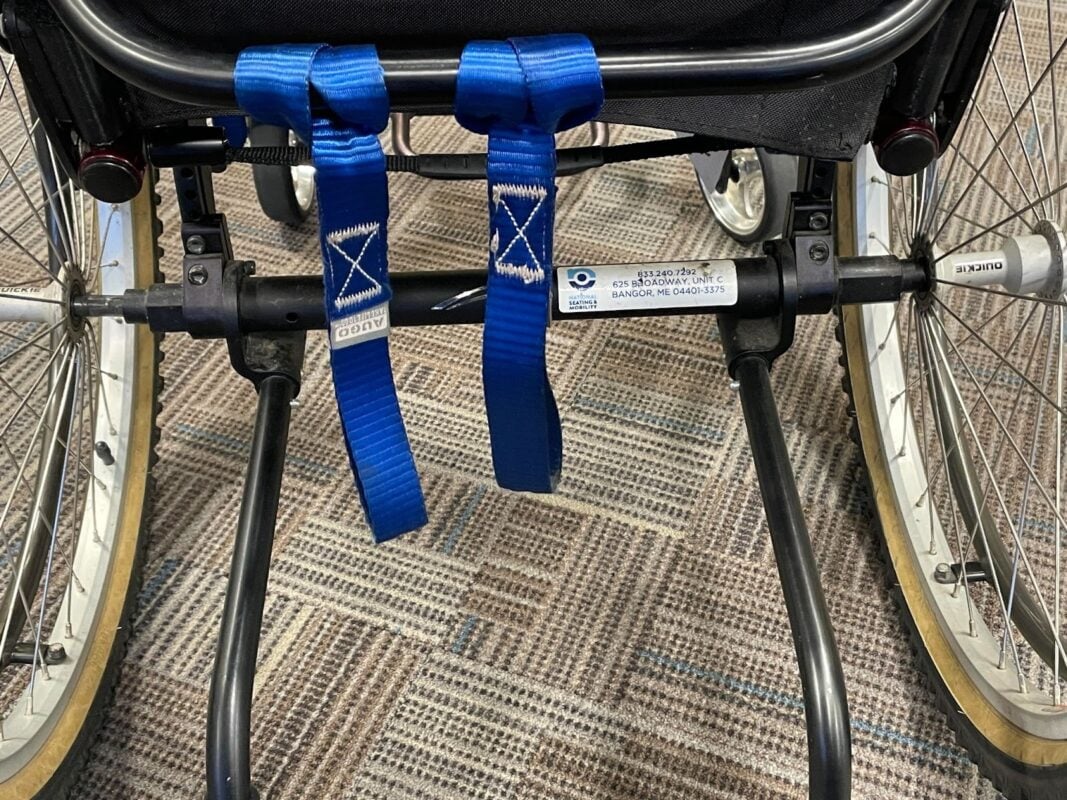
Kao Spencer’s damaged wheelchair.
Here’s the offer from American Airlines
Spencer spent four hours at the airport filing her claim after she landed in Maine. The process was a bureaucratic relay race. She contacted American, which referred her to Global Repair Group (GRG), a subcontractor, for the fix. GRG correctly noted it only handles repairs, not compensation.
So she filed a formal complaint with the airline. American’s customer relations department sent a letter apologizing for the “alleged regulatory violation.” It reiterated that it would cover the repairs and provide a loaner chair.
In recognition of her difficulty, the airline offered her a $200 flight credit. Spencer notes her ticket cost $400 and values her claim for loss of use and suffering at $2,000.
Was this enough compensation?
Here’s what we need your help deciding.
Yes, it was enough compensation: Under the Department of Transportation (DOT) regulations and the airline’s contract of carriage, a carrier’s primary liability is to repair or replace a damaged assistive device up to the original purchase price.
Technically, American Airlines is fulfilling this obligation. It has authorized Global Repair Group to fix the chair. It is providing a loaner chair to ensure Spencer has mobility while parts are on order. (Related: Air Canada canceled her flight and promised to cover her hotel. Then it didn’t.)
From a regulatory standpoint, the airline has met the requirements. The law does not strictly mandate compensation for “pain and suffering” or “loss of enjoyment of life” in these administrative settlements.
The $200 credit is classified as a goodwill gesture—an optional perk provided over and above the legal minimum.
American acknowledged its error immediately. It admitted the handler failed to follow procedure regarding the photo and storage orientation. By covering the full cost of repairs and offering a credit worth 50 percent of her ticket value, American is arguably adhering to the industry standard for property damage claims where no bodily injury occurred.
No, it was not enough compensation: While American may be following the letter of the law, the compensation fails to account for the functional reality of the damage.
A wheelchair is not luggage. It’s an extension of the passenger’s body. When American broke Spencer’s snow tires, it effectively made Spencer housebound. The loaner chair provided is a standard model, which Spencer argues is useless in the Maine snow.
“The added cost of delivery fees for my groceries because I can’t leave campus to get them myself is already eating at me,” Spencer wrote in her email to the airline.
The damage was also the result of admitted negligence—storing the chair on its side and failing to document it—rather than an unavoidable accident. A $200 voucher, which requires the customer to spend more money with the airline to use, does not address the immediate financial burden of delivery fees and lost independence.
Spencer argues that being stranded for months warrants restitution that reflects the severity of the disruption, not just a token credit.
They did not provide her with a loaner. That’s like an insurance company saying that they’re going to fix your automobile, and while it’s in the shop, their loaner will be a bicycle. It’s not equivalent. If the insured can’t get to work (30 minute drive on the freeway) on the bicycle, the insurance company owes him/her for lost wages, and saying, “Sorry, we won’t pay for pain and damages, we gave you a loaner bicycle,” is insulting and should be illegal.
Would American have considered a set a crutches an adequate loaner? This is a semantics game that American should have lost, and the airline, by failing to meet the standards of a loaner, owes the victim a completely repaired wheelchair AND compensation for “lost wages”–the money she had to pay to have groceries delivered, etc. Failure to provide a loaner = American should pay.
Read more insightful reader feedback. See all comments.
Did American Airlines offer enough compensation?
This is a surprisingly difficult case. On paper, American is following the rules. It’s fixing the chair and offering a token apology.
But in reality, a student is stuck in her dorm room in the middle of a Maine winter because an airline employee ignored her instructions.
There was a moment when it looked like the government was going to force airlines to do better. The Biden administration had finalized a rule, Ensuring Safe Accommodations for Air Travelers with Disabilities Using Wheelchairs, which would have made mishandling a wheelchair an automatic violation of the Air Carrier Access Act. It would have also simplified the process for passengers like Spencer to hold airlines accountable.
But the Department of Transportation under the new administration has paused enforcement of key provisions of that rule, citing pending litigation and a need for review. That leaves travelers like Spencer in a regulatory limbo, relying on existing protections—and advocates like us..
What you’re saying
Readers engaged in a fierce debate over liability versus morality. While some argued the airline met its legal obligations, the vast majority felt that treating a medical device like common luggage—and offering a pittance for its destruction—was unacceptable.
-
The “Bicycle” analogy
Pattipeg argued that giving a standard loaner chair to someone who needs custom snow tires is like wrecking someone’s car and giving them a bicycle as a loaner. If the “loaner” doesn’t provide actual mobility, the airline owes compensation for lost independence.
-
Liability vs. Negligence
Matthew W tried to argue that the “baggage handling company” was at fault, not American Airlines. Claudia C. Davis and BKMatthew immediately shut that down, explaining that legally, the airline is responsible for the agents it hires.
-
The reality of custom gear
Kelly Red corrected readers who demanded immediate replacement, noting that custom wheelchairs aren’t “off the shelf” items you can buy at a store. This complexity makes the airline’s negligence in handling the chair even more damaging.
Your voice matters
American Airlines followed the rules by offering repairs and a loaner, but for Kao Spencer, a broken wheelchair meant losing her independence during a Maine winter.
- Is a $200 flight credit a fair trade for weeks of being stranded in a dorm room?
- Should airlines be required to pay cash compensation for “loss of use” when they damage essential medical equipment?
- Does the current law do enough to protect travelers with disabilities, or is it time for stricter enforcement?

Have a question about this story? Tell us what happened — we read every comment.
Join the conversation