in this commentary
- AI chatbots are failing travelers when they need help most, trapping them in loops of frustration during complex booking changes.
- The travel industry’s proposed solution isn’t better technology—it’s a “human premium” that charges you extra to speak to a real person.
- Experts warn that monetizing empathy creates a dangerous class divide and signals a fundamental failure of the automated systems companies rely on.
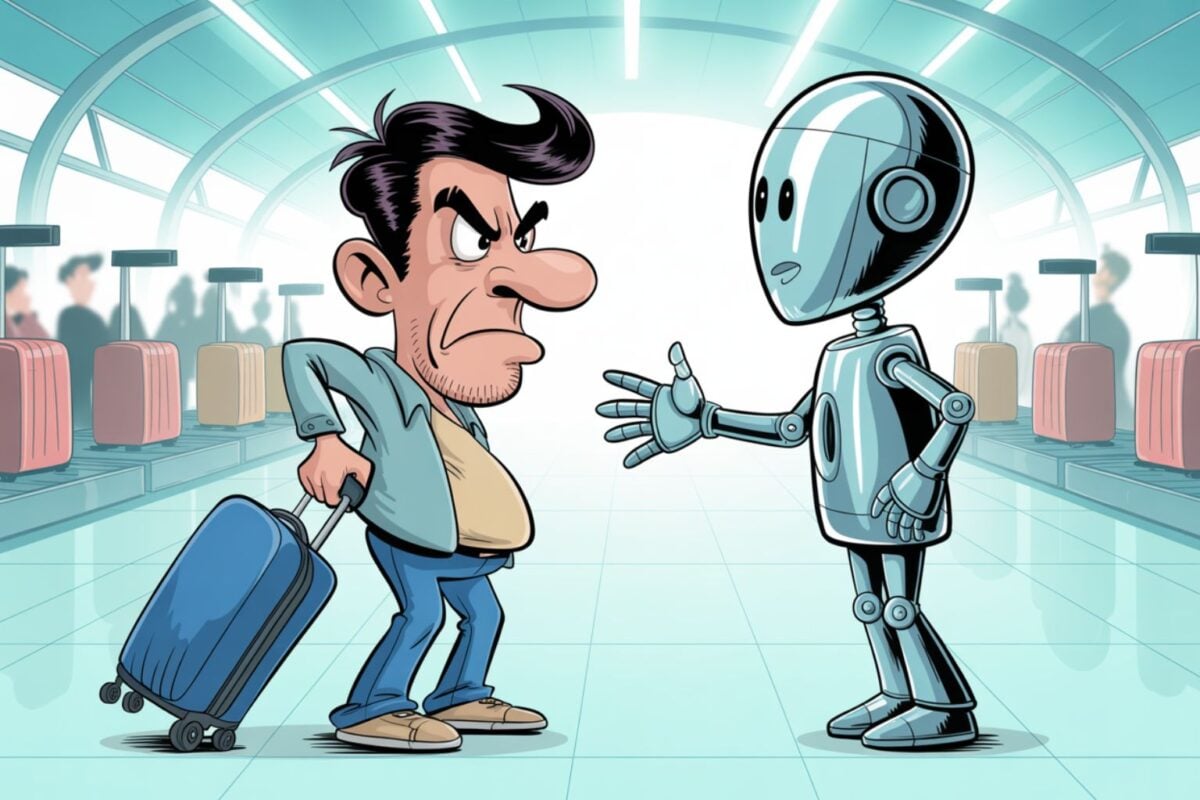
The problem with artificial intelligence is simple: When travelers need it the most, it is the least helpful.
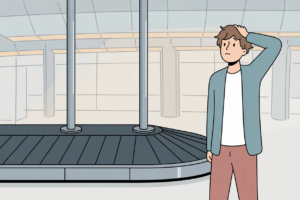
That’s the experience of people like Mark Beales, a retired mortgage banker from Mill Creek, Wash. He says for simple queries, like confirming a flight, AI usually offers a fast, accurate answer. But when it comes to complicated matters, like changing a ticket, it falls flat. It’s a lot of “I didn’t understand that,” and “Do you want me to repeat those options?”
“Sometimes, a bot can’t answer my questions, which is aggravating,” he says. “I don’t mind dealing with AI — as long as I can get around it when I need.”
Well, it looks like the travel industry may have a solution, and you’re probably not going to like it.
Travel companies want you to pay extra to bypass the bot.
A “human premium” for customer service?
“Many customers prefer talking to a live representative, especially when dealing with complex issues,” says David Hunt, chief operating officer of Versys Media, a design agency. “I believe we’ll see a human premium for customer service.”
Hunt ought to know. He recently worked with a major airline, which noticed that passengers strongly preferred direct human communication during booking.
“For me, this highlighted a clear willingness to pay for human interaction,” says Hunt.
A recent survey found three-quarters of Americans would pay more for a premium customer service experience (read: skipping the AI and talking to a person).
Of course, preferred customer service has always been a staple of the travel experience. If you have a platinum card, you get to call a special customer service number. If you’re traveling in first class, your customer service call gets preferential treatment. Or, if you want a white-glove travel experience, you can pay a travel advisor for personalized treatment instead of booking through an online travel agency.
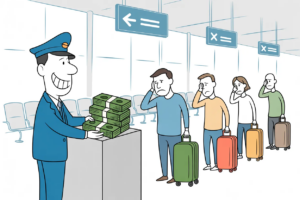
Experts say travel companies could take things to the next level. Imagine being on hold with an airline and hearing an offer: “Press 3 to be connected to a human for an additional $25 fee.” As far-fetched as it sounds, travel companies could be mulling such a move.
As I was reading this article, I got to thinking: around here, stores have self check out lanes so customers can scan their products and pay for them without dealing with a human cashier unless there is an issue. These lanes got popular when the minimum wage went up.
I wonder if travel companies adopted AI for the same reason: they thought it would be cheaper than hiring more people. Then some realized that even when charging to have a customer speak to a human worked, they kept the charges and other companies may start doing it, too. I think AI is too basic to do this as it is “not ready for prime time” in any situation I have had to deal with it.
Read more insightful reader feedback. See all comments.
In a way, it’s already here
The talk-to-a-person fee already exists in the airline industry, to a certain extent. Many airlines charge a fee if you want to speak to a customer service agent instead of using the website to book a ticket. The fees range from $25 to $50 per reservation, depending on your destination. (Some airlines, notably Delta and Southwest, do not charge to talk to a person.)
Table: How much does it cost to book a ticket with a human?
| Airline | Phone Fee (Domestic) | Phone Fee (International) | Notes |
| Alaska Airlines | $15 | $15 | Waived for MVP Gold+ and Club 49 members |
| American Airlines | $50 | $50 | Waived for AAdvantage Executive Platinum/Platinum Pro |
| Delta Air Lines | $0 | $0 | Fees may apply for certain European-origin tickets |
| Hawaiian Airlines | $25 | $35 | Waived for Pualani elite members and cardholders |
| JetBlue | $25 | $25 | Waived for Mosaic members |
| Southwest | $0 | $0 | No fees for phone/airport bookings |
| Spirit Airlines | $25 | $25 | Waived for Spirit Gold members (online/app is cheaper) |
| United Airlines | $25 | $25 | Waived for Premier Silver+ |
Travelers say they would pay more to get human service
I asked travelers how they felt about paying more to avoid an AI and frankly, I was surprised by the answers.
“Yes, I would pay extra to speak to a person,” says Raquel Scott, a film producer from Los Angeles. “I absolutely abhor AI chatbots. They are typically a complete waste of time, and sometimes you can’t type what you want to say; you can only click on one of the suggested responses. It’s infuriating!”
Even some insiders say they would pay more to skip the AI.
“I would pay more to speak with a person,” says Mary Zimmerman, a travel advisor. “I think people are increasingly wary of speaking with a robot.”
Others don’t think you should have to pay for human customer service
The idea of charging more to talk to a person doesn’t sit well with everyone.
“When something goes wrong thousands of miles from home — especially while you’re traveling abroad — peace of mind comes from knowing there is a real person on the other end of the line who knows your name and understands the urgency in a way technology can’t,” says Mike Hallman, CEO of Medjet. “And that’s where paying extra for a real person rubs people the wrong way.”
There’s another problem with making people pay to talk to a human. Paying to talk to a person may be the only option for those who can least afford it.
“Smart phones, laptops, and other electronic toys are beyond the financial reach of quite a few Americans,” notes Bill McGee, a senior fellow at the American Economic Liberties Project.
His organization has taken a position that human-staffed travel call centers should be mandatory, and that regulators should enforce such policies. But in the current “anything goes” regulatory environment, it’s doubtful the government would stop a travel company from offering a “skip the AI” upgrade.
Is there a way around pay-to-play? Possibly, says Emily DeJeu, who teaches business communication at Carnegie Mellon University. You can become a smarter user of technology, finding ways to circumvent a chatbot.
“Long-term, I think we need to apply collective pressure to avoid turning human assistance into a pay-to-play commodity,” she adds. The EU is expected to introduce a “Right to Speak to a Human” law by 2028, so it’s possible that government intervention will stop the monetization of human support.
Why the human premium may be one of the worst ideas ever
Should travel companies charge extra to talk to a person? In a word, no. In fact, charging to skip the AI may be one of the worst ideas the travel industry has ever had.
“Charging more to talk to a human undermines trust and signals that empathy is a luxury,” says Mario Matulich, president of Customer Management Practice. “Brands that get this right will flip the script, not penalizing customers for needing help, but designing hybrid experiences where AI empowers agents and real people are accessible when it matters most.”
But why is charging extra such a terrible idea? The reason is simple. In a way, charging extra for human service is an acknowledgment that the AI-dependent system doesn’t work. And that’s a terrible message to send to your customers, especially someone who is trying to rebook a canceled flight or change a room reservation.
Paying a human premium monetizes something that should be included with every product a company offers. Businesses that try to unbundle customer service are playing a dangerous monetization game with their customers. And they stand to lose far more than they can imagine.
What you’re saying
Readers saw the “human premium” as a cynical money grab. Many drew parallels to self-checkout lanes, arguing that companies are cutting labor costs while simultaneously charging customers to fix the problems their automated systems create.
-
Profiting from failure
Jennifer and Sheryl agreed that companies shouldn’t profit from their own technological failures. If the bot can’t solve the problem, connecting to a human is part of the service already paid for, not a premium add-on.
-
The self-checkout effect
Tim compared AI adoption to grocery self-checkouts: a move designed to cut labor costs rather than improve service. He warned that once companies realize people will pay to bypass broken systems, the practice will spread.
-
Admission of a broken system
The Brown Crusader and Little Lion argued that charging for human help is an admission that the AI doesn’t work. If the automation were effective, especially in complex situations, customers wouldn’t need to pay to escape it.
Your voice matters
Airlines are betting that frustration with AI chatbots will drive customers to pay extra for human interaction. It’s a bold move to monetize basic customer service.
- Would you pay a $25 “human premium” to skip the phone tree and talk to a real person immediately?
- Is access to human support a basic right of purchase, or a luxury add-on like extra legroom?
- Do you trust AI chatbots to handle complex travel issues, or do you always demand a representative?

Have a question about this story? Tell us what happened — we read every comment.
Join the conversation