
in this commentary
- Germany’s Spreewald region goes beyond basic conservation to practice regenerative tourism. Locals and rangers actively manage a 186-mile network of wild canals to ensure humans and wildlife thrive side-by-side.
- At properties like the Michelberger Farm, gardeners cultivate innovative “food forests.” They intentionally prune pioneer trees to trigger natural stress hormones, which accelerates the growth of organic fruit and berries on the forest floor.
- Tourism officials enforce strict environmental standards for local hotels and businesses. Meanwhile, residents keep their Sorbian heritage alive in island-like villages where even the fire department and trash collectors still travel by boat.
Germany’s Spree Forest region, with its serene labyrinth of waterways, forests, and meadows, feels both ancient and forward-thinking at the same time. And that’s intentional.
Spreewald has become a model for regenerative tourism. It’s a place that doesn’t just preserve nature but improves on it, from its famous biosphere reserve to hotels that are on the cutting edge of sustainability.
What sets the Spreewald apart isn’t just its remarkable beauty — during the summer, you can see cranes and greylag geese while dodging water lilies along 186 miles of navigable waterways. Nor is it the cultural heritage of Sorbian villages with their trademark thatched roofs.
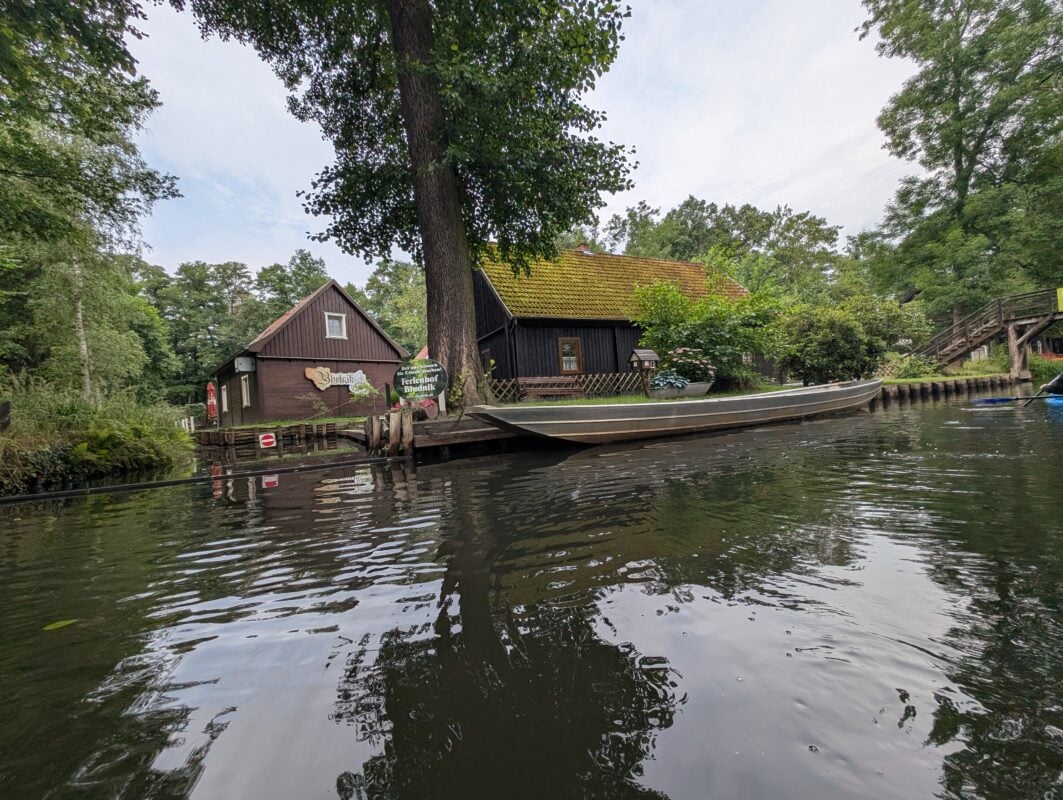
Historic homes along the canals in the Spreewald Biosphere Reserve. (Photo by Aren Elliott)
Co-existing in the biosphere reserve
The canals are a unique feature of the region, forming an intricate network within the biosphere reserve.
Hundreds of years ago, this flat river valley was wild and swampy, explains Carolin von Prondzinsky, a ranger with the Spreewald Biosphere Reserve.
“The early settlers faced a tough existence,” she says. “To survive and farm, they had to cultivate the land, putting in a lot of drainage to transform the really flat valley.”
This extensive human effort created an intricate network of streams, rivers and canals that defines the Spreewald today. (Related: Sustainability meets serenity (and a surprise) on Germany’s Baltic coast.)
Von Prondzinsky explains that the core mission of the biosphere reserve is to ensure nature and humans live together in a sustainable way.
“This concept of co-existence — rather than pure noninterference — is what makes Spreewald a role model,” she adds.
That attitude isn’t confined to the biosphere reserve.
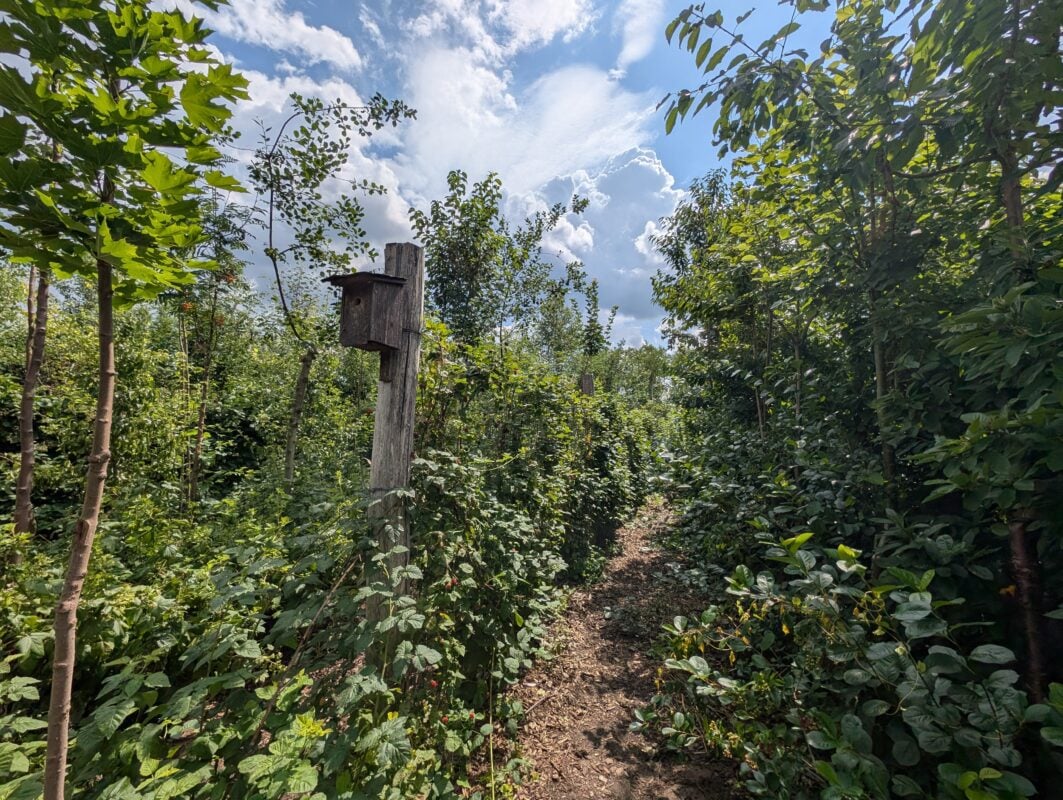
The Michelberger Farm’s famous food forest in late summer. (Photo by Aren Elliott)
Michelberger Farm’s food forest: A blueprint for regenerative agriculture
At the nearby Michelberger Farm, an upscale farmstay property, you’ll find a remarkable food forest that illustrates this region’s commitment to regenerative practices.
Michelberger established its food forest six years ago to supply naturally grown organic food to its guests. But it has evolved into much more.
One of the most fascinating aspects of the forest is the management of pioneer species – the quick-growing trees that first colonize an area. These trees, mainly silver birches, form the top layer, creating a cooler microclimate underneath.
I appreciate the detail about managing pioneer species. It’s a fascinating counterintuitive strategy that really challenges the “leave it all alone” school of conservation.
It’s good to see that there’s a sophisticated understanding of ecosystem dynamics happening on the ground there.
Read more insightful reader feedback. See all comments.
Through careful pruning by the gardeners, the trees control the amount of sunlight reaching the fruit trees and berries below. This isn’t just about light. The birches’ stress response to being cut releases hormones into the ground, promoting quicker growth in other trees nearby, not just the same species. It’s a counterintuitive yet effective way of stimulating the entire ecosystem.
During late summer, the food forest is filled with ripening fruit — red currants, apples, plums, and apricots. It’s only a few steps to the kitchen, where Michelberger’s chef incorporates the fruit into the farm-to-table menu.

Navigating one of the locks in the Spreewald’s canals. (Photo by Aren Elliott)
Spreewald’s holistic approach to sustainable tourism
Spreewald’s commitment to sustainability extends beyond farms and forests. It’s also part of the Brandenburg region’s tourism strategy.
The Spreewald Tourism Association has created an ambitious sustainability plan to ensure the region’s continuous development.
One key pillar is a commitment to its TourCert certification. This independent organization audits tourism companies for environmental and social impact, ensuring they “act in a socially responsible and environmentally friendly way.”
Hotels in the Spreewald region are also focusing on sustainable aspects, and that includes Michelberger. The values include:
- Environmentally friendly energy sources. Investing in renewable energies like solar or biomass.
- Regional cuisine and products. Sourcing food from local farmers and producers to support the economy and offer authentic, fresh food.
- Waste reduction and recycling. Minimizing disposable packaging and promoting recycling.
- Environmentally friendly mobility. Encouraging the use of bicycles, electric cars and public transportation.
- Nature and environmental education. Informing guests through guided tours and materials.
Many tourism businesses partner directly with the biosphere reserve or support local nature conservation projects, showing their collective regional commitment to responsible tourism. This comprehensive approach ensures that tourism not only is an economic factor but also contributes to the preservation of nature.
Navigating the Spreewald’s watery center
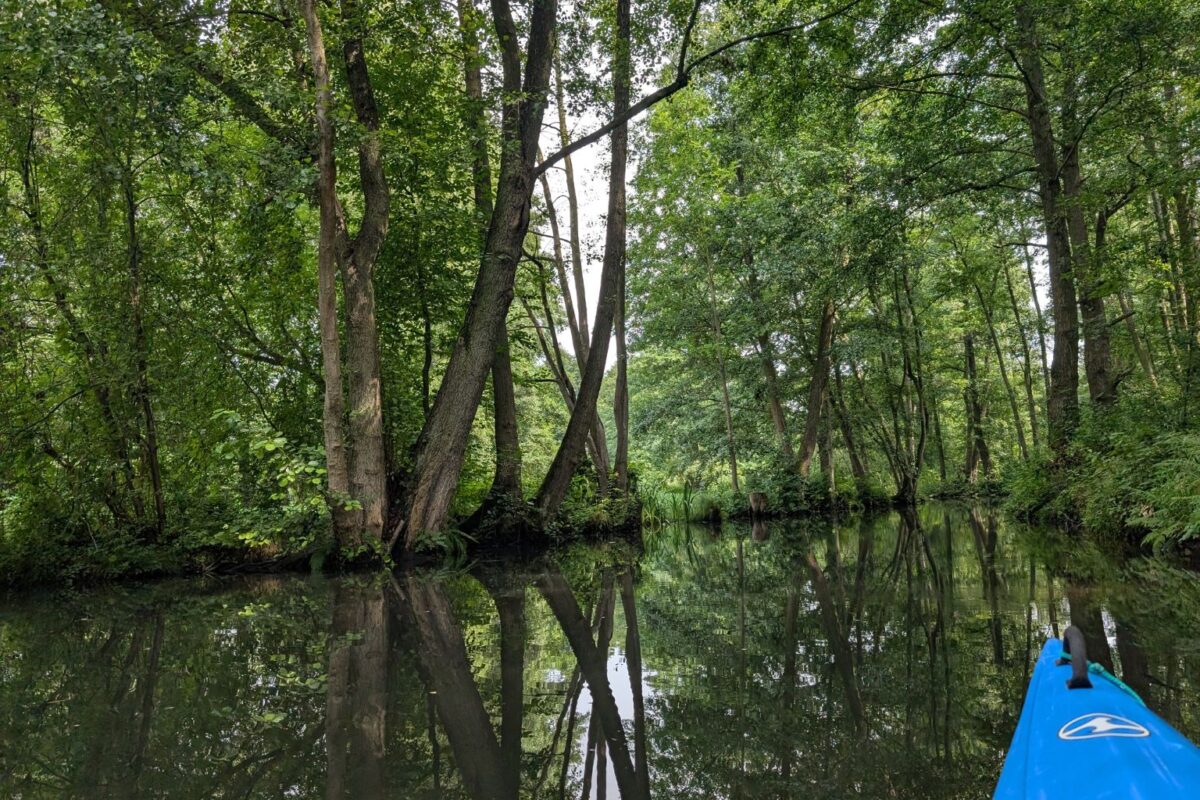
The most iconic way to experience the Spreewald is by canal. A boat ride offers an intimate look at the region’s unique ecosystem.
Along the shores, you’ll find large cottonwood trees, which thrive near the water.
Navigating the waterways also involves passing through locks. Von Prondzinsky, the park ranger, says you can still use the locks, but now there’s a more sustainable way of getting your canoe or kayak to the other side using rollers, which don’t require any electricity.
The Spreewald region is deeply intertwined with the Sorbian heritage. Although German is now the primary language, some older residents still speak Sorbian, a Western Slavic language, and a few schools continue to teach it. This unique linguistic and cultural presence is inextricably linked to the region’s distinctive landscape.
Along these intricate canals, visitors will discover villages and individual houses that historically, and in some cases even today, can only be reached by boat. Until the late 1920s, all transport – from moving furniture to delivering building materials – relied entirely on boats. This dependency on water transport is reflected in the architecture, with the attractive side of houses traditionally facing the waterfront. Even essential services like the fire department and trash collection still operate by boat in these unique island-like locales, preserving the Spreewald’s enduring connection to its canals..
A model for future generations
The Spreewald is a living laboratory for sustainability. From the large-scale planning of the biosphere reserve to the regenerative practices in a small food forest, this region is showing how communities can move beyond simply preserving nature to actively regenerating it.
In a world struggling with environmental challenges, the Spreewald is a necessary reminder that sustainability is about intelligent design and a deep respect for the interconnectedness of all living things. It shows that with thoughtful planning and dedicated effort, we can cultivate landscapes that are not only beautiful and productive but also resilient, much like a carefully tended garden that yields both sustenance — and inspiration.
Germany’s Spreewald region proves that tourism can actively heal the environment, rather than just minimizing the damage.
Your voice matters
What you’re saying
Readers debated the merits of active environmental management, with some praising the Spreewald’s hands-on approach and others questioning if human intervention ever truly benefits nature.
-
Does intervention help or hurt?
Mr. Smith and Blues Traveler praised the counterintuitive strategy of intentionally pruning trees to stimulate growth, arguing it proves humans can enhance an ecosystem rather than just minimize damage. Conversely, Berkinet and 737MAXPilot pushed back, suggesting the best thing people can do for the environment is to leave it alone. They questioned whether intensive “food forests” disrupt natural biodiversity in favor of human-selected crops.
-
Buzzwords vs. scalability
Miles Will Save Us All and Dangerous Ideas questioned the long-term viability of the model. They wondered if “regenerative tourism” is just a new marketing buzzword for boutique eco-resorts rather than a scalable solution for broader agricultural and environmental needs.
-
Authentic commitment
M.C. Storm and Jennifer applauded the region’s tangible, low-tech commitments. They noted that using manual rollers for canoes and relying on boats for trash collection proves the Spreewald’s dedication is authentic, not just a gimmick to justify higher room rates. The Brown Crusader also appreciated the hard science and biological engineering driving the local farming efforts.

Have a question about this story? Tell us what happened — we read every comment.
Join the conversation