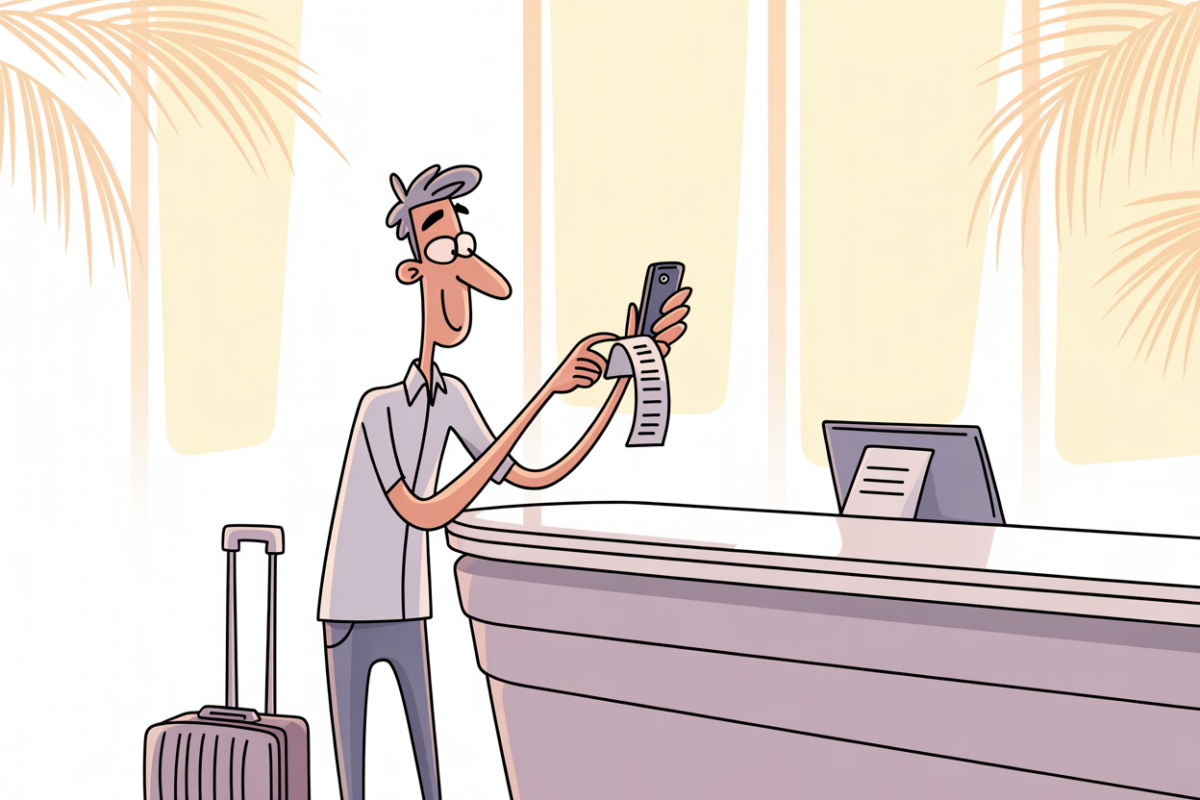
When something goes wrong on the road — a flight delay, vainshing luggage, illness — you file a travel insurance claim, expecting a quick reimbursement.
Then your insurance company asks for documentation, and you realize you’ve kept almost none of it.
If I had a penny for every time I’ve heard that as a consumer advocate, I’d be retired in the French Riviera by now. According to Squaremouth, one-third of travelers had their insurance claims denied in 2024.
“The biggest reason travel insurance claims get delayed or denied isn’t the event itself,” says Suzanne Morrow, CEO of InsureMyTrip. “It’s missing paperwork. Gathering the right documentation while you’re still on your trip can mean the difference between a full reimbursement and no reimbursement at all.”
Your phone’s full of blurry photos. Emails are buried in your inbox. That receipt you grabbed at the hotel? Long gone. Your memory of what you actually spent? Even foggier.
The difference between a fully paid travel insurance claim and a denied one often hinges on whether you’ve kept the right documentation—receipts, photos, emails, and timestamps that prove what happened and what it cost you. The good news is that staying organized requires nothing more than your smartphone, a folder system, and five minutes of nightly discipline.
This is one of the greatest articles that I’ve read from Christopher Elliott, and a fantastic public service. Thank you, Chris.
It’s happening more than ever
The consequences of failing to keep good paperwork when you travel can be brutal. Missing bills lead to denied claims. Incomplete forms trigger requests for more information that slow everything down. Late reporting means missed deadlines.
“One of the most common causes of a delay is incomplete paperwork,” warns Clayton Eidson, CEO of AZ Health Insurance Agents. “Make sure you furnish your travel insurance company or claims administrator with all the requested information. Otherwise, you could be looking at a lengthy delay.”
Eidson has seen thousands of dollars in refunds lost simply because paperwork didn’t tally.
“Good recordkeeping need not be difficult, but it needs to be done with deliberation,” he adds. “The clearer it can be shown what has happened and what the financial result will be, the easier the claim will be to settle.”
Experts say they’re seeing more travel insurance denials because of lax paperwork. But that doesn’t have to be you.
The process starts with a simple device almost everyone has: a phone.
Your phone is your secret documentation weapon
Using your smartphone in a smart way can spell the difference between success and failure.
“If one has a good phone, just taking tons of photos and maybe videos would be super helpful,” says Justin Gordon, a travel documentation enthusiast who runs a vacation rental website.
OK, his advice sounds almost absurdly basic, but here’s why it matters. Photos create a timestamped, objective record. They’re harder to dispute than memory or paper receipts that fade over time.
Recent iOS updates make this even more practical. The latest version of Apple’s operating system introduced a game-changing feature: the ability to record calls — a lifesaver when you’re battling an airline or hotel over a refund.
Apple Notes now automatically embeds call recordings, so you’re not juggling multiple files. You can attach related images directly to the same note.
How to use your phone to keep better records
Basically, keep your phone out at all times and take pictures of everything. Snap receipts immediately after you get them. Photograph your luggage before you check it (make sure you get that bar code on the tag, too). Screenshot flight confirmations. Take a video of your rental car’s condition before you drive off the lot. Take another one when you return it.
“I religiously take a picture of the dashboard before I hand in my keys,” says Jon Mest, a frequent traveler who’s learned this the hard way after being hit with several bogus fuel charges.
How to file the information you collect when you travel
Photographs are just the beginning. You need a system for organizing all of them, plus invoices, emails, booking confirmations and proof of incidents.
Experts say you should create a dedicated folder for everything related to your trip, both physical and digital.
“Before each trip, I create a shared folder in Google Drive titled with the trip name,” explains Merna Emara, a frequent traveler who manages all her logistics digitally. “Every booking email, PDF, and invoice gets saved there automatically using a Gmail filter.”
Pay extra close attention to any invoice you pay with cash.
“If I buy something in cash, I immediately snap a picture of the receipt using Google Lens and upload it to the same folder,” Emara says. This is crucial. Cash transactions leave no electronic trail, so you need to create one yourself.
For the old-school approach, travelers still swear by simple systems.
“When traveling or at home, I keep all correspondence pertaining to the matter at hand in a specific titled folder on my desktop and my email page,” says Harry Wenkert, a retired pharmaceutical sales representative from Pittsburgh. “This obviously reduces the time spent searching for receipts, information and photos, as well as keeping information from being lost. For an extra layer of retention, I use an external hard drive as a backup.”
The common thread here is centralization. Everything in one place means nothing gets lost. Whether it’s a folder on your phone, a Google Drive, Dropbox, or an external hard drive at home, the system only works if you actually use it.
Apps can automate the work
If you prefer to let technology do some of the heavy lifting, there are several apps you can consider.
.
- Expensify stands out as a favorite among frequent travelers. The app uses optical character recognition to automatically extract transaction details from receipts. You photograph a receipt, and Expensify captures the date, vendor, amount, and category. It syncs across devices, and you can export everything as a spreadsheet for insurance companies or tax reports.
- Notion has become popular for building custom tracking templates. “I built a simple ‘Travel Tracker’ template with columns for item, cost, date, and category,” Emara explains. “It syncs across devices and allows me to export as a spreadsheet for insurance or tax reports later.”
- TripIt Pro also has its devotees. The app automatically tracks your flight details and sends alerts for delays, cancellations, and potential refunds. It also allows you to store and access up to 25 documents per trip, such as booking confirmations and passport information.
But how do you actually pull it all together? To find out, I asked insiders.
What travel insiders say about good recordkeeping
The travel industry perspective on this is: don’t overthink it.
“We recommend using cloud applications like Expensify or TripIt, which automatically store receipts, tickets, and reservations in one place,” says Vlad Polyanskiy, chief marketing officer at FlightRefunder. “This helps to collect all the evidence even in case of loss of phone or luggage.”
But apps only work if you use them. This is where discipline comes in — specifically, the nightly review.
For travelers on longer trips, a simple nightly spreadsheet session works wonders.
“We take long trips: two months and more at a time. I bring my laptop and create a chart on Excel,” says Susan Stevens, a veteran traveler. “It is chronological but I have different columns for transportation, lodging, meals and tips.”
So here’s the routine: Each evening, review receipts from the day. Enter amounts into your tracking system (converting currencies as needed). File physical receipts into labeled manila envelopes by week.
It sounds tedious, but it can save you a lot of headaches down the line, according to experts.
“It only takes a few seconds but saves hours later if there’s a dispute or reimbursement delay,” says Jonathan Dies, owner of DFW RV Rentals, who manages documentation for his business and clients dealing with insurance claims.
His key insight is to treat every trip like an insurance claim before it ever becomes one.
“Every repair, refuel, and overnight stop is logged with date, mileage, and invoice photos,” Dies says. “When insurance or taxes come calling, you’ll have every proof you need at your fingertips.”
How keeping good paperwork can help you
Consider what happened to Yunna Takeuchi, co-founder of City Unscripted, a travel experience platform. A series of flight delays caused her to miss prepaid cultural workshop bookings across Italy.
“My habit of photographing every receipt, saving all confirmation emails in dedicated Gmail folders, and maintaining real-time expense tracking through Expensify provided a complete evidence chain that our insurance required for full reimbursement,” Takeuchi explains.
For example, during a luggage delay in Barcelona, having digital copies of packing lists, purchase receipts for workshop materials, and photographic evidence of bag contents enabled full replacement reimbursement within two weeks. Total value of her claim: $3,500.
Kimberly O’Donovan, vice president of operations at Travelex Insurance Services, says the best recordkeepers tell a convincing story.
“Receipts, invoices, and even photos are critical pieces of evidence that support a travel insurance claim,” he adds. “Travelers who take the time to document their relevant expenses and incidents thoroughly — and submit all the evidence required — are more likely to have their claims processed sooner.”
Documentation also buys you speed. Claims adjusters are obsessed with paper trails because they reduce ambiguity. When you submit a complete package with receipts, screenshots, correspondence, timestamps and photos, the adjuster can approve your claim quickly. There’s no back-and-forth.
The process starts before you leave your home.
Here’s what travel insurance companies want
Experts say the trick is to know what your travel insurance company will ask for and to anticipate it.
Before your trip, create a documentation checklist based on your travel insurance policy. What does your insurance company require? Medical records? Police reports? Airline incident reports? Flight confirmations? Proof of payment?
Knowing in advance prevents scrambling later.
“Save all your receipts. Take photos of your travel receipts and store them in a dedicated album on your phone to keep them organized,” Nihan advises. “Save all your travel booking confirmation emails in a specific email inbox folder, too. This way, you can avoid spending extra time searching for the right receipt should you need to make a claim.”
For expensive items you’re bringing on your trip, take pre-trip photos.
“If these items are lost or damaged, having proof of their original cost will help support your claim,” Nihan says. “If you want to be extra diligent, take photos or videos of the items you’ve packed in your suitcase before you leave in case they’re lost, damaged, or stolen on your trip.”
This might sound excessive, but it’s not. Lee Charlton, a commercial photographer based in England who travels extensively, approaches each documentation like it’s a legal case.
“Act like you’ll need to prove everything,” he says. “Don’t rely on memory or flaky Wi-Fi to pull stuff up later. Snap it, store it, and back it up.”
Bottom line: good records are mandatory when you travel
Travel documentation isn’t an optional best practice. It’s the difference between getting paid and getting nothing if you have to file a travel insurance claim. It’s the difference between a claim processed in five days versus languishing for months.
Fortunately, it doesn’t require elaborate systems or expensive apps. A smartphone, a Google Drive folder, and five minutes of discipline each night will get you most of the way there. Add an app like Expensify if you want to automate receipt capture. Create a nightly ritual if you want to ensure nothing falls through the cracks.
But do something. Because when your flight gets delayed and you’re stuck in a hotel for an unplanned night, or your luggage goes missing and you need to replace everything you packed, or you get sick abroad and need a $14,000 hospital bill covered, the receipts, screenshots, emails, and photos you collected will be the only thing between you and a financial loss.
Think of it as cheap insurance for your insurance. And unlike travel insurance itself, it’s absolutely free.

Have a question about this story? Tell us what happened — we read every comment.
Join the conversation