On a cloudless September afternoon, the view from the summit of Feldberg stretches across the Alps, from the peaks of eastern Switzerland to the Austrian ranges beyond Lake Constance. The trail to the top of Baden-Württemberg’s highest mountain is crowded with autumn hikers, and the open, grassy slopes look as if they could hold snow for months.
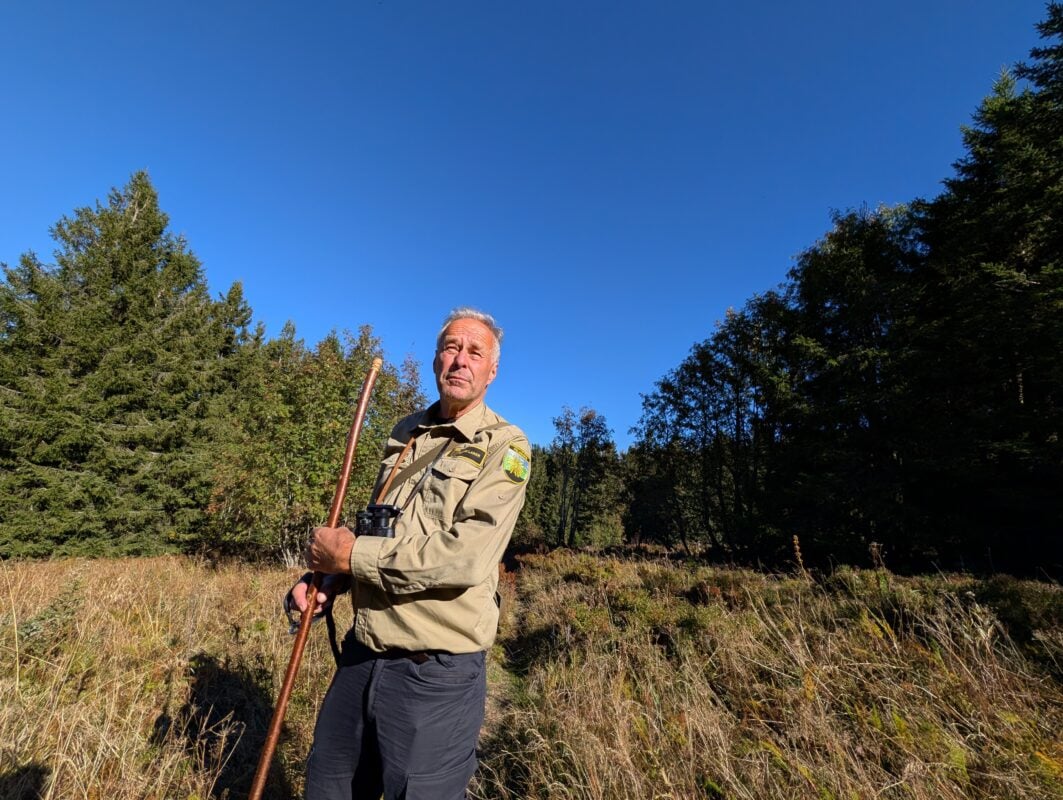
How many more winters they’ll hold the snow is a question Achim Laber is trying to answer. Laber has been a ranger in Feldberg Nature Reserve for 36 years. He’s seen — and documented — every dry winter, early spring and protracted autumn.
Asked how long the ski lifts on the mountain have left, he doesn’t hedge.
“I have no idea,” he says.
That kind of talk is unusual at a European ski resort. But then, these are unusual times. Feldberg has had far fewer days with snow on the ground over the past eight decades, with records from 1945 through 2025 showing a clear decline. Across Europe, the outlook is bleak: a study in Nature Climate Change of 2,234 ski resorts in 28 countries found that 53% would face a very high risk of poor snow if global temperatures rise 2 degrees Celsius above preindustrial levels, and 98% would at 4 degrees.
Resorts sell confidence through snow guarantees, new snowmaking systems and expansion plans that assume winter will keep happening on schedule. Laber’s answer may be a better starting point for sustainable tourism than any weather forecast. A resort that admits it doesn’t know what’s coming can stop spending money to pretend it does.
A nature reserve with a hole in it
When Feldberg Nature Reserve was created in 1937, planners left a gap along the main road for tourism. Ski lifts started going up in the 1950s. One became two, and by 1968 there were 12. In 1990, the year Laber arrived, authorities expanded the lifts outside its boundaries to accommodate Germany’s growing appetite for skiable terrain.
Ownership complicates everything. Roughly a third of the protected land is private (much of it cattle pasture), a third belongs to the state and a third to local communities. Every conservation decision needs a deal. On Feldberg, the mountain that interests conservationists is the same one that interests tourists.
Winters that won’t settle into a pattern
Snow traditionally covers Feldberg from November through April. A photo series Laber keeps from 2013 shows snow falling as late as May 26, with the last patches melting around July 1.
Recent winters haven’t followed that script. For the last four years, the mountain has had no snow over the two-week Christmas break, the most important holiday of the season for Black Forest tourism. That hurts more than visitors might expect. Laber says local businesses earn more in winter than in summer. Skiers buy lift tickets, and when it’s cold, they eat in restaurants instead of picnicking on a meadow. The last four years were “really horrible” for the towns around the mountain, he said.
“In winter, we only have tourists when we have snow,” Laber says.
Without it, visitors just drive about an hour and a half to Switzerland or Austria. The lower Alpine resorts there are closing lifts too.
The warming doesn’t arrive in a straight line, which makes planning much harder. About four years ago, a strong winter persuaded some people that climate change had been exaggerated, Laber says. Businesses made money again. Then the Christmas snow stopped coming altogether.
Snow needs water, too
The region’s primary strategy has relied on snowmaking, a process that requires collecting water from local mountain springs starting with the warmer months and storing it to generate artificial snow for the ski slopes. Operators hope it will buy winter tourism some time. Communities used to collect water for snowmaking starting in autumn. Now they want to begin in spring.
That runs into a problem nobody on Feldberg saw coming. The mountain is full of springs, and for most of Laber’s career, water was never a concern. “We never thought it would become difficult to get water,” he said. Over the last four or five years, the springs have produced less and less. In some towns on the mountain’s southern slopes, the fire brigade now brings water to farmers in tanker trucks.
On a boardwalk through one of the reserve’s bogs, Laber points to a patch of moss that grows only in bogs like this one. It’s dry and dead.
“There is simply too little water,” he said.
Storing water through a hot summer raises other questions, including what grows in it while it waits, and Laber says nobody has good answers yet. The cost of making snow keeps climbing, and lift ticket prices are climbing with it. He worries skiing is drifting out of reach for ordinary families. Prices at the summit restaurants have risen too, pushed up by energy costs.
The forest came back once
Feldberg has been through an environmental crisis before. The resolution surprised even the experts.
In the early 19th century, the land south of the mountain was stripped nearly bare. Laber says it looked like Ireland. Wood was the only fuel, and people had cut down almost everything. Only about 10% of the area was forested.
When the Haus der Natur, a museum attached to the reserve, made a documentary about that recovery, the explanation caught the filmmakers off guard. Nobody expected the forest to return. It came back because the region switched from wood to coal around the 1830s. Some land was replanted, but a lot of it grew back on its own after struggling farmers gave up their meadows. One pasture abandoned in the 1950s turned into forest within 40 years. In Laber’s hometown, forest covers about 80% of the land.
The Black Forest now needs a second energy transition, away from fossil fuels. Nobody is leaving it to chance. Developers want wind turbines across much of the region. On this question, tourism and conservation groups are on the same side, pushing to keep turbines off the most scenic and sensitive summits. Feldberg will probably be spared, in part because it’s home to the capercaillie, a rare grouse. Laber expects more turbines on the lower ridges within a decade.
“We should work against climate change,” he says. “But we are really not sure if it will work.”
If it doesn’t, he said, the people who live here will have to reshape tourism to fit the climate they get.
No backup plan for winter
Summer isn’t the problem. The Black Forest is busy from spring through fall. Laber says it doesn’t need more summer attractions. He’s also seeing visitors he never saw 30 years ago, from Spain, Italy and Israel, who now spend their summers in the mountains to escape the heat at home. But Feldberg’s alpine plants and birds can’t make that trip. They’re already on the highest ground in the region, with nowhere left to climb.
Winter is a different story.
“In winter, the only attraction is snow,” Laber says. Hiking and mountain biking can’t replace it. In a thin-snow winter, he adds, people try to go mountain-biking, but there’s often too much snow to make that practical.
Asked what the region could offer visitors when the snow fails, Laber laughed and called it the hardest question he could imagine. He hasn’t heard an idea that would work for both conservation and tourism. He compares the region to a factory that used to build cars and doesn’t anymore, and says the Black Forest could end up in the same position.
The companies that run the lifts talk about the future differently. Feldbergbahnen, which operates the ski area for the three towns that own it, answers the question of whether winter sports have a future with a resounding yes. It concedes that climate change is a serious challenge and that swings in the weather make planning harder. But it says snowmaking gives vacationers a snow guarantee they can book around.
The lift association has pushed to expand that system. In 2023, machines could cover only about a third of the mountain’s runs, using about 100 snow guns and two reservoirs holding 8,600 cubic meters of water (about 2.3 million gallons). The association called that far too little. It said the cold days needed for snowmaking are getting scarcer, and there isn’t enough water to run every gun when they come.
A master plan called Feldberg 2030 aims to turn the mountain into a year-round destination while modernizing its snowmaking.
Last winter was so-so for skiing. Feldberg opened November 28 after an early storm dropped about 70 centimeters (28 inches) of snow. Then a December thaw cut deep into the Christmas holiday business. Strong crowds in January and February made up most of the losses, but the lifts closed March 22 instead of at Easter as planned. Snowfall had stopped and warm weather was wearing down the south-facing slopes.
Across the border in France’s Jura Mountains, a resort at similar elevations, has made a different choice. After several bad winters, Métabief commissioned climate projections in 2016, and they showed conditions weren’t likely to improve.
The resort now expects to end alpine skiing sometime between 2030 and 2040. It’s maintaining its old lifts instead of replacing them and building up mountain biking, trail running and other activities that don’t require snow. So far, no other resort in this area has followed Métabief’s lead.
Feldberg is betting that better snowmaking can buy more winters, and Métabief is betting it can’t. But the truth is, nobody knows.

Have a question about this story? Tell us what happened — we read every comment.
Join the conversation