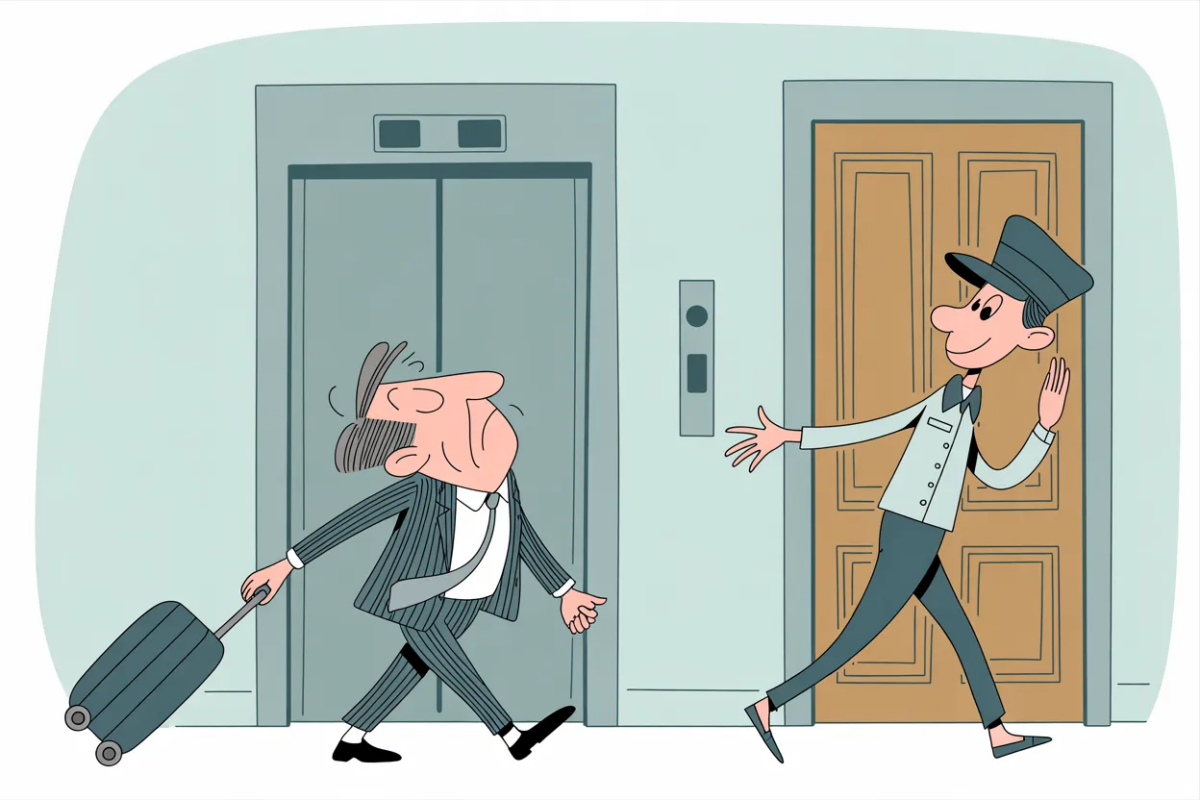
When is a room guarantee not a room guarantee? Omer Malik discovered the answer when he booked a few nights at a chain hotel in Germany.
Malik, the CEO of a computer security firm in London, always reserves rooms on lower floors. His expertise is in infrastructure and risk management, so exits, evacuation routes, and stairwells aren’t abstract concerns.
When his confirmation came through for a king room on a low floor, he thought the matter was settled.
It wasn’t.
Malik arrived late one evening after a long flight. That’s when a front-desk employee told him he was actually on a higher floor in a twin room. Malik pulled up his confirmation and pointed to the room type.
“The employee calmly said, ‘That’s subject to availability,'” he recalls. “‘Only elite members get guaranteed room type.'”
Room type is now a loyalty perk
Across the hotel industry, a quiet but significant shift is happening. What used to be a reasonable baseline expectation—getting the room type you selected and paid for—has been repackaged as a loyalty perk. If you don’t qualify for status at your chosen hotel chain, your room selection is merely a request. The hotel will try to honor it, but it doesn’t have to.
I’d call it confirmation theater. You click, you choose, you pay. You feel like you bought something specific. But the hotel sold you something else.
The hospitality industry has a term for this. It’s called a run-of-house booking. Originally, run-of-house was a budget option. You’d accept any available standard room in exchange for a lower rate.
Today, hotels have extended that same flexible-assignment logic to full-price bookings, using sophisticated revenue management systems that treat room assignments as adjustable inventory right up until you check in.
“Preserving assignment flexibility enables hotels to accommodate late-arriving elite members, manage out-of-order inventory, handle maintenance-related displacements, or rebalance housekeeping workloads across floors,” says Apostolos Ampountolas, who teaches hospitality finance at Boston University’s School of Hospitality Administration. “This creates a structural gap between what guests reasonably believe they are purchasing and what the hotel is obligated to deliver.”
So when you’re on the hotel’s website at 11 p.m., scrolling through room photos, selecting a specific floor, configuration and view, what you’re doing is telling the hotel what you’d like. The system responds as if you’ve made a purchase. But what you’ve actually done is submitted a very expensive preference form.
Nick Holroyd-Doveton, co-founder of Candid Hospitality, a hiring platform for the hospitality industry, says you have to pay attention to the details when you book a room.
“The myth of ‘guaranteed room type’ lies in the fine print,” he says. “Many consumers assume that clicking on a room category secures that exact layout or floor placement. In reality, guarantees often apply only to the bed configuration, not to view, floor height, or square footage variations within the same category.”
At the very least, someone paying for a King or Queen bed should not be given a twin room.
Floors are a different story. I always specify higher floor in a hotel with an elevator but don’t assume it is a done deal.
When an inconvenience becomes a safety issue
Most of the time, a room reassignment is annoying. Your preferred view is gone, or you end up next to the elevator bank.
But some travelers pick specific rooms for reasons that aren’t about the view. They choose lower floors because of fire safety concerns, evacuation anxiety, or past trauma. They book specific bathroom configurations or proximity to elevators because of mobility limitations. They need accessibility features that weren’t just a preference, they were the whole point of the booking.
When those travelers show up and get reassigned, the shrug from an employee at the front desk can be infuriating.
Stanley Gichuki, chief operating officer of Majestic Kenya Safaris and Tours, runs a tour operation that puts him in three or four hotels a week. He had a client last year who booked a lower floor because of mobility issues. The hotel assigned her a room on the ninth floor.
“When she asked about it, they told her the booking was a preference, not a guarantee,” he says. “She paid the same price as everyone else. She had a confirmation number. But somehow that wasn’t enough.”
Joe Cronin, president of International Citizens Insurance, says the shift can affect your security.
“The problems arise when there are legitimate safety concerns, like needing a lower floor for mobility reasons,” he says. “Then you end up in a position where you’re advocating for yourself or a family member at the check-in desk after you’ve been traveling all day and you’re exhausted.”
Who’s legally responsible?
When it comes to getting your preferred room, your rights are probably not as strong as you think.
Most booking confirmations include qualifying language that allows hotels to substitute accommodations if the booked category is unavailable. Phrases like “room type subject to availability” or “specific room requests cannot be guaranteed” are standard contractual language. Hotels have drafted these terms carefully to give the property maximum operational flexibility.
Tom Warsop, a 25-year travel industry veteran who curates high-end hospitality experiences, notes that U.S. deceptive advertising law requires material features be honored if explicitly promised.
“If a property advertises specific features such as balcony access or accessibility modifications and then fails to deliver, that can raise consumer protection concerns depending on jurisdiction,” he says.
The clearest legal exception involves accessibility. If a hotel confirms an ADA-compliant room with specific features and fails to deliver it, that may create obligations that go beyond a room swap apology. If your accessibility needs are not just a preference but a legal accommodation, say that clearly in writing before you arrive. It changes the conversation.
For everything else? Ampountolas, the hospitality professor, notes that some card issuers may treat a dispute as worth reviewing if you paid a premium for a specific room type and received something materially different. Some jurisdictions with robust consumer protection laws may offer additional avenues. But don’t expect an automatic win.
Marieme Seck, founder of Weelp, a global safety app, says the real problem is disclosure.
“If a room type is not guaranteed, that limitation should be visible before payment, not embedded in secondary terms,” she says. “Clear labeling such as ‘room preference’ or ‘guaranteed configuration’ would likely reduce misunderstandings and disputes at check-in.”
What should you do if your hotel room matters?
Don’t rely on the booking interface. Selecting a room type online is the beginning of a conversation, not the end of one. Call the hotel directly after booking and ask them to note your requirements, specifically whether they’re medical, accessibility-related, or safety-related. Get the name of the person you with whom you spoke.
Use the word “requirement,” not “preference.” Alex Veka, founder of Vibe Adventures, says it matters how you frame your needs. If the hotel hears “preference,” it treats the room as flexible. If it hears “requirement,” it creates a different obligation in the reservation notes.
Screenshot the room description at booking. If you end up at the front desk in a dispute, documentation helps. A lot.
Arrive earlier in the day. Room inventory is less constrained before the afternoon check-in rush. If you can get there by noon, you have more options. Midnight arrivals, as Malik discovered, leave you at the mercy of whatever’s left.
Some hotels offer a pre-arrival upgrade bid. If you care about your room type, you might want to consider it. While it costs extra, it will ensure you’re more likely to have the exact room you want.
Room confirmations are just a starting point
Here’s the uncomfortable truth: When you book a hotel room, you’re not buying a specific room. Most of the time, you’re buying a room category, and you’re hoping the hotel will assign you something that matches what you saw on its website.
That gap, between what the interface implies and what the contract actually guarantees, is where travelers keep getting blindsided.
A room confirmation isn’t a contract these days. It’s an expensive lottery ticket. The hotel sells you flexibility and calls it a reservation. You learn the real terms only when it hands you the wrong key.
Malik’s conclusion, after his late-night reassignment in Germany, cuts to the heart of it. “Most travelers only discover that at check-in,” he says, “And by then, there’s nothing left to negotiate.”

Have a question about this story? Tell us what happened — we read every comment.
Join the conversation