Have you ever taken your seat on a plane and had the strange realization that you haven’t spoken to a single person since you got to the airport?
Not at the check-in kiosk, where you silently printed your bag tag. Not at security, where you scanned your boarding pass and faced a camera instead of an agent. Not at the gate, where you flashed your boarding pass on a machine.
Then you sit in your seat and plug in your noise-canceling headphones, effectively hanging a “do not disturb” sign around your neck.
Welcome to modern travel. It’s efficient, frictionless — and incredibly lonely.
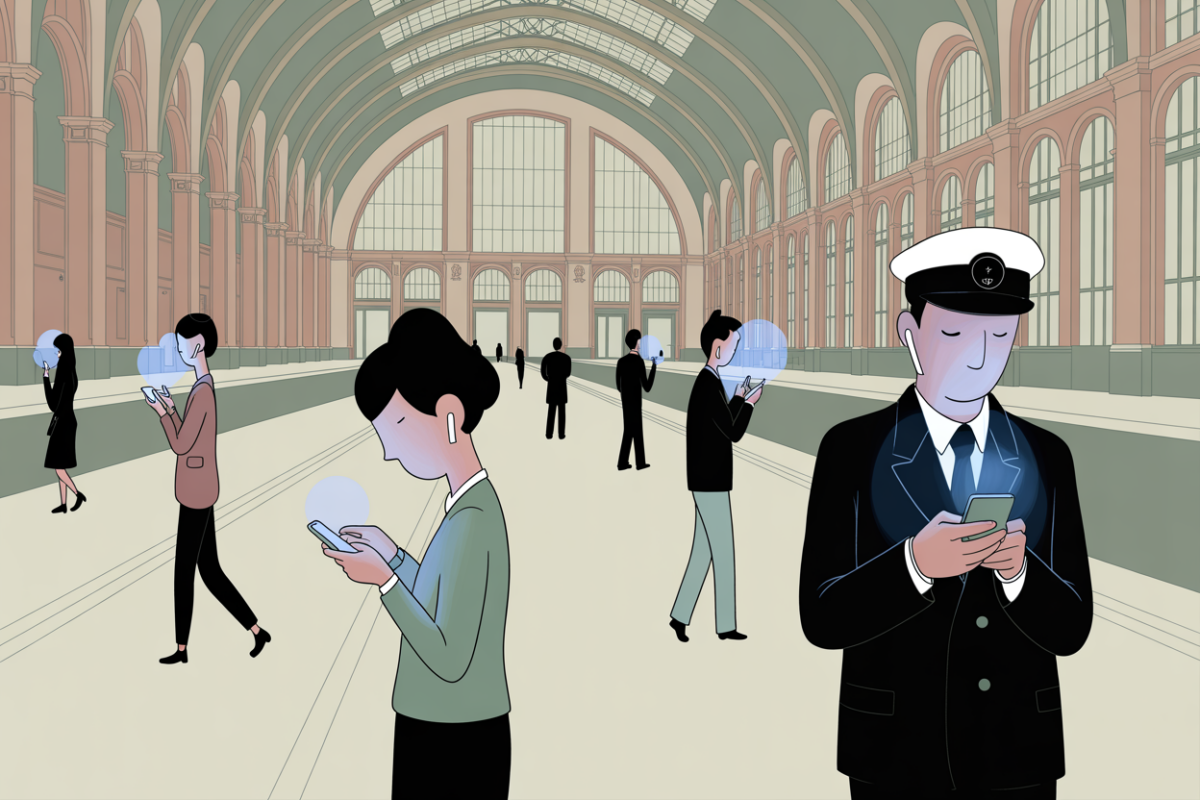
Walk through any airport, hotel lobby, or train station today and you’ll see it. People moving efficiently through space, eyes down, earbuds in, interacting with screens instead of humans. The gate agent? There’s an app for that. The concierge? Ask AI. The stranger at the bar? Look closely; they’re wearing noise-canceling earbuds.
“Places that once buzzed with humanity feel more like transit corridors than destinations,” says Lawrence Quill, co-director of San Jose State University’s Loneliness Project. “We travel with earbuds in, eyes on screens, impervious to our surroundings.”
Call it the Great Disconnect. We’ve engineered humanity right out of travel. But why is travel so solitary, and what can we do about it? As AI continues to strip the human touch from travel, there’s no better time to ask these questions.
I work with the public and the amount of abuse I’m required to let wash off my back on the daily would break a lesser person not trained in it.
People think nothing of threats, name calling, assault to get their way. The quickest way to anger them? Tell them no. The entitlement is unreal now. They want what they want when they want it, and if you dare to say no, hellfire will be rained down on you.
This could be part of the reason we interact with fewer and fewer employees with each passing year. The abuse is out of control.
Why does travel feel so lonely?
The shift didn’t happen overnight. It crept in gradually, accelerated by a pandemic that taught us to fear proximity and trust screens. What started as convenience morphed into something else entirely: isolation on the move.
“We built technology to make travel effortless,” says Francis Hellyer, CEO of tickadoo, an AI-powered travel platform. “But in the process, we stripped away the human warmth that made it meaningful. The silence you feel in airports and hotels is the sound of efficiency.”
The numbers tell part of the story. Travel data shows the average group size for trips has decreased 9 percent since COVID-19 began. In 2020, the average trip included 2.14 travelers, according to travel insurance site Squaremouth.com. By 2025, that dropped to 1.95. More striking: The percentage of trips with more than two travelers plummeted from nearly 20 percent to just over 15 percent.
Thomas Plante, a psychology professor at Santa Clara University, sees this shift mirrored in his clinical practice.
“Our culture has evolved with technological advances and conveniences to the point where you don’t have to interact with real people at all,” he says. “A major downside is that as we avoid human interactions, we lose our skills to do so and our social lives and skills atrophy.”
Reality check: For some people, being able to travel without talking to anyone and enjoying the silence is a bonus. (If you’re a new dad, you know what I mean.) For others, it’s kind of maddening.
Which travel technology cut out the human contact?
The culprits aren’t hard to spot. They’re in your pocket, on your wrist, around your neck.
Christian Petzold, a travel expert at BCN Travel, says he can now breeze through airports and hotel lobbies with minimal human contact.
“I can go from the curb to my room without a word to any staff member,” he says. “As much as it’s convenient, I feel a bit empty because I’m missing out on the human element that once made the traveling experience so much richer.”
The technology itself isn’t the villain. It’s how we’re misusing it:
- Smartphones. We can’t seem to get off them, says frequent traveler Molly Streuli, a marketing manager from Rice Lake, Wis. “Walking down the street, at dinner, at the beach — it’s happening everywhere,” she says. “No asking locals for restaurant recommendations, no wandering around without a destination, no making small talk with strangers at the bar.”
- Apps and kiosks. Self-check-ins. AI concierges. QR code menus. Digital tip systems. Each innovation removes another moment where humans might connect. It’s particularly noticeable in Asia, where efficiency is highly valued and technology is seen as a solution to every problem. Anna Shaverni, a 25-year-old nomadic traveler who’s visited 38 countries in three years, experienced it in Japan. “Ticket machines everywhere,” she recalls. “iPads instead of waiters. QR codes instead of front desk staff. I spent a week in Osaka. I had less real conversation than one day in an Italian village.”
- Noise-canceling headphones. They’re brilliant on long flights. But they’ve become an all-the-time accessory, sign that says: “Leave me alone.” These habits started during the pandemic and never went away, according to experts. “Post-pandemic, I have noticed more people reading or putting headphones in so they don’t have to interact,” says Beth Ribarsky, a professor of interpersonal communication at the University of Illinois Springfield.
In other words, we wanted control, reliable service and freedom from long lines. Technology delivered it. But we accidentally ordered a side of loneliness, too.
There’s nothing wrong with a little solitude when you’re traveling. Sometimes, it can give you time to relax or focus on work. But research shows that prolonged loneliness can raise the risk of serious physical conditions like dementia, heart disease, or a stroke. It can also lead to depression and anxiety.
How to have a real conversation while traveling
How can travelers avoid the Great Disconnect?
Ask for a person (even if you don’t have to). That’s what Andy Abramson, one of the most experienced travelers I know, does when he checks into a hotel. He always emails the general manager before he arrives. “I tell them a bit about who I am and what I like,” says Abramson, a communications consultant from Las Vegas. “In return, they share local tips with me.”
Leave the headphones off. It’s a simple signal that you’re available for conversation. Ralph Velasco, a professional travel photographer who spends months on the road, forces himself to be more outgoing, and it goes beyond leaving his headset in the carry-on bag. “I’ll sometimes ask directions from someone when I already know where I’m going, just to practice some social skills, perhaps start a conversation and get that human touch,” he says,
Choose the counter over the app. Robert Herbst, an attorney from Larchmont, N.Y., makes this his policy. On a recent trip, he ignored several emails from his car rental company to check in online. “I always want to get the local lore and recommendations of routes, restaurants, etc. from rental agents, desk clerks, and the like,” he says. (Note: If you want to check in for a flight at the counter, some airlines charge extra to talk to a person, so ask before you do this.)
Sit at the bar. Streuli, the marketing manager, swears by this. “I am very intentional about not using my phone at a bar or restaurant. And I always sit at the bar when it’s an option, because you just never know who you’re going to meet.”
Funny story: In 2019, she sat at an oyster bar in Ho Chi Minh City and watched the stranger next to her order spring rolls and a beer. “Good choice,” she said. She’d ordered the same thing.
Seven years later, that stranger is her husband.
“Research shows that even small, genuine interactions with strangers can increase happiness and well-being,” says Michal Strahilevitz, a marketing and consumer psychology professor at Saint Mary’s College of California.
Where travel still leaves room for people
The goal isn’t to return to some imaginary golden age of travel. (Smoking sections on flights? Hard pass.) It’s to design experiences where efficiency and empathy coexist.
“Technology should be an enabler of connection,” says Hellyer, the tickadoo CEO. “Not a replacement for it.”
There are plenty of opportunities for human contact. From the Southwest Airlines flight attendant cracking a joke during the in-flight announcements to Wingle, an app that lets you chat with other passengers on your flight, there are more opportunities than ever to make a human connection. Travel is many things, but it should never feel as lonely as this.

Have a question about this story? Tell us what happened — we read every comment.
Join the conversation