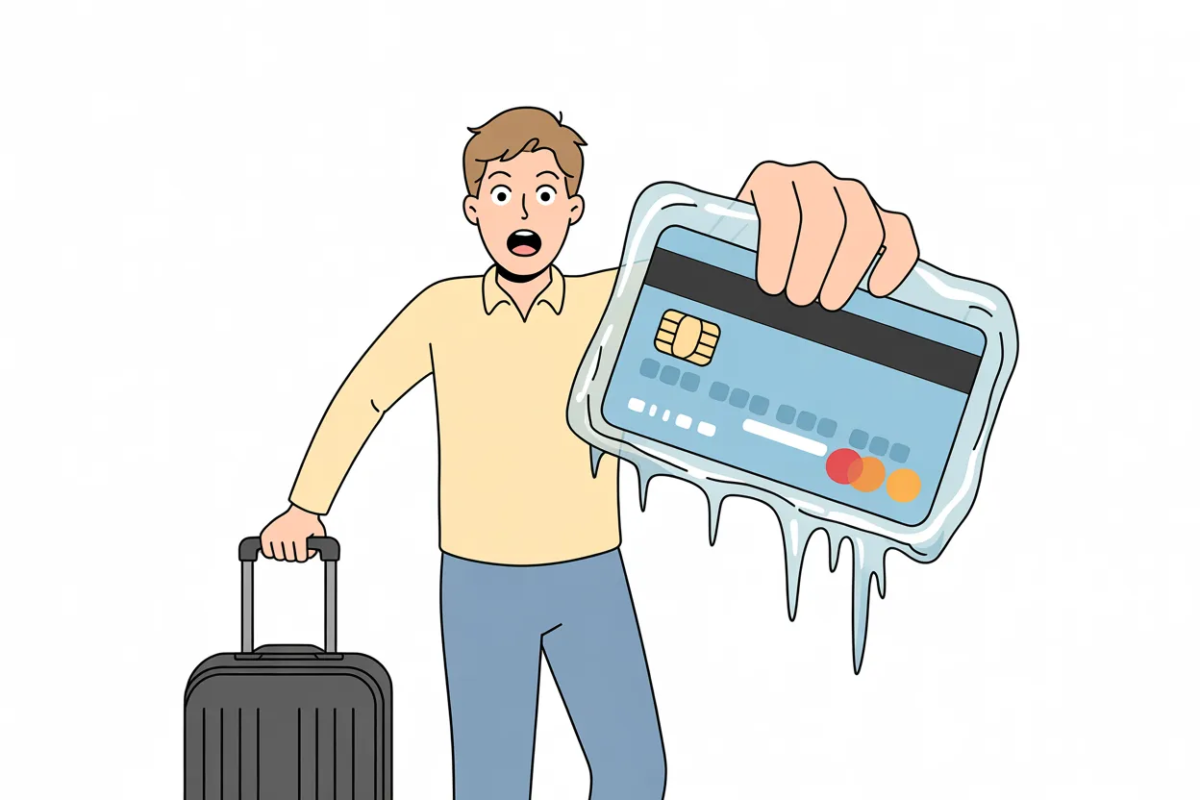
My credit card was frozen after a recent flight from Auckland to Wellington, and I’m still steamed about it.
Before I collected my luggage, I tried to buy a cinnamon roll at Belén Plant Bakery. My bank freaked out within a few seconds, denying the purchase and sending me urgent text messages ordering me to call “immediately” to verify my transactions.
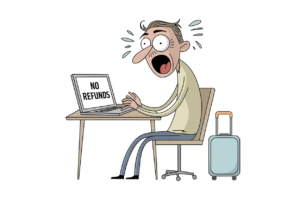
Everything — I mean everything — came to a screeching halt. No credit card, no debit card, and even my bank account was locked.
Why are travelers experiencing more false positives?
Freezes like this are common. Many financial institutions run false-positive rates in the high 90s, according to an analysis by McKinsey. That means for every actual fraud an institution catches, it might be flagging 19 legitimate transactions like my pastry purchase.
What’s driving this trend? American consumers reported losing about $16 billion to fraud in 2025. That’s a roughly 25% jump from the previous year. To fight back, banks rely on fraud models that err toward saying no.
“Banks don’t have to be perfect at fraud detection,” explains Luca Ziveri, the chief strategy officer for SaidText, a software company that specializes in operational workflows. “They just have to be conservative. And travelers sometimes pay the price for that conservatism.”
What bothers me more is that banks think these high false-positive rates (and to a certain extent, travelers’ suffering) are absolutely fine.
“Most banks quietly tolerate these false positives,” says Kevin Surace, chair of the security firm Token. A bank would rather deal with a customer service headache than the liability of a successful hack. Most customers never notice until they’re stuck without access to their funds.
What happens when your bank freezes your credit card?
Matan Korin recalls a credit card block on a recent trip to Chicago.
“My bank rejected a hotel payment as ‘suspicious’ even though the transaction matched my usual spending profile,” recalls Korin, a vice president of a windows manufacturer in Edmonton, Canada.
What happened? His bank’s fraud-detection algorithm saw large transactions and movement between two cities and assumed the worst. Korin says he couldn’t pay for his hotel or his car until he straightened things out with his bank hours later.
I know what that’s like. I called my bank when it froze my accounts while I was in New Zealand and spoke with several representatives. One told me I had the wrong department, and then transferred me to a dial tone. Another one simply hung up. And another one said my only option for getting my cards reactivated was to go to my bank in person with my ID. Not an option when you’re 18 time zones away.
Finally, three hours later, a helpful agent restored access to my account.
Come on.
How to avoid a freeze when you’re traveling
If you don’t want to end up like me — stranded at a bakery counter — you need a survival plan. Here’s what I’d do before your next trip:
- Tell your bank you’re traveling. Although most algorithms are sophisticated enough to detect your travel, it can’t hurt to call your bank and tell it of your plans. For example, my bank allows me to set up a travel alert through its mobile app that ensures it doesn’t flag legitimate purchases at new locations as fraudulent. I should have done that.
- Enable location services on your banking app. This allows the bank to see that your phone’s GPS matches the merchant’s location. Discrepancies between your location and the merchant can, in some cases, trigger a fraud alert.
- Add two-factor authentication. If you’re abroad and your phone doesn’t work, you could get locked out of your ability to verify your identity. Switch your authentication to an app like Google Authenticator or a physical security key before you leave home.
In hindsight, my strategy of buying a cinnamon roll at the airport before heading to my Airbnb in Wellington turned out to be a smart move. You want to make a small purchase at the airport, where you can still get a strong Wi-Fi signal, rather than waiting until later when you might not have a reliable signal or access to text messages.
Travel insurance might be able to help extract you from a frozen credit card problem, too.
Most standard travel insurance policies provide emergency cash assistance or cash advance services as part of their 24/7 emergency support,” says Lauren McCormick, a spokeswoman for Squaremouth.com, a travel insurance marketplace.
Above all, carry a backup credit card that isn’t connected to the same bank account. Fortunately, I had a backup card from another bank. Having a little local currency would help, too.
Until banks shift to biometric-assured identity, we’re all just data points in a giant experiment in risk management. Don’t get caught on the wrong side of that experiment on your next trip.

Have a question about this story? Tell us what happened — we read every comment.
Join the conversation